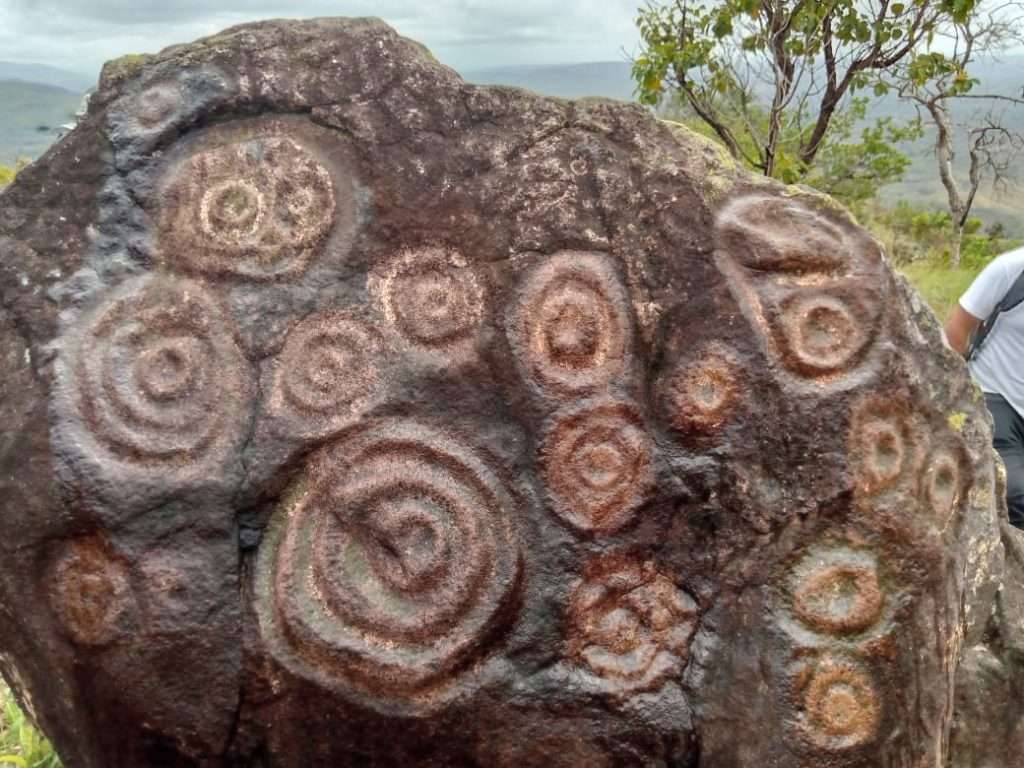
In the highland community of Quebrada Seca, northeastern Venezuela, authorities have confirmed the discovery of a major petroglyph complex estimated to be between 4,000 and 8,000 years old. If the upper range proves correct, this would place the engravings among the earliest known symbolic expressions in eastern Venezuela.
The site lies 3.5 kilometers from San Félix in Cedeño municipality, at 647 meters above sea level — a landscape long suspected to have functioned as a transit corridor between ecological zones.
Carved Cosmology in Stone
The surface features spirals, concentric circles, and anthropomorphic figures cut into the rock using a linear low-relief technique. The grooves are deliberate — averaging 1.24 centimeters deep — suggesting sustained effort rather than casual marking.
Spiral motifs across northern South America are frequently linked to cyclical time, water symbolism, and solar cosmology. Human-like forms often signal ancestral presence or ritual actors. Interpretation remains cautious. But repetition implies structure.
Cedeño has been informally described as the “capital of petroglyphs” in Monagas. The region later became associated with Indigenous groups such as the Chaimas and Kariñas. Yet the proposed age of Quebrada Seca pushes far deeper into the past — potentially into the Paleoindian–early Mesoindian transition (c. 6000–1700 BCE).
If the 8,000-year estimate holds, eastern Venezuela enters a different chronological conversation.

The Dating Problem
Petroglyphs cannot be radiocarbon dated directly. The current timeframe is based on stylistic comparison, weathering patterns, and surface patina analysis.
That matters.
An earlier confirmation would suggest that complex cosmological systems were already established in this region thousands of years before agricultural consolidation in much of northern South America.
No pigment traces have yet been identified at the site, although mineral residues have been documented at other Venezuelan rock art locations Further fieldwork may clarify that question.
Preservation Before Promotion
Officials have moved quickly to geolocate and formally register the monument. Rock art sites in Venezuela have suffered irreversible damage from erosion and vandalism in the past. Once surface details are lost, they cannot be recovered.
At the same time, regional authorities have floated the idea of incorporating Quebrada Seca into a structured archaeological tourism route. The challenge will be clear: access without deterioration.
Why It Matters
Whether 4,000 or 8,000 years old, the Quebrada Seca engravings expand the documented timeline of symbolic behavior in northeastern South America.
They are not decoration.
They are evidence of thought systems — carved directly into the landscape by societies navigating migration, territory, and cosmology long before written history.
Further scientific testing will determine the final chronology.
Cover Image Credit: National Land Institute