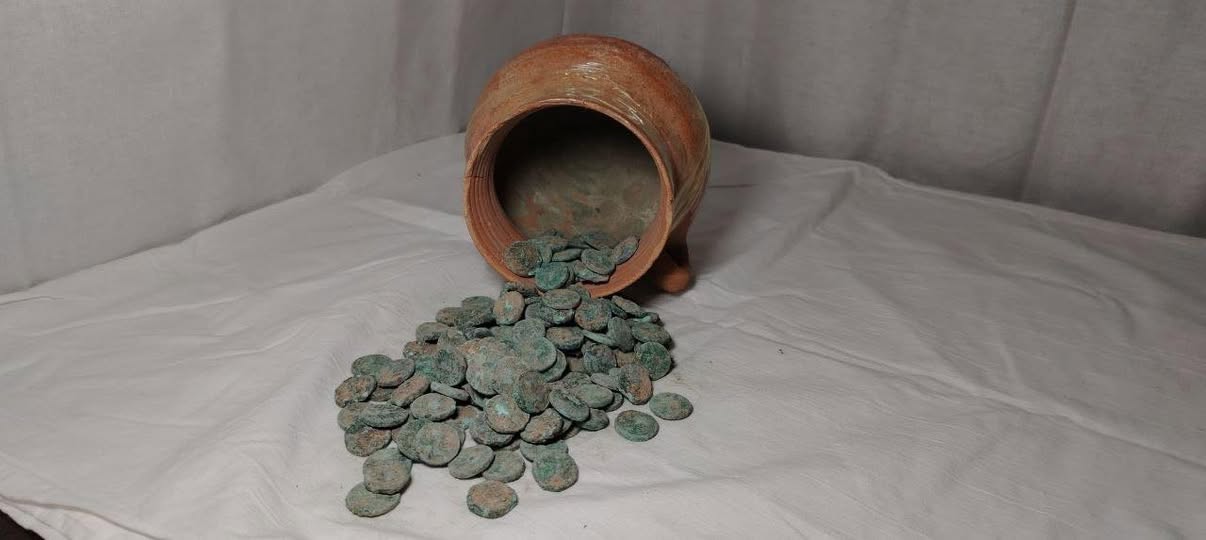
A farmer’s routine work in southern Tajikistan has led to a discovery that reaches back nearly two millennia. In the Shahritus district, more than 150 copper coins dating to the 1st century AD were found buried inside a small ceramic vessel—an intact hoard from the early days of the Kushan Empire.
The find, announced in early 2026 by the National Academy of Sciences of Tajikistan, was accidental. Beneath ordinary agricultural soil lay a compact pot filled with heavily oxidized coins. The vessel had remained sealed and undisturbed for almost 2,000 years.
Once authorities were notified, specialists moved quickly. The hoard was documented on site and transferred into state custody for conservation and study. What initially appeared to be a modest rural discovery soon proved to be historically significant.
Coins of a Transitional King
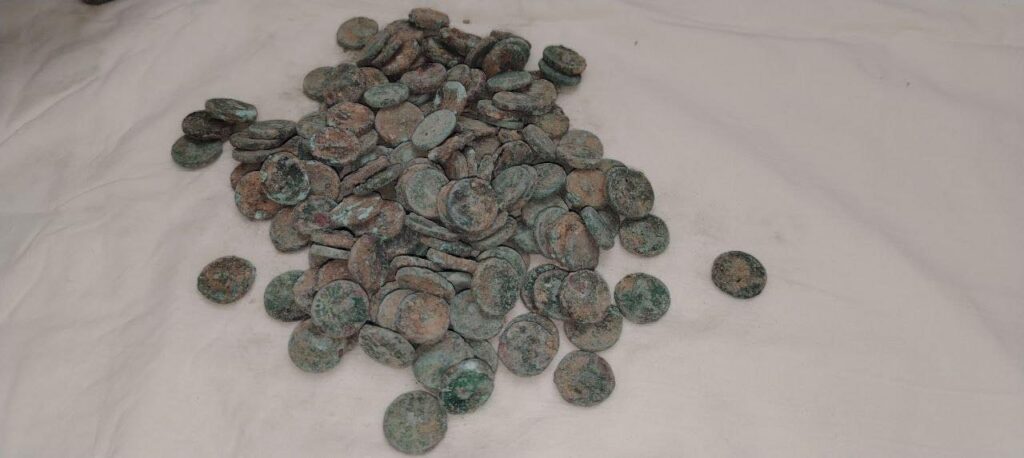
Numismatic analysis revealed that most of the coins were struck during the reign of Vima Taktu, a Kushan king who ruled during a pivotal transitional period in the late 1st century AD.
Overshadowed in popular memory by his successor Kanishka I, Vima Taktu nevertheless played a decisive role in consolidating Kushan authority. His reign followed the westward expansion of the Yuezhi tribes into Bactria and northern India—movements that ultimately reshaped the political map of Central Asia.
The Shahritus coins, despite corrosion, retain clear diagnostic features: iconography, inscriptions, and weight standards characteristic of early Kushan minting. These elements firmly situate the hoard within the formative phase of Kushan imperial administration.
That matters. Early Kushan chronology remains debated, and securely dated coin finds are among the most reliable tools historians possess for reconstructing political authority and economic systems.
Restoration Underway
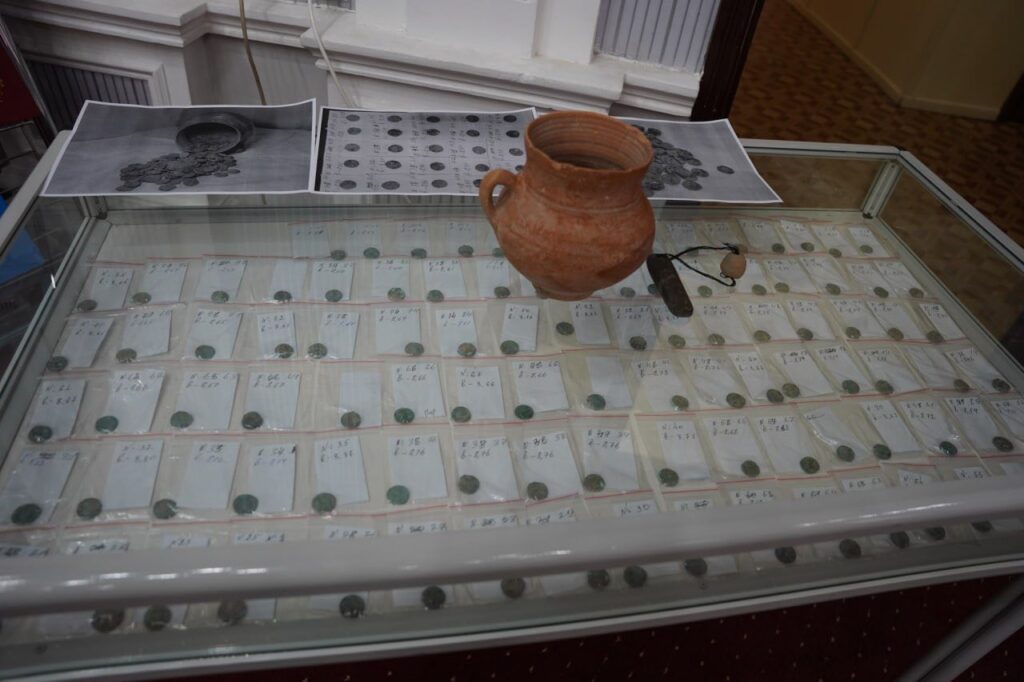
Conservation work is now being carried out at the Institute of History, Archaeology, and Ethnography under the Tajik Academy. Each coin is undergoing careful cleaning and stabilization to prevent further copper degradation. Documentation accompanies every stage.
Preliminary observations suggest the hoard was intentionally buried. Not scattered. Not casually lost. The concentration within a ceramic container indicates deliberate concealment—perhaps during a moment of local unrest or uncertainty.
Why it was never retrieved remains unknown.
Central Asia at the Heart of Empire
The discovery also underscores the broader historical importance of the Kushan Empire. Often described as one of antiquity’s great transregional powers, the empire stretched from modern Uzbekistan and Tajikistan through Afghanistan and into northern India.
Positioned along the Silk Road the Kushans mediated trade between Rome, Parthia, China, and South Asia. Their coinage reflects this cosmopolitan world: Hellenistic artistic traditions merged with Iranian religious motifs and emerging imperial ideology.
Copper coins like those from Shahritus were not ceremonial objects. They circulated in markets, paid soldiers, facilitated taxation, and moved through local and long-distance trade networks. In other words, they powered daily economic life.
The presence of such a hoard in southern Tajikistan confirms the region was not merely a transit corridor between civilizations—but an active administrative and commercial center within the Kushan sphere.
A Hoard That Expands the Timeline
As restoration progresses, scholars expect the coins to yield further data on minting practices, circulation patterns, and regional governance. Even subtle variations in legend or weight can recalibrate historical timelines.
Each specimen adds clarity to a period that remains partially obscured by fragmentary written sources. Coins endure where manuscripts perish.
What began as a chance agricultural discovery has become something more substantial: physical proof of Kushan consolidation during the empire’s formative decades. And at its center stands Vima Taktu—a ruler often eclipsed in textbooks, yet foundational to the imperial structure that followed.
Nearly two thousand years later, his reign surfaces again—this time in copper, earth-stained but still legible.
Cover Image Credit: Asia+ via Facebook