
A young horse was buried alone in a chamber grave at Pień in northern Poland about 1,000 years ago. The unusual burial, dated to the late 10th or early 11th century, offers a rare look at how horses could be drawn into elite ritual life during the formation of the Polish state.
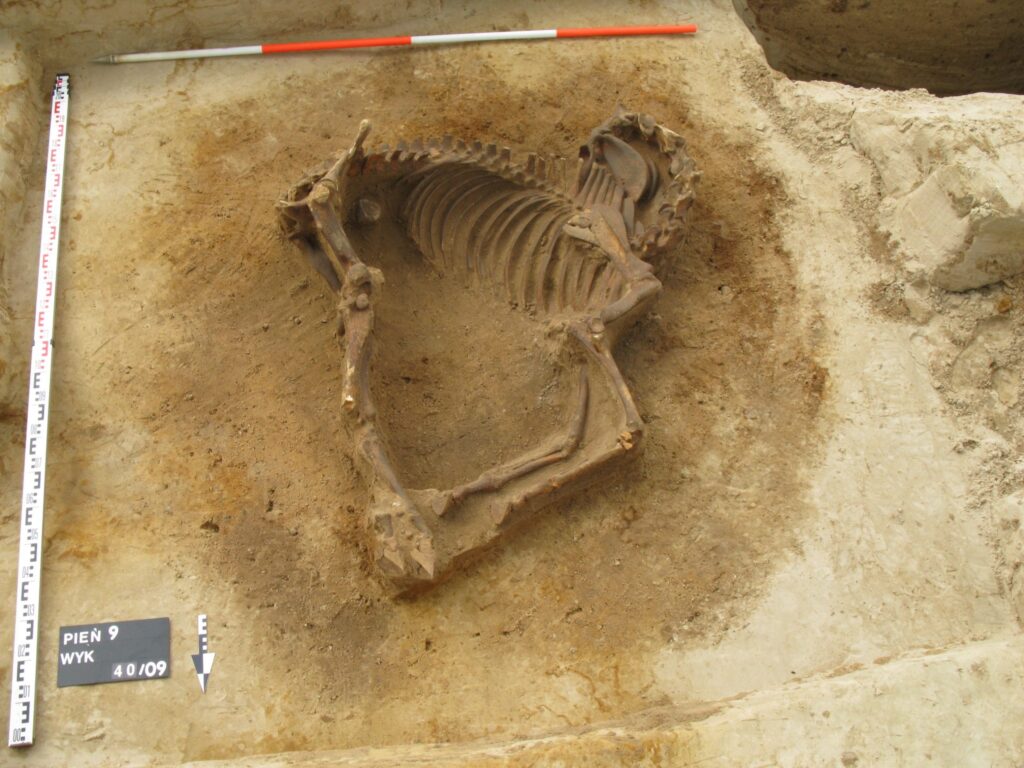
The grave, recorded as no. 70/09, was found at the Pień archaeological site in the Dąbrowa Chełmińska commune. Instead of a human body, the oval pit held the skeleton of a horse placed in a carefully arranged position. The pit measured about 2.5 by 2.5 meters.
Researchers see the burial as more than the disposal of an animal carcass. Its layout, date, and connection with chamber graves in the same cemetery point to a deliberate ritual act.
A young male horse buried on its own
Bioarchaeological analysis showed that the horse was about 2.5 years old when it died. Its teeth indicate a young animal, while the presence of canine teeth suggests that it was male.
The animal was relatively small. Its height at the withers was calculated at about 133 centimeters, placing it among the smaller or medium-sized horses known from early medieval contexts.
That detail matters. This was not an old work animal placed in a pit after years of use. It was a young male horse, buried in a grave prepared only for it.
The body was carefully arranged
The position of the skeleton is one of the most important details of the find. The head, neck, and limbs do not suggest a casual deposit.
Researchers have suggested that the horse’s legs may have been bound and that the head was turned back toward the body. The position of the neck could have allowed access to major blood vessels, although the bones themselves do not show clear cut marks or impact trauma.
That makes the exact cause of death difficult to state with certainty. What can be said more safely is that the animal was handled and arranged before burial. The grave was planned, not accidental.
A date close to the birth of the Polish state
Radiocarbon dating places the burial between AD 901 and 1033. A narrower probability range falls between AD 986 and 1021.
This places the Pień horse in a period of major change. The early Piast dynasty was strengthening its rule, Christianity was spreading, and older forms of ritual life had not simply vanished.
The cemetery at Pień seems to belong to that mixed world. Chamber graves, rich burial customs, and unusual ritual features appear together. The horse burial fits this setting, where status, belief, and older symbols could still overlap.
Horses and early medieval status
In early medieval Europe, a horse was not only a useful animal. It was tied to mobility, warfare, rank, and public identity. For warriors and local elites, owning and controlling horses carried social meaning.
That is why the Pień burial is important. The animal may not have been buried for itself alone. It may have been part of a wider funerary language connected with the people buried in the same cemetery.
Researchers link the horse burial with the chamber graves of the local elite. The owner of the horse is unknown, and it is not certain whether the animal belonged to one specific person. Still, the separate grave prepared for it shows that the horse held a serious place in the ritual life of the community.
An unusual grave with unanswered questions
Horse burials are known from early medieval Europe, but a separate chamber grave prepared for a young horse remains an unusual case in Polish archaeology.
The Pień burial does not answer every question. It does not tell us who chose the horse, who owned it, or what exact ceremony took place before it was placed in the ground.
But it does show that horses could occupy a serious place in early medieval funerary practice. At Pień, a young animal was buried with care at a time when power, belief, and status were being reshaped in Poland.