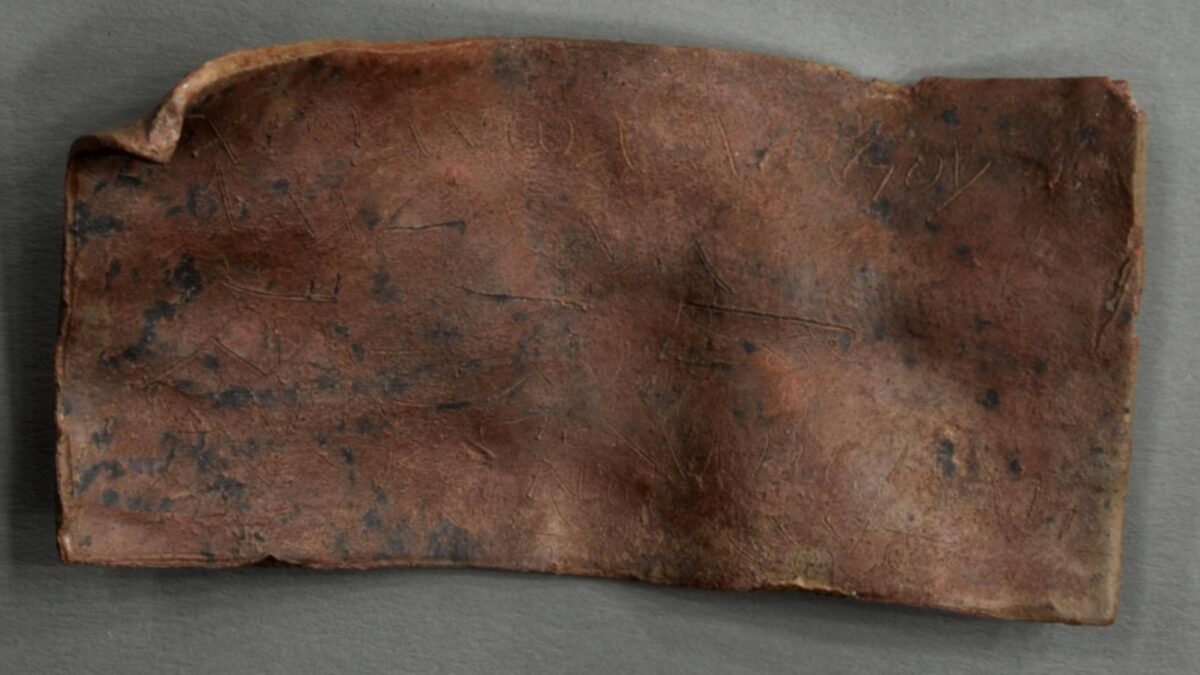
A small lead tablet found beneath Heerlen’s town hall square was meant to do harm. Nearly 1,800 years later, its scratched Greek words are revealing how Egyptian-style magic reached Rome’s northern frontier.
Researchers at Heidelberg University have deciphered the inscription on the Roman-period curse tablet, discovered in the Dutch municipality of Heerlen. In antiquity, the site was known as Coriovallum, a settlement in the Roman province of Lower Germania.
The artifact measures only 9.3 by 4.8 centimeters, but its text is exceptional. Most curse tablets found in northern Europe were written in Latin. This one carries an ancient Greek invocation of gods and demons, shaped by magical traditions associated with Roman Egypt.
A Roman curse from Heerlen
The lead tablet was found by a Dutch archaeological team in a pit beneath the modern town square. Its material was typical for ancient curse tablets. Lead was soft enough to scratch, heavy, cold to the touch, and widely associated with the idea of binding.
Such objects were known in Latin as defixiones and in Greek as katadesmoi. They were not public monuments. They were private instruments, usually hidden after being inscribed with a spell. Some targeted opponents in court cases. Others were aimed at business rivals, athletes, lovers, or enemies whose names were written down and handed over to supernatural powers.
Dr. Rodney Ast, Academic Director at Heidelberg University’s Institute of Papyrology, said the Heerlen tablet contains a binding spell. Its purpose was either to curse four enslaved people named in the text or to act on their behalf against an unnamed person.
That uncertainty is part of what makes the object so intriguing. The tablet does not explain the dispute. It preserves only the ritual trace of it.
Greek words far from the Nile
The inscription was examined at Heidelberg using Reflectance Transformation Imaging, known as RTI. The method records the surface of an object under changing light. On screen, researchers can move the virtual light source and bring out shallow scratches that are difficult to see with the naked eye.
This revealed three groups of signs on the Heerlen tablet. One section contains the Greek invocation. Another includes three magical symbols, called characteres. Ast suggests these symbols may have served as a way to carry the message to divine or demonic forces.
Then come four names: two men and two women, all described as fellow slaves.
The language is striking. A Greek magical text in Egyptian style is not what archaeologists usually expect from a curse tablet in the Roman north. The find suggests that ritual knowledge did not remain fixed in one region. It travelled with people, through military routes, trade networks, slavery, and migration.
Four names on a lead tablet
The people named on the tablet also raise questions. The two men have Latin names, while the two women have Greek names. Dr. Julia Lougovaya, a researcher at Heidelberg University’s Institute of Papyrology, notes that one of the women could possibly have written the inscription herself.
It remains only a possibility. But it is not an empty one.
In the Roman Empire, enslaved people could be moved across great distances. A person from the eastern Mediterranean or Egypt could end up in a northern frontier settlement. With them came languages, habits, religious ideas, and private rituals that rarely appear in official inscriptions.
That is why the Heerlen tablet is more than a strange magical object. It is a small piece of evidence for human movement inside the empire, and for the hidden practices that followed people from one province to another.
Magic on the edge of the Roman world
Prof. Dr. Joachim Quack, Director of Heidelberg University’s Institute of Egyptology, emphasizes that magic had a long and complex place in Egyptian religious life. Protective and healing rituals could be accepted and ordinary. More aggressive rituals, especially those meant to damage another person or advance one’s own interests, were handled more discreetly.
By the early centuries CE, Egyptian, Near Eastern, Jewish, and sometimes Christian traditions were blending across the Roman world. The Heerlen tablet shows that this mixture reached even Lower Germania.
It is a modest object, but not a minor one. The tablet records a private act of fear, pressure, or revenge, carried out in a settlement far from the Nile but still connected to the wider religious landscape of the empire.
The curse tablet is expected to be displayed in the Heerlen Museum. Heidelberg University researchers will also publish the deciphered inscription in a scientific study, allowing the artifact to be examined further as evidence for ancient magic, slavery, mobility, and religious exchange in the Roman Empire.
Cover Image Credit: The Heerlen curse tablet bears an ancient Greek spell written in Egyptian Style, revealing how magical traditions from Roman Egypt reached the empire’s northern frontier. Credit: Elke Fuchs, Institute of Papyrology, Heidelberg University.