
At first glance, it looked like an ordinary mosaic floor.
But a short inscription embedded in stone told a very different story—one that reaches into the social heart of the Byzantine world.
Archaeologists working at the ancient city of Hippos, overlooking the Sea of Galilee, have uncovered what may be the earliest archaeological evidence of an organized nursing home. The structure dates to around 1,600 years ago, during the Byzantine period.
The key discovery is a Greek mosaic inscription placed near the entrance of a large building. Its message is simple and striking: “Peace be upon the elderly.”
The research team included Dr. Arleta Kowalewska and Professor Gregor Staab from the University of Cologne. Their findings were published in the academic journal Zeitschrift für Papyrologie und Epigraphik.
According to researchers, this was not a decorative phrase chosen at random. Its wording, location, and architectural context suggest that the building served a specific social function—caring for older members of the community who could no longer live independently.
Historical texts from Late Antiquity occasionally mention institutions that supported the elderly, the sick, or the poor. Until now, however, such references lacked clear archaeological confirmation. This find at Hippos changes that.
The structure’s layout supports the interpretation. It includes multiple rooms arranged around shared spaces, consistent with long-term accommodation rather than private housing or commercial use. The mosaic itself appears carefully planned, indicating that the building’s purpose was publicly acknowledged and socially valued.
The discovery also challenges a common assumption that organized elderly care is a modern concept. Instead, it points to a Byzantine society that recognized aging as a collective responsibility, not merely a family matter.
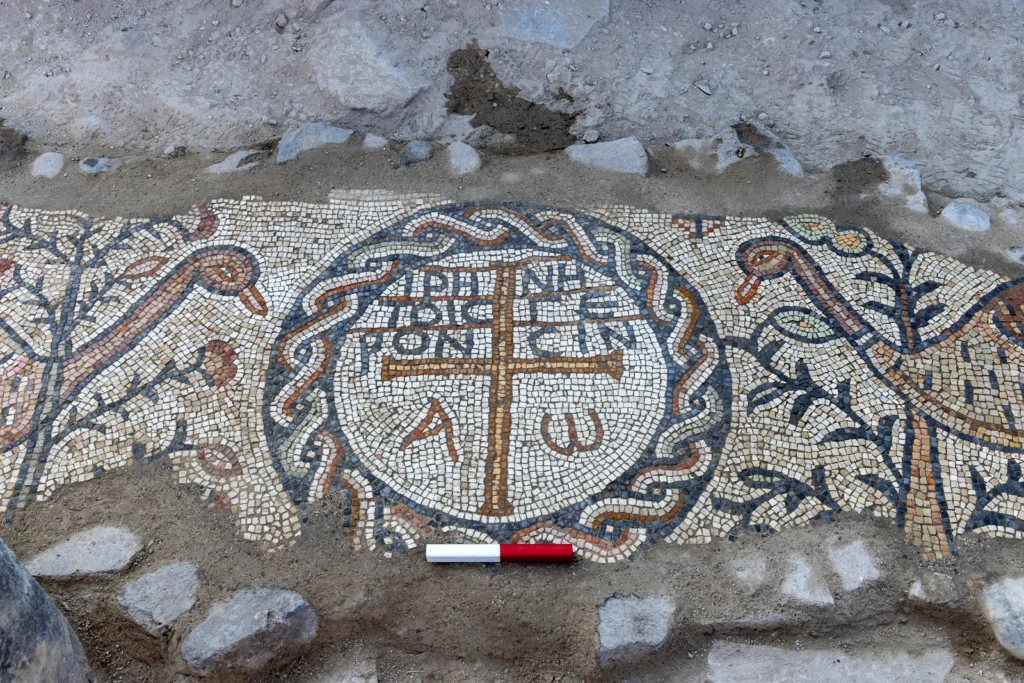
Credit: Dr. Michael Eisenberg
Hippos was a prosperous urban center within the eastern provinces of the Byzantine Empire, known for its churches, streets, and civic buildings. The presence of a dedicated nursing institution adds a new layer to our understanding of daily life in the city—one focused not on power or religion, but on care.
For archaeologists, the significance lies not only in the building itself, but in what it represents: an early attempt to institutionalize dignity, support, and respect for old age.
Sometimes, history speaks not through grand monuments, but through a few carefully chosen words set into stone.
Cover Image Credit: Dr. Michael Eisenberg