
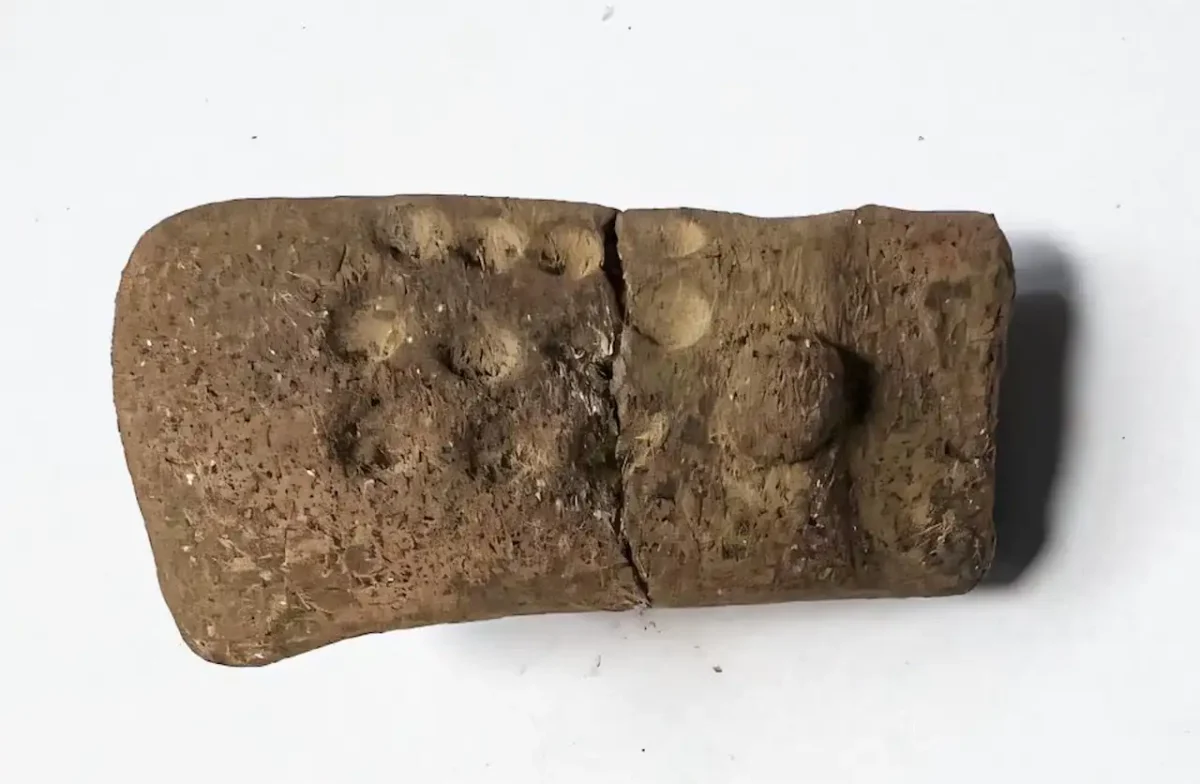
Mesoamerica’s earliest numbers may have survived on something far smaller than a monument.
A fragmentary ceramic figurine found at La Blanca, on Guatemala’s Pacific coast, carries eleven tiny clay dots pressed into the area of its head. The object is only a few centimeters across, but researchers argue that those marks may represent the earliest securely dated evidence of a dot-based numerical system in Mesoamerica.
The figurine has been dated to roughly 750–650 BC, placing it in the Middle Preclassic period, centuries before many clearer examples of Mesoamerican writing and calendrical notation.
Eleven dots on a broken figurine
The object belongs to a group known as “tab” figurines, named for their flat, tongue-like heads rather than naturalistic faces. It was discovered in the Grupo Joyas sector of La Blanca, about one kilometer from the city’s ceremonial center.
What makes it unusual is the pattern on its head. Eleven small dots were arranged in three vertical columns: three on the left, four in the center, and four on the right. They were not scratched in later. They were impressed into the clay before the figurine was fired, which points to a deliberate choice made during production.
The study, by Julia Guernsey of the University of Texas at Austin, Stephanie M. Strauss of the University of Texas at El Paso, and Michael Love of California State University, Northridge, does not claim the case is closed. The authors are careful. A dot is not always a number. In early Mesoamerican art, circular marks could stand for water, breath, ornament, or other symbolic ideas.
Still, the number eleven matters. If the dots were merely decorative, the researchers note, a more balanced arrangement might be expected. An odd total, placed so prominently on the head, makes the numerical reading harder to dismiss.
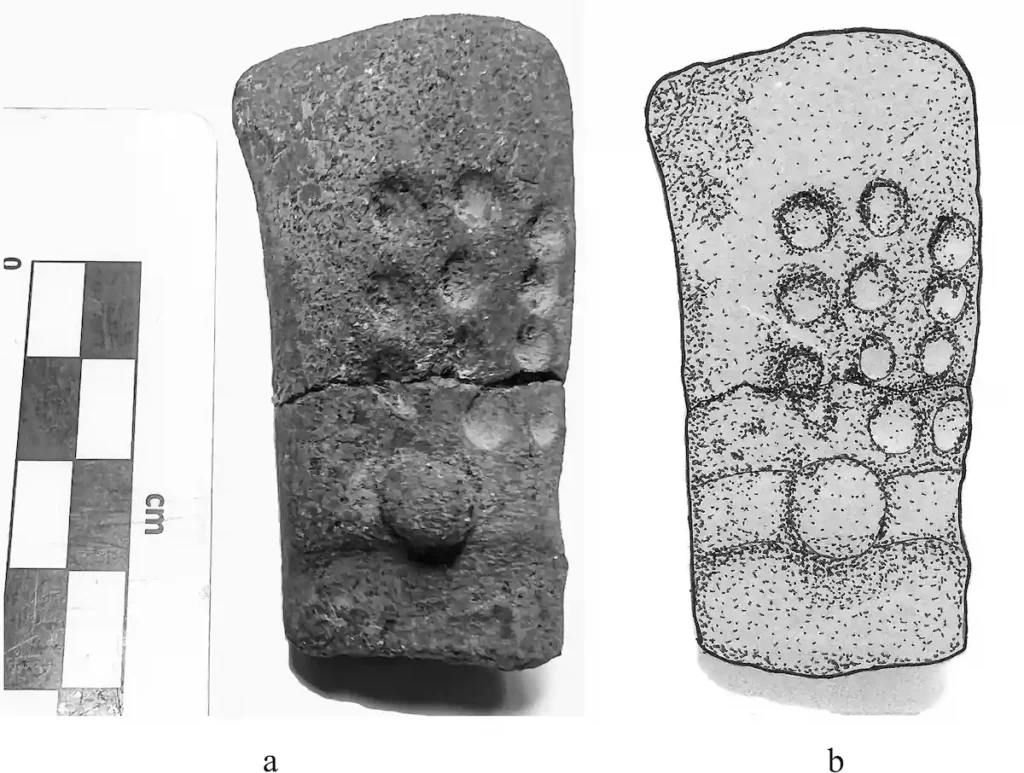
A rare object from La Blanca
The figurine was recovered from a domestic context, near a floor associated with a lower-status household. Its archaeological layer belongs to the Conchas E subphase, dated by radiocarbon evidence to around 650 BC. The figurine itself may have been made slightly earlier, during the Conchas D subphase, between about 750 and 650 BC.
That context is one reason the find is important. Earlier possible examples of Mesoamerican numeration exist, but many are debated because their dates, meanings, or archaeological contexts are less secure.
La Blanca has produced more than 5,000 figurine fragments over decades of excavation. Very few are complete. Most were broken, probably on purpose, suggesting that fragmentation was part of how these objects worked in ritual life.
Against that background, this small marked fragment stands out. It is not an elite inscription from a temple wall. It came from a household setting. That detail gives the find a different weight, suggesting that early ideas about numbers, identity, and ritual may have circulated beyond ceremonial centers.
Numbers before formal writing
Later Mesoamerican cultures used a bar-and-dot system in which a dot represented one and a bar represented five. Clearer examples appear in the Late Preclassic period, including inscriptions from Monte Albán in Oaxaca and painted texts from San Bartolo in Guatemala.
The La Blanca figurine is different. It has no bars, only dots. If the researchers are right, it may preserve an earlier stage in which numbers were being marked visually before more formal writing systems became widespread.
This does not mean that the figurine is “writing” in the strict sense. That is precisely the difficult part. The marks may be numerical without being part of a full writing system. They may belong to a more basic but highly important practice: counting, naming, or marking identity through number.
Identity placed on the head
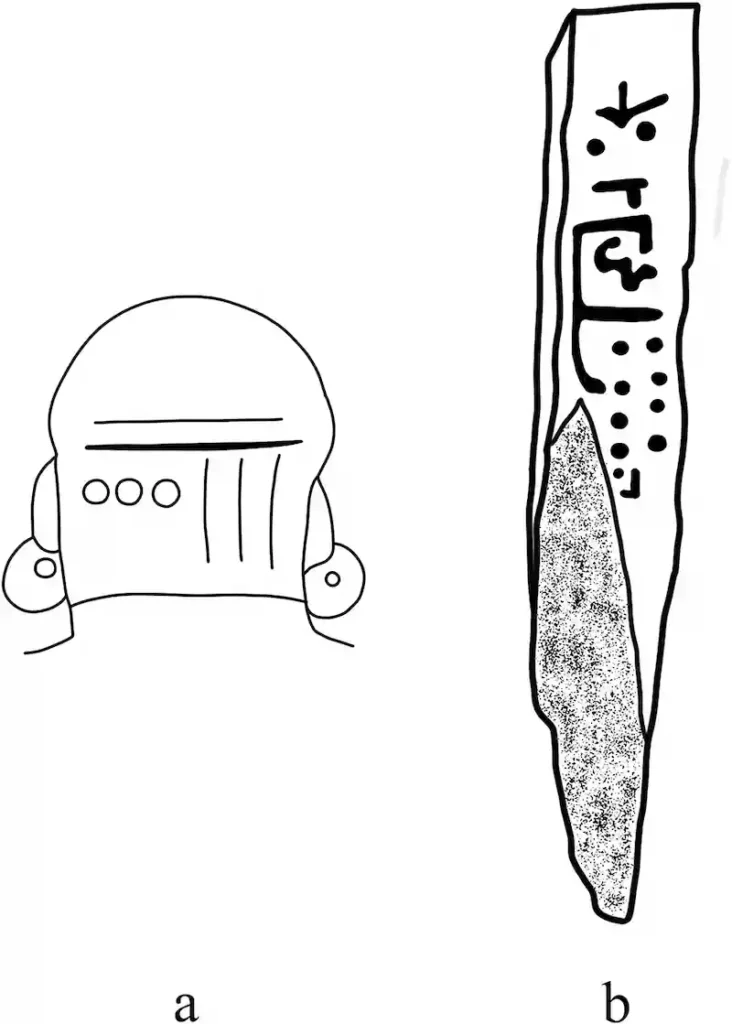
The location of the dots may be as meaningful as the dots themselves. They appear on the head area, beneath what looks like a headband or headdress.
In Mesoamerican visual culture, the head was often a place where identity was displayed. Headdresses, signs, and facial features could indicate status, ancestry, role, or name. The La Blanca figurine follows that broader habit of placing key information around the head.
That makes the possible number more than a simple count. It may have been connected to personhood.
The study also points to a later Mesoamerican way of thinking in which numbers, birth dates, identity, and destiny were closely linked through the 260-day sacred calendar. In some Maya languages, the idea of a “person” was tied to the number twenty, reflecting the total number of fingers and toes. Such beliefs are later than the La Blanca figurine, but they show why a number placed on a body, especially the head, could carry meaning beyond arithmetic.
A careful claim, not a final answer
The researchers compare the La Blanca figurine with other early and debated examples, including dots in Oxtotitlán cave art in Guerrero, Mexico, and a seal from San Andrés in Tabasco. These have been linked by some scholars to early calendrical or numerical signs, though not everyone accepts those readings.
The clearest early calendrical date in Mesoamerica still comes later, from San Bartolo, where a painted fragment records the date “7 Deer” between about 300 and 200 BC.
That is why the La Blanca find is so intriguing. It does not replace later evidence. It opens an earlier window.
The authors stop short of saying they have found the oldest confirmed number in Mesoamerica. The object is too singular for that. But it is securely dated, carefully excavated, and unusual within the large body of figurines known from La Blanca.
For now, the eleven dots remain a question with weight. They may be decoration. They may be ritual signs. Or they may be one of the earliest surviving attempts in Mesoamerica to turn number into a visible mark.
If that last reading is correct, then one of the region’s oldest numerical ideas was not carved into a royal monument. It was pressed into the head of a small ceramic figurine, broken, buried, and left in a household deposit for nearly 2,700 years.
Cover Image: The figurine with 11 dots that may represent the number 11. Credit: Julia Guernsey.