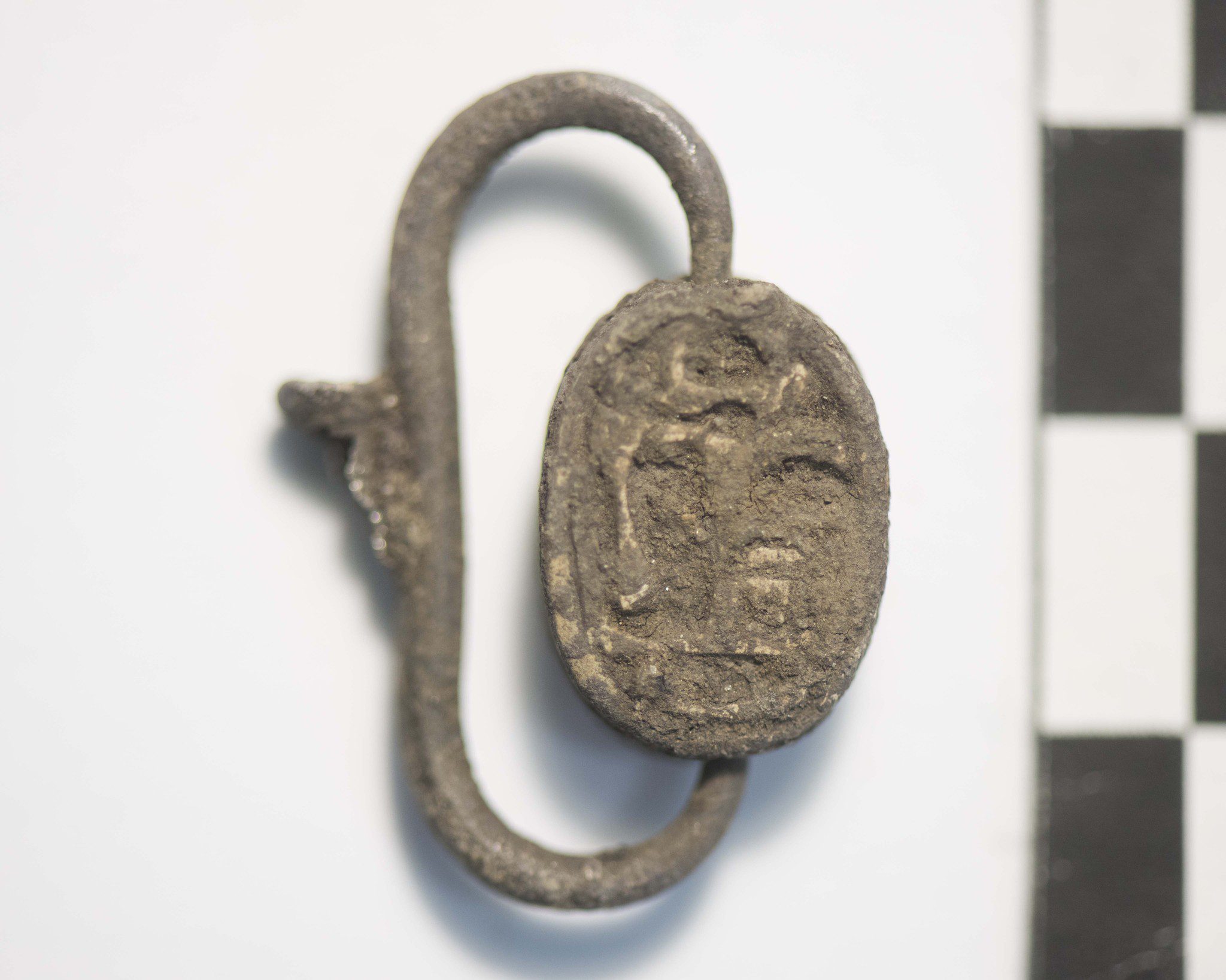
Archaeological excavations in the rugged interior of Sardinia have revealed a discovery that is already reshaping discussions about ancient Mediterranean exchange networks. At the Nuragic site of Ruinas, near the mountain town of Arzana, researchers uncovered a steatite scarab seal that appears to provide compelling evidence of direct contact between Nuragic communities and the Phoenician world.
The object is small. The story it carries is anything but.
A Journey from the Eastern Mediterranean to Sardinia
The seal was recovered from rooms belonging to a settlement area adjacent to the main nuraghe structure. Its material composition and engraved hieroglyphic characters strongly suggest a Phoenician origin. Researchers believe it was most likely produced along the Levantine coast, possibly in what is today Lebanon. Chronologically, the artifact is dated to the later phases of Nuragic culture during the Iron Age.
Scarab seals were among the most recognizable objects of ancient Near Eastern glyptic art. Carved carefully into steatite — a soft yet durable stone — these pieces were not merely decorative. They functioned as protective amulets and were often worn around the neck. At the same time, they served as personal seals representing authority, identity, or ownership. Each scarab carried a unique design, which explains the extraordinary diversity observed among thousands of known examples.
The artifact is currently undergoing delicate conservation treatment in archaeological laboratories. Once stabilization is complete, specialists will begin a detailed decipherment of the hieroglyphic inscription. The text may reveal a personal name, a sacred formula, or a symbol of power.
Nuragic Sardinia and Its Strategic Mountain Settlements
The Ruinas complex reflects the defensive and settlement architecture typical of Nuragic society. The site occupies a commanding position within the Ogliastra region. The modern settlement of Arzana begins at roughly 670 meters above sea level and climbs toward the slopes of Monte Idolo, reaching elevations close to 800 meters. Such rugged terrain appears to have been deliberately selected, likely offering strategic protection and territorial control.
This mountainous environment is traditionally associated with the Ilienses, a Nuragic population known from both archaeological and classical literary sources. The Roman geographer Pomponius Mela described the Ilienses as one of the oldest communities on Sardinia. Archaeological evidence indicates that during the second millennium BCE, this group dominated large portions of central and southern Sardinia.
As Punic and later Roman influence expanded across the island, the Ilienses appear to have retreated into the more inaccessible interior regions. Their social structure was likely organized around approximately forty tribes, each governed by a local leader who probably resided within complex multi-towered nuraghe structures.
Myth, Migration Traditions, and Archaeological Evidence
Ancient mythography preserves two distinct narratives regarding the origins of the Ilienses. One tradition connects them to Iolaos, the Theban hero who was said to have led the descendants of Heracles to Sardinia. Another suggests they descended from settlers originating in Ilium, the legendary city of Troy, who later mixed with the island’s indigenous population.
Legends, however, only partially reflect the historical reality. Archaeological discoveries demonstrate that Nuragic Sardinia was deeply embedded in long-distance exchange networks stretching across the Mediterranean.
Fragments of Mycenaean and Aegean ceramics discovered at the nuraghe sites of Antigori and Arrubiu provide early material evidence of these connections. Similarly, copper oxhide ingots — widely believed to originate from Cyprus — have been recovered from several locations across central and southern Sardinia, including Ogliastra. These finds reveal not only trade but also technological and cultural interaction.
Nuragic gray ware ceramics offer another striking example. Produced between the 14th and 13th centuries BCE, this distinctive Sardinian pottery has been identified at the palace of Knossos in Crete and at the Sicilian site of Cannatello near Agrigento. Some scholars, including archaeologist Giovanni Ugas, have suggested that the Ilienses may have represented one of the most influential Nuragic populations and could be connected, directly or indirectly, to the Shardana — one of the so-called Sea Peoples documented in Egyptian records as both mercenaries and adversaries of the pharaohs.
A Phoenician Layer Added to the Mediterranean Interaction Map
The Ruinas scarab seal strengthens growing evidence that Nuragic exchange networks were not limited to contacts with the Aegean world. Its Phoenician origin introduces a new dimension, suggesting that communities in the mountainous Barbagia region maintained relationships with multiple cultural centers across the eastern Mediterranean.
It is a personal object, a portable item of value. Yet it traveled more than two thousand kilometers across sea and land, crossing cultural boundaries before ultimately reaching a mountain village in Sardinia’s interior. Its presence materializes the commercial routes, prestige economies, and possibly even the movement of specialized individuals — artisans, traders, or metalworkers — who connected the Levant to the western Mediterranean.
Research into the artifact is only beginning. Every microscopic scratch and wear pattern may provide clues about its use and lifespan. The most anticipated stage remains the decipherment of its hieroglyphic inscription, which could identify the object’s owner or clarify its symbolic meaning.
Once conservation and analytical work are completed, the discovery is expected to be formally presented to the scientific community and the public. Plans for its long-term museum display will follow.
The small seal recovered at Ruinas serves as a powerful reminder that Nuragic Sardinia was far from an isolated mountain culture. Instead, it formed an active participant within one of the most dynamic exchange networks of the ancient Mediterranean world.
Soprintendenza Archeologia, belle arti e paesaggio di Cagliari