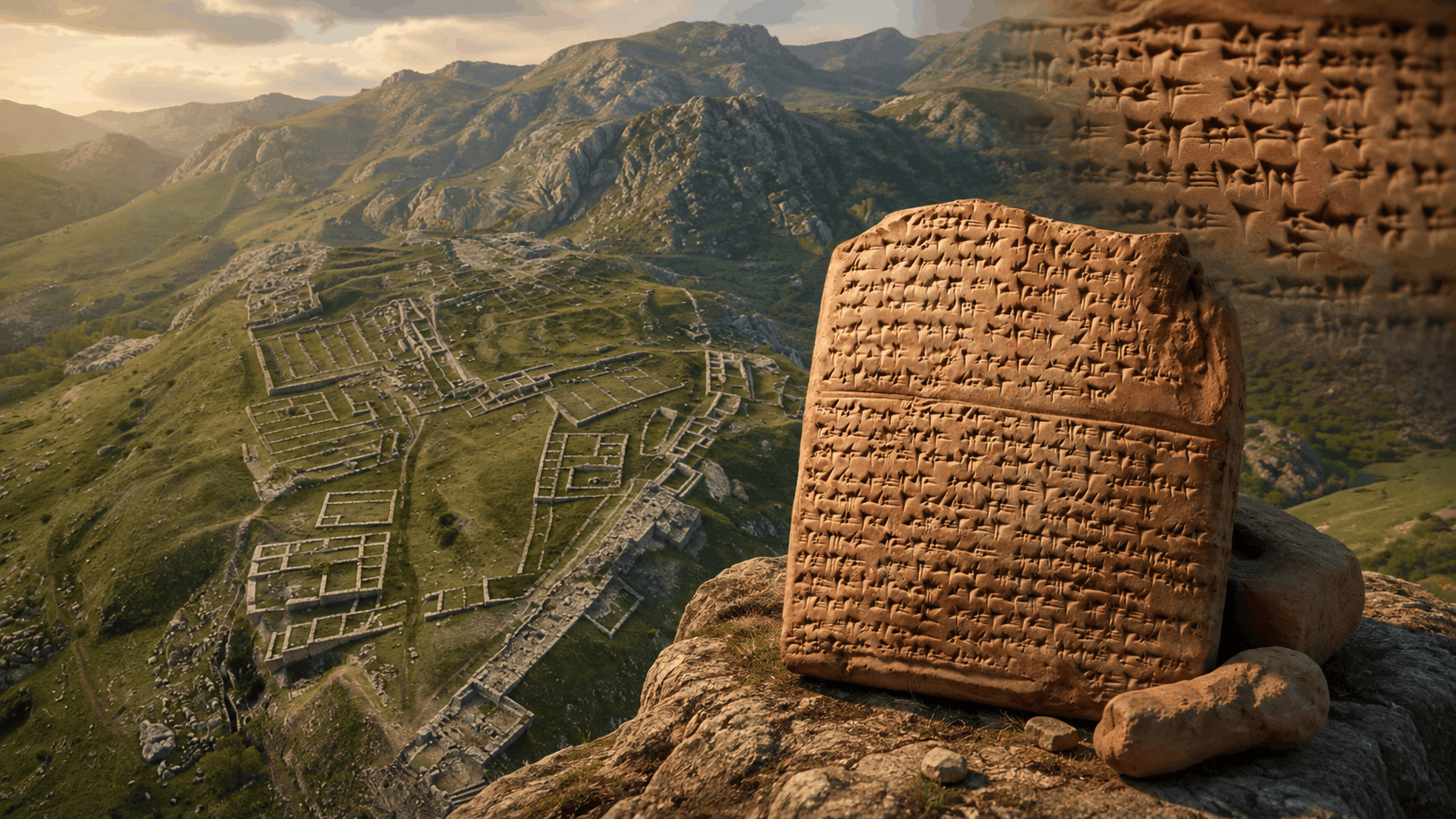
A Hittite scribe working more than 3,000 years ago copied a ritual that included words from a language other than Hittite. Those few lines remain the only known written example of Kalašma, a language once spoken somewhere northwest of the Hittite capital.
Before the tablet was identified, Kalašma was known only as the name of a region mentioned in Hittite records. The surviving passage offers rare evidence of the linguistic diversity that existed across Bronze Age Anatolia.
The tablet was found at Hattusa in 2023. When the discovery was announced that September, researchers confirmed that the unfamiliar passage belonged to the Anatolian branch of the Indo-European language family.
A fuller picture emerged in 2024. Linguists Elisabeth Rieken, Ilya Yakubovich and Daniel Schwemer published the first detailed analysis of the tablet in Archäologischer Anzeiger. Their study, A New Language within the Hittite Empire: The Discovery of the Kalašma Tablet, examined the text, its archaeological context and its relationship to other ancient Anatolian languages.
A Ritual Text from 13th-Century BC Hattusa
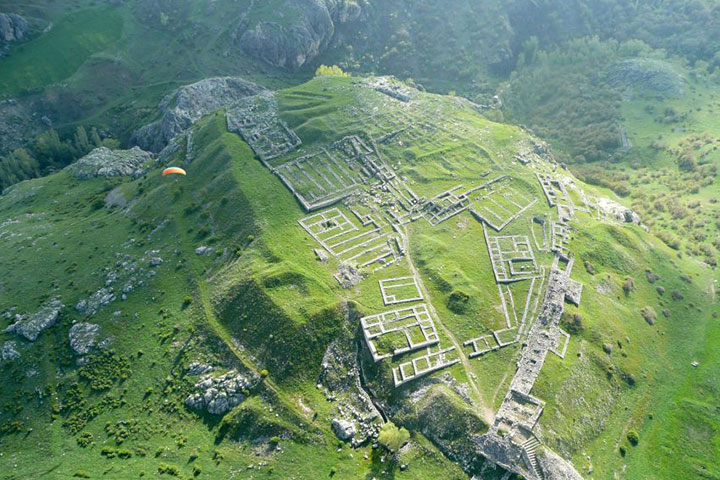
The tablet, catalogued as Bo 2023/12 and KBo 71.145, was recovered near the northwestern slope of Büyükkale, between the citadel and Ambarlıkaya.
It lay in debris beside a wall belonging to a Hittite-period building. Its size, preservation and position led the excavators to suggest that it had probably not travelled far from the structure in which it was once kept.
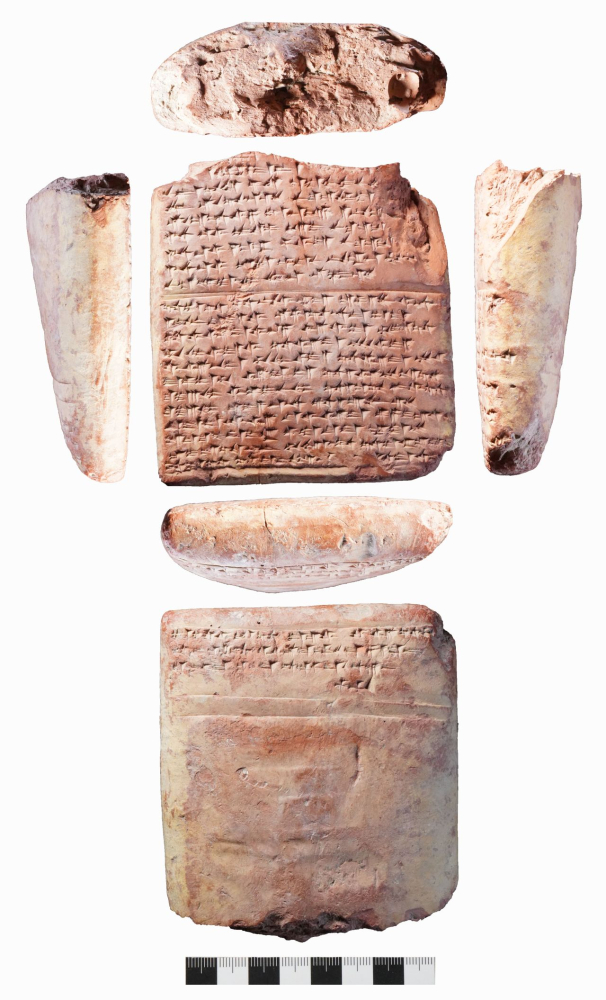
Only the lower half of the tablet survives. It measures approximately 11 centimetres across and was written in a single column. The form of the cuneiform signs places it in the second half of the 13th century BC, near the end of the Hittite Empire.
The first surviving lines contain ritual instructions in Hittite. A dividing line then separates them from a recitation written in another language.
Immediately before the change, the Hittite scribe introduces the following words with a phrase that can be understood as “in the town of Kalašma” or “in the language of the town of Kalašma.”
That note gave the researchers their starting point. Kalašma was already known from Hittite geographical and historical texts, although its precise location has never been securely established.
What Was Kalašma?
Kalašma appears to have been a territory northwest of Hattusa, on the edge of the Hittite heartland. Bolu and Gerede in northern Türkiye have both been proposed as possible locations.
The region sometimes came under Hittite control, but the surviving records suggest that its political position could change. It belonged to a frontier landscape where imperial authority, local communities and neighbouring territories met.
Until the tablet was found, no text written in the language of Kalašma had been recognised.
The few surviving lines do not provide enough material to reconstruct the language or determine how widely it was spoken. They do show that at least one community associated with Kalašma used a language distinct from the Hittite of the royal administration.
An Appeal to a Storm God
The Kalašma passage was initially described as largely incomprehensible. Rieken, Yakubovich and Schwemer later applied several methods of linguistic comparison to produce a preliminary reading.
Their interpretation suggests that the speaker invites a deity, probably the “Storm-god of Striking Down,” to accept ritual offerings. The god is then asked to grant benevolence and abundance.
Much of the passage remains uncertain. Some signs can be read clearly, but their words have no direct equivalents in better-known languages. The proposed translation therefore gives the general sense of the ritual rather than a complete line-by-line rendering.
The study nevertheless established that the text is an Anatolian Indo-European language. Its grammar and vocabulary show links with the Luwic group, which includes Luwian and closely related languages.
Kalašma cannot simply be labelled Luwian. The researchers identified features that set it apart from Luwian as it is currently known. With only one short passage available, its exact position within the Luwic group remains provisional.
Hattusa’s Tablets Recorded More Than Hittite
The presence of a regional language in the Hittite capital makes sense within the wider tablet collection from Hattusa.
Nearly 30,000 cuneiform tablets and fragments have been recovered there. Most are written in Hittite, but the archive also contains passages in Luwian, Palaic and Hattic. Akkadian was used in diplomacy and correspondence with other states.
These languages did not all have the same history. Hittite, Luwian and Palaic belonged to the Anatolian branch of Indo-European. Hattic did not. Its presence reflects the older linguistic traditions of central Anatolia.
Religious texts account for much of this variety. Hittite scribes copied ceremonies associated with different parts of Anatolia, Syria and Mesopotamia. Ritual instructions might be written in Hittite while spoken formulas, prayers or recitations were retained in another language.
Daniel Schwemer described this as a characteristic feature of Hittite scribal culture: the Hittites showed an unusual interest in recording rituals in foreign languages.
The Kalašma text belongs to that tradition. Its Hittite introduction explains how the ritual should be performed, but the recitation itself remains in the language associated with the community from which it came.
A Small Addition to Anatolia’s Linguistic Map
The Kalašma tablet does not reveal how the language sounded in ordinary conversation. It provides no personal names, no account of local history and no continuous narrative. Its surviving passage is confined to a religious ceremony.
Its value lies in the evidence it adds to a poorly documented period.
The political history of Late Bronze Age Anatolia is largely known through records produced by the Hittite state. Those records describe kings, treaties, military campaigns, land grants and religious obligations. The Kalašma passage offers something different: direct evidence that a regional language continued to be used within a ritual tradition.
For now, Kalašma is represented by a single tablet fragment. Further texts may remain unidentified among existing collections, or they may yet emerge from future excavations. Until then, Bo 2023/12 remains the only known written trace of the language.