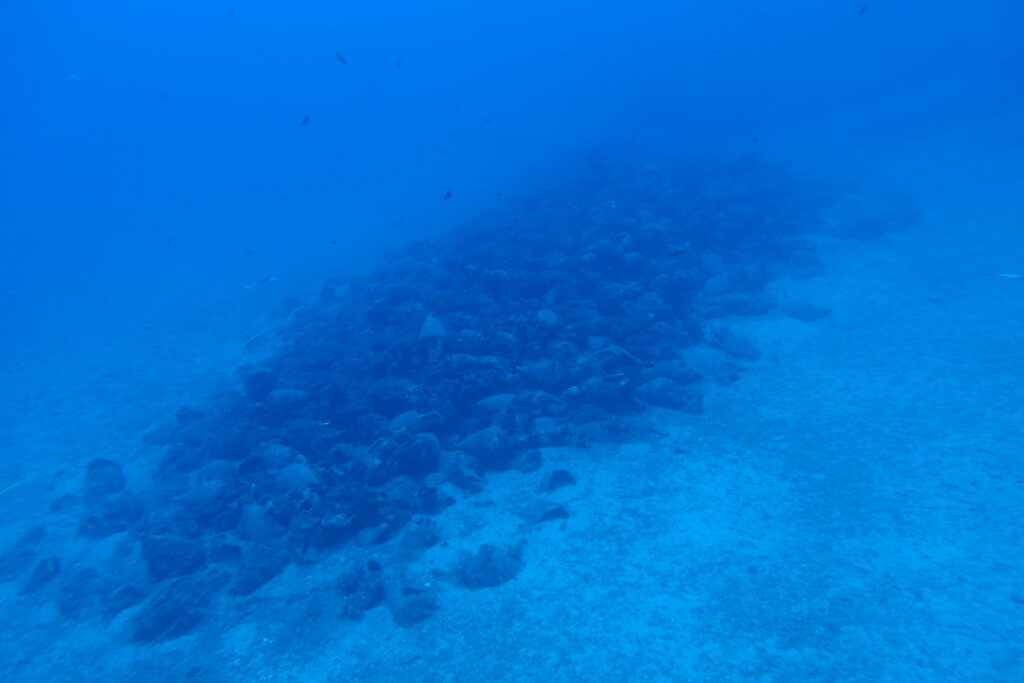
Greek underwater archaeologists have documented the remains of an ancient merchant ship carrying as many as 650 transport amphorae off the island of Andros.
The vessel sank between the late fifth and early fourth centuries BC, leaving behind a dense concentration of ceramic containers at a depth of between 39 and 44 metres. The discovery was announced by Greece’s Ministry of Culture following an investigation by the Ephorate of Underwater Antiquities.
The site was first reported by a private citizen. Archaeologists subsequently surveyed the seabed, recorded the cargo and raised selected objects for conservation and study.
Although little or none of the ship’s wooden hull appears to have survived, the amphorae still preserve the approximate area once occupied by its cargo hold.
Hundreds of amphorae remain together
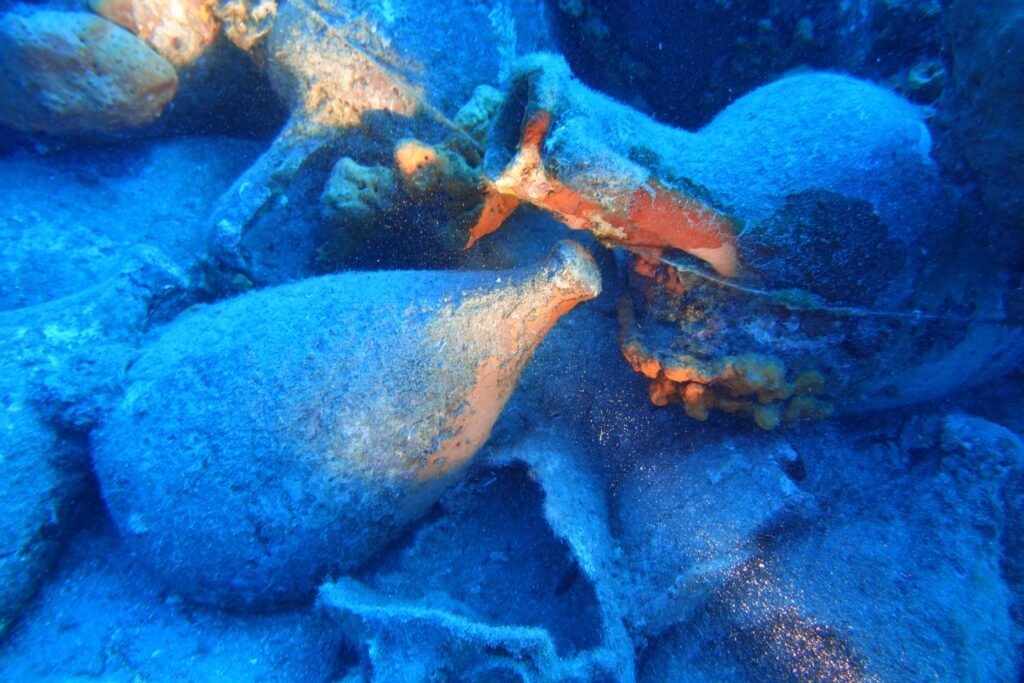
Researchers estimate that the wreck contains between 600 and 650 pointed transport amphorae.
These containers were made for maritime commerce. Their narrow bases allowed them to be fitted closely together inside a ship, where they could be supported in rows or packed into several layers.
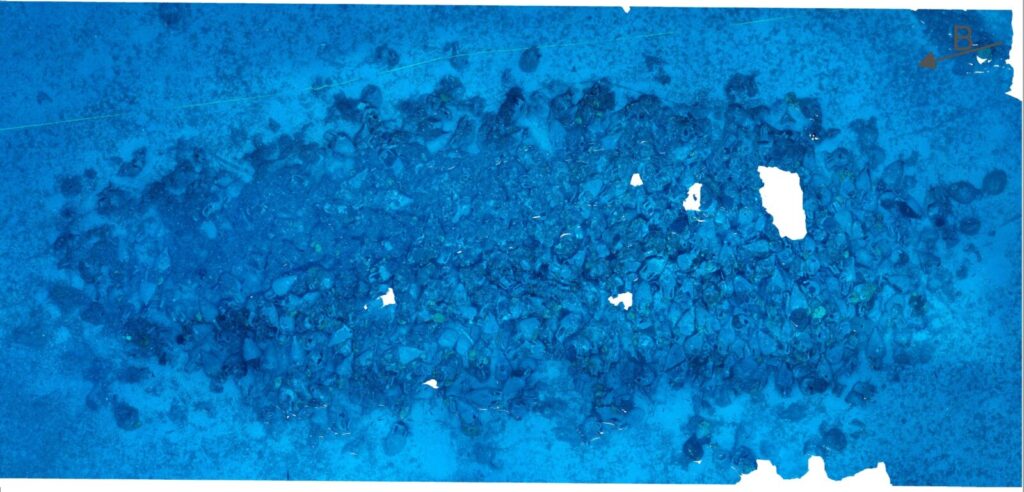
After the vessel sank, the wooden structure gradually deteriorated. The fired-clay amphorae, however, remained on the seabed, forming a visible cargo mound that can now be mapped and studied.
The archaeological team also recorded part of a lead anchor stock and several stones that may have served as ballast. Such finds could help establish the ship’s orientation, size and position at the moment it came to rest.
The arrangement of the cargo is equally important. An intact or only slightly disturbed amphora deposit can reveal how ancient merchants organised goods inside a vessel and how the load shifted during the sinking.
Cargo linked to several Aegean regions
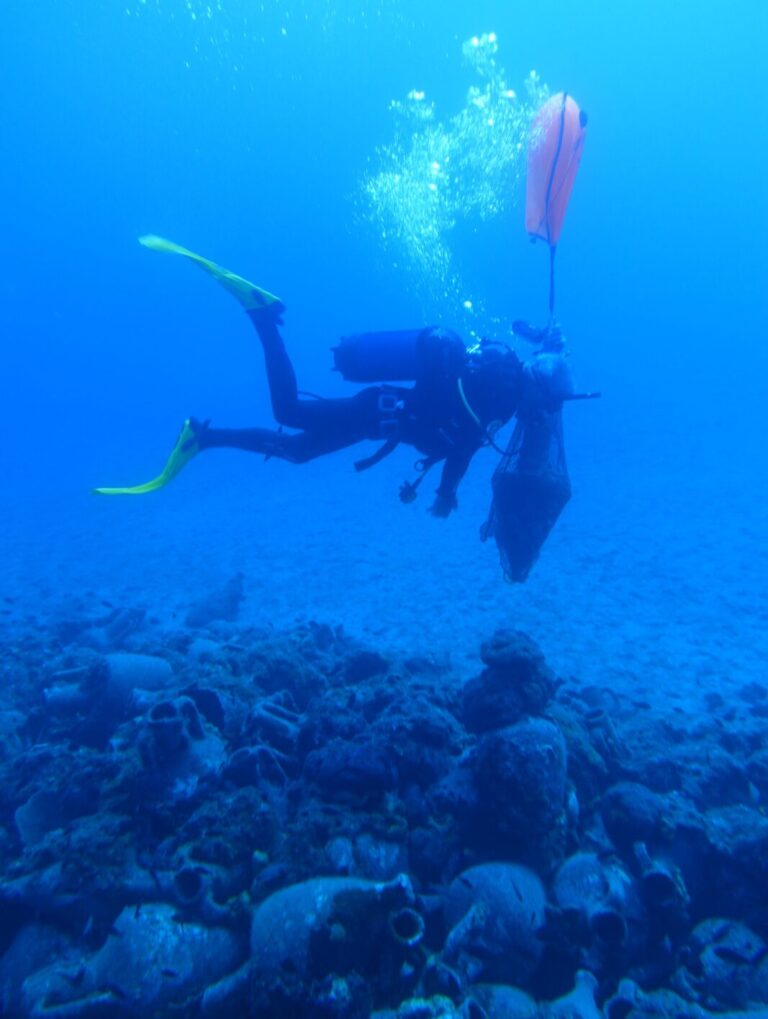
Initial examination identified at least three amphora groups among the cargo: vessels associated with Mende, Peparethos and the Solokha 2 type.
Mende, located on the Kassandra Peninsula, was known in antiquity for its agricultural production and maritime connections. Peparethos, the ancient name for modern Skopelos, was another important island centre involved in Aegean trade.
The presence of amphorae connected with several production traditions suggests that the ship did not carry a uniform shipment from a single workshop or harbour. Its cargo may have been assembled through multiple ports or commercial intermediaries before the vessel reached Andros.
Archaeologists selectively recovered one example from each identified group. Conservation work and laboratory analysis may provide more precise information about their clay, manufacture and place of origin.
The original contents have not yet been confirmed. Amphorae of this period often transported wine, oil and other agricultural products, but their shape alone cannot establish what was inside them. Residue analysis may eventually offer an answer.
A ship caught inside an Aegean trade route
Andros lies at the northern edge of the Cyclades, close to maritime passages linking the central Aegean with Euboea, Attica and the northern Greek coast.
The location makes the wreck particularly relevant to the study of Classical trade. Ships passing through these waters moved commodities between islands, coastal settlements and larger urban markets.
The vessel’s departure point and intended destination are still unknown. The amphora types may eventually narrow the possibilities, although researchers will need to complete the study of the cargo before proposing a reliable route.
This archaeology discovery is significant not because amphorae are rare, but because so many of them survive together in one underwater context. A single jar can identify a ceramic tradition. Hundreds of jars, still grouped as cargo, can preserve evidence of an entire commercial operation.
Their relative numbers may show which products dominated the shipment. Their position may reveal whether containers from different regions were stored separately. Marks, stamps or traces of their contents could identify producers, merchants or distribution networks.
The wreck belongs to a period marked by political upheaval across the Greek world, yet maritime commerce continued to connect distant communities. Archaeological evidence from shipwrecks records that movement more directly than many surviving written sources.
At present, the Andros wreck remains largely where it was found. Its cargo still rests on the Aegean seabed, preserving the final stage of a voyage interrupted around 2,400 years ago.