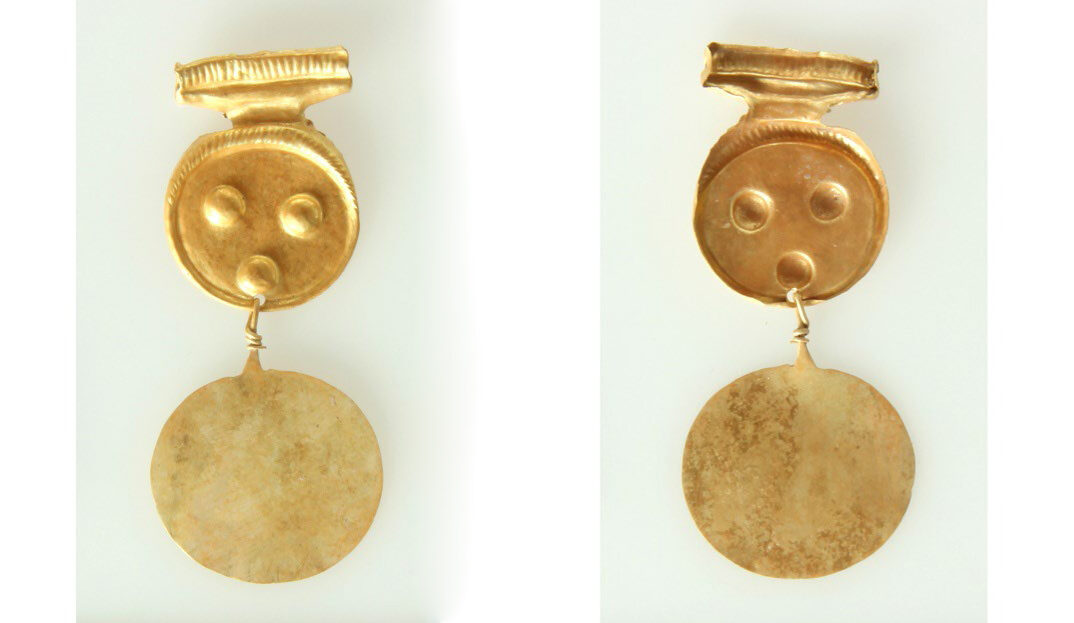
That is the case at Kolona on the Greek island of Aegina, where archaeologists have uncovered an exceptional set of Middle Bronze Age gold ornaments dating to the first half of the second millennium BCE. Announced by the Greek Ministry of Culture, the discovery may offer fresh insight into elite identity, funerary customs, and the island’s role in Bronze Age Aegean exchange networks.
The find is especially significant because several of the ornaments show formal similarities to the famous Aegina Treasure, a prehistoric group of gold and precious objects now held by the British Museum. That older collection has long been surrounded by debate because its exact archaeological context remains uncertain.
A rare gold assemblage from Bronze Age Kolona
The jewelry was discovered during the 2025 excavation season at Kolona, conducted by the University of Salzburg in cooperation with the Austrian Archaeological Institute in Athens. The project is directed by Professor Alexander Sokolicek and supervised by the Ephorate of Antiquities of Piraeus and the Islands.
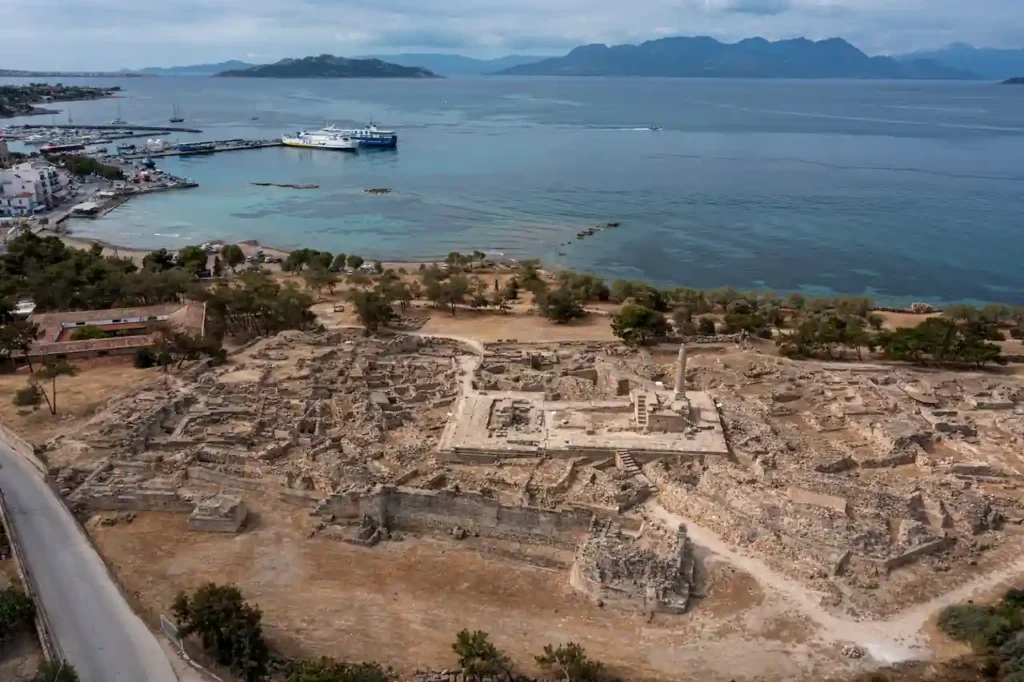
The objects came to light inside a large stone-built structure beside the defensive wall of a Middle Bronze Age settlement expansion, often described as the “inner suburb.” Although the findspot had been disturbed at an unknown time, the group itself appears remarkably coherent.
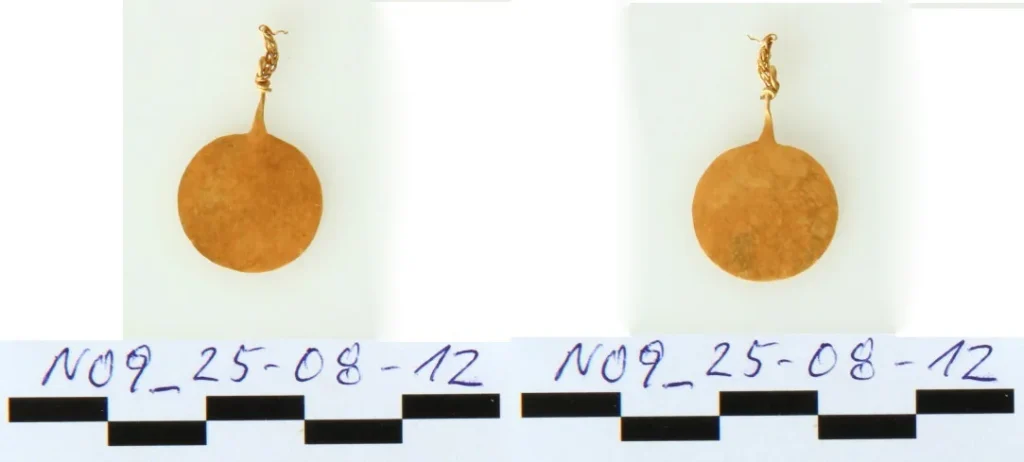
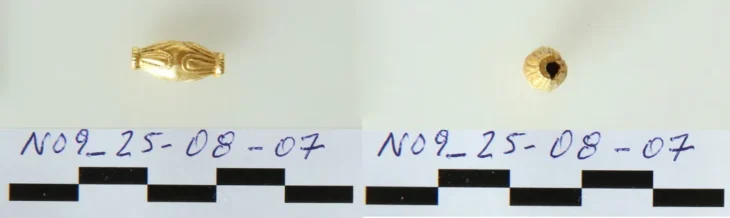
Archaeologists recovered eight two-part gold disc-shaped pendants, one additional gold disc pendant, seven gold biconical beads, one cylindrical gold bead, eight decorative sheet-gold ornaments, and seven spherical carnelian beads. The Greek Ministry of Culture has indicated that these pieces probably belonged to a single necklace or suspended ornament.
Their preservation is striking. The gold ornaments remained in excellent condition, suggesting that the assemblage was buried quickly and protected from heavy later damage. Alongside the jewelry, archaeologists also found twelve copper fragments, probably from small knives, as well as a needle or pin.
These associated objects may point to a broader depositional setting. Still, the original purpose of the assemblage cannot yet be reconstructed with certainty.
A possible burial, but not a closed case
The most likely interpretation is that the jewelry belonged to a funerary deposit. In the Middle Bronze Age Aegean, precious ornaments were not merely decorative. They could signal social rank, identity, family status, ritual role, or access to long-distance networks.
Yet the evidence must be handled carefully. Archaeologists have not identified an intact tomb at the site. No preserved burial chamber, skeletal remains, or sealed grave structure has been confirmed so far. The disturbed stratigraphy means that the objects must be interpreted through their material character, location, and comparison with similar finds rather than through a fully preserved burial context.
This kind of uncertainty is not unusual in Aegean archaeology. Ancient looting, later construction, reuse of space, or natural disturbance can erase the architecture of a grave while leaving behind small, valuable objects. At Kolona, the jewelry may preserve the memory of a burial even if the burial itself has vanished.
That tension makes the discovery more interesting, not less. The objects are clear. Their original setting remains partly hidden.
Why the Aegina Treasure matters
The new discovery has renewed attention around the Aegina Treasure, one of the most intriguing prehistoric jewelry groups associated with the island. The collection entered the British Museum in the late nineteenth century, but its exact findspot and circumstances have remained debated for generations.
Some of the newly found pendants from Kolona, especially the disc-shaped ornaments, appear to share artistic features with pieces in that older treasure. This does not prove that the Aegina Treasure came from the same area, nor does it solve the long-standing questions around its discovery. But it does strengthen an important possibility: Aegina may have been a more active center of Bronze Age luxury production, exchange, and elite display than previously understood.
The materials support that view. Gold and carnelian were not local resources. Their presence points to acquisition routes reaching beyond the island, likely connecting Aegina with mainland Greece, the Cyclades, and Minoan Crete.
In this sense, the jewelry is not only a beautiful find. It is evidence of movement. Materials, techniques, symbols, and social ideas were circulating through the Aegean long before the rise of the classical city-states.
Kolona before the classical world
Kolona is often associated today with the remains of the sanctuary of Apollo, but its history extends much further back. The site preserves traces of prehistoric occupation, later sacred activity, the acropolis of the ancient city, and Byzantine phases.
That long sequence makes Kolona one of the key archaeological reference points in the Saronic Gulf. It was not a single-period settlement. It was a place repeatedly occupied, reshaped, and reinterpreted across thousands of years.
The newly discovered gold ornaments add a more intimate layer to that story. Unlike walls, temples, or fortifications, jewelry belongs close to the body. It reflects how people presented themselves, how communities marked difference, and how wealth could be transformed into social meaning.
If the assemblage did come from a burial, it may have accompanied someone whose identity mattered deeply to the community. If it came from another kind of deposit, it still points to a deliberate act of placement rather than ordinary loss.
Scientific analysis may reveal the next clues
Researchers plan to study the jewelry and associated materials in detail on Aegina rather than transferring them immediately elsewhere. That decision allows the objects to be examined under controlled local conditions.
Metallurgical analysis may clarify the composition of the gold and possibly reveal technological choices made by Bronze Age craftspeople. Isotopic study of the carnelian could help identify where the stone originated. Microscopic examination may detect traces of organic material, including fibers or cordage once used to assemble the necklace or suspended ornament.
Such evidence would be rare and valuable. It could show not only what the object looked like, but how it was made, strung, worn, repaired, or deposited.
The results may also allow closer comparison with jewelry from Mycenaean grave circles, Minoan ritual contexts, and Cycladic assemblages. That comparison could help place Aegina more precisely within the cultural and economic map of the Middle Bronze Age Aegean.
A discovery that sharpens old questions
Future excavation around the stone-built structure will be crucial. Archaeologists will now look for any surviving traces of the original context, including displaced grave material, architectural remains, soil marks, or associated artifacts.
Even fragmentary evidence could change the interpretation of the entire assemblage. A small detail in the ground may help explain whether the jewelry belonged to a burial, a special deposit, or a disturbed elite context that has not yet been fully recognized.
For now, the Kolona jewelry stands between certainty and mystery. It is a coherent set of precious ornaments. It belongs to the Middle Bronze Age. It reflects elite Aegean connections. It may be linked stylistically to one of the most debated prehistoric treasures associated with Greece.
After more than a century of excavation, Kolona still has the ability to surprise. Its newest gold discovery does not close the story of Bronze Age Aegina. It opens it wider.
Cover Image Credit: Greek Ministry of Culture