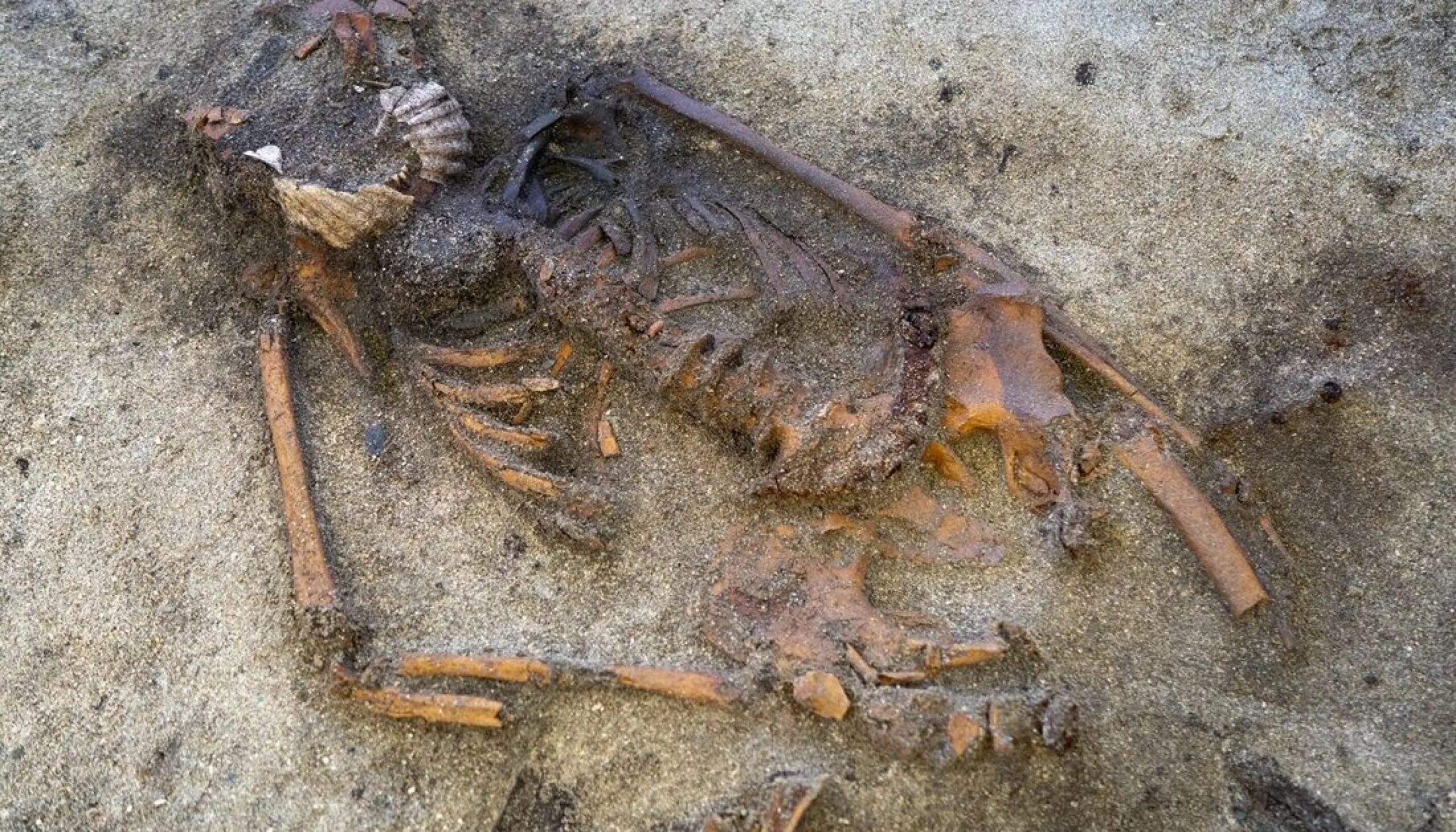
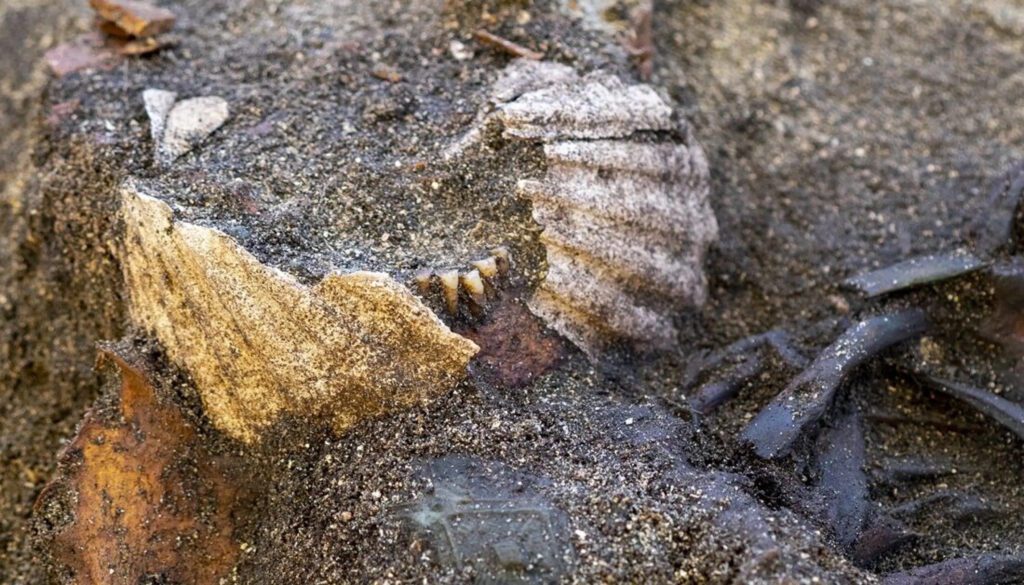
Archaeologists in central Norway have uncovered a burial unlike anything previously recorded in the country: a 9th-century woman laid to rest with two scallop shells positioned on either side of her mouth, partially covering it like a silent seal. The discovery, made in Trøndelag, has quickly become one of the most enigmatic Viking-Age graves documented in Scandinavia.
The grave was shallow—barely 15 to 20 centimeters below today’s plough layer—and had been harmed decades ago when a drainage ditch sliced through the lower end. Despite that, most of the skeleton remained intact, preserved just in time as the soil’s increasing acidity threatens organic material across the region.
High-status woman with an unusual funerary treatment
The deceased is believed to have been a married woman of considerable status. She wore a pair of large oval bronze cup brooches, typical fasteners for a woman’s halter dress in the Viking Age. A smaller ring brooch—likely used to close her petticoat—completed the set. These objects alone would mark the burial as belonging to someone of elevated social position.
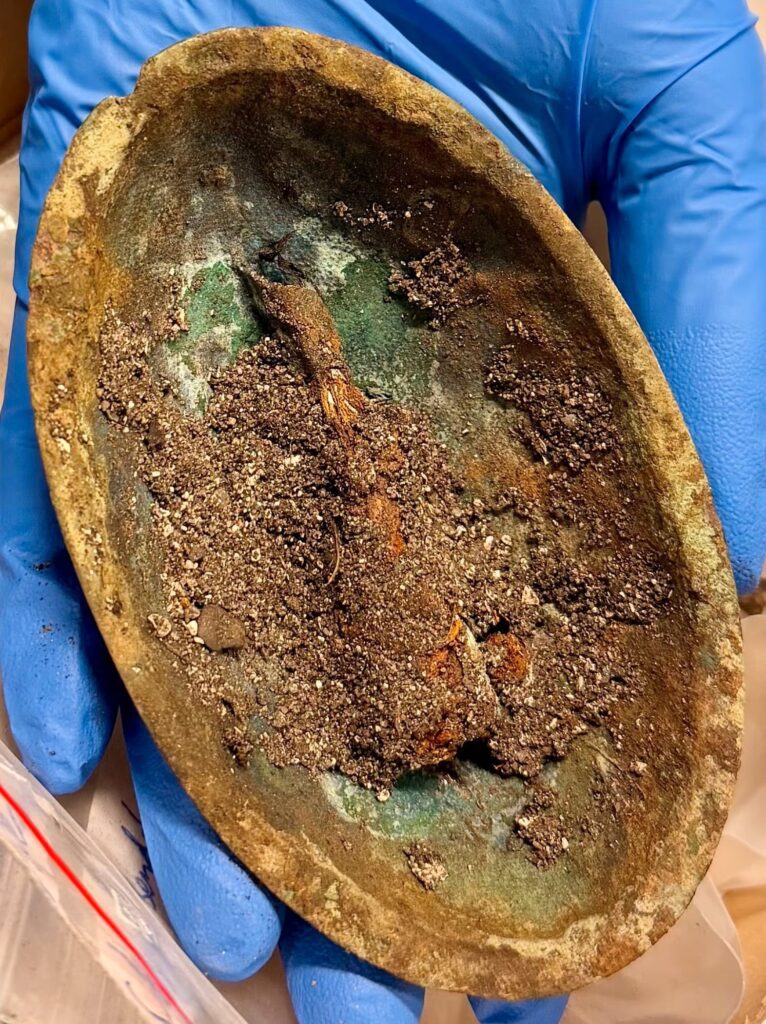
Around her body, archaeologists found small bird bones—likely remnants of wings once attached to a garment or blanket. Over time, only the tiny skeletal pieces survived. Another hypothesis is that she was placed upon a bed of feathers, an idea not without precedent: one cremation grave in Norway was found with wing fragments from 29 different birds.
The scallop shells: a practice not seen before in Norway
The most puzzling element is the pair of scallop shells. They were placed with the curved side outward and the straight edge upward, partly masking the woman’s mouth.
“This is a practice not previously known from pre-Christian graves in Norway. We do not yet know what the symbolism means,”
says Raymond Sauvage, senior engineer at the NTNU Science Museum and project manager of the excavation.
Scallop shells do appear in a handful of western Norwegian burials excavated more than a century ago, but in fragments so scattered that they may have been naturally mixed into sandy soil. Nothing comparable to this deliberate placement exists in the archaeological record.
The choice of scallops is equally intriguing. In later medieval Europe, the scallop becomes a clear symbol of pilgrimage—especially along the Camino routes—but this burial predates widespread Christian influence in the region. Whether the shells reflect travel, identity, ritual symbolism, or something entirely different remains an open question.
Another early medieval skeleton found nearby
Roughly ten meters from the “scallop woman,” archaeologists uncovered another skeleton from the 8th or 9th century earlier this year. DNA analysis will determine whether the two individuals were related. Stable isotope testing will also help reconstruct their childhood origins—whether they were locals or grew up somewhere across the North Atlantic world.
For now, the burial remains a rare glimpse into funerary traditions that do not fit neatly into known Viking-Age patterns. As the scientific work continues, this quiet grave on private farmland may end up rewriting part of Norway’s early medieval cultural history.
The 9th-century skeleton discovered in Trøndelag, showing the two scallop shells placed at the mouth — a burial practice previously unknown in pre-Christian Norway. Photo: gemini.no