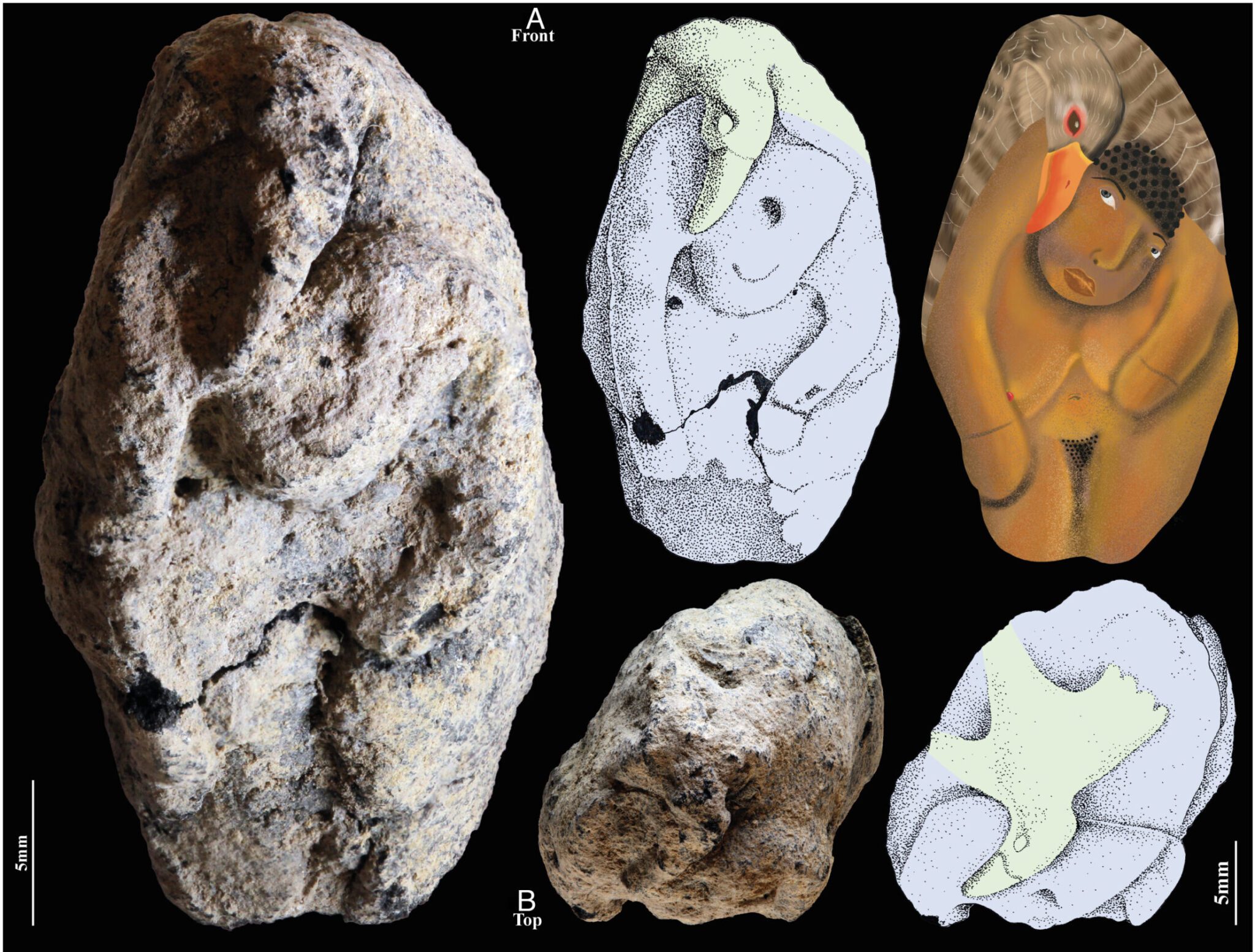
The famous myth of Zeus seducing Leda may dominate classical imagination, but the idea of human–bird unions turns out to be far older — and far more grounded in prehistoric reality. A newly analyzed fired-clay figurine from northern Israel shows that Natufian hunter-gatherers were modeling such entanglements 10 millennia before Greek poets put stylus to tablet.
The piece, only 37 millimeters tall yet loaded with symbolic punch, depicts a goose mounting a bent female figure — the earliest human–animal interaction ever represented in fired clay and the oldest full female depiction known from Southwest Asia. The research, published in PNAS, pushes Near Eastern symbolic traditions back to a period when villages were only an emerging idea and mythology had yet to be formalized.
A 12,000-Year-Old Imagination Frozen in Clay
Archaeologist Laurent Davin wasn’t expecting a revelation while sorting through thousands of clay scraps from Late Natufian excavations. Then one fragment practically shouted its identity. The shape of a woman’s torso, the posture of a goose in classic mating position — wings partly extended, neck wrapped forward — all unmistakably intentional.
What the Natufian artist created is not a hybrid creature, not a hunting trophy, not a fertility token recycled from some stale Paleolithic theme. It’s a narrative — a crafted scene with agency, tension and intention.

That distinction matters. Natufian communities (15,000–11,500 years ago) lived at a threshold moment: still foragers, but building stone structures, forming stable cemeteries and experimenting with a symbolic repertoire that foreshadowed the Neolithic. Even so, full human figures are extremely rare — and interaction scenes are practically nonexistent.
A Woman Rendered With Unusual Precision
The figurine’s female figure is modeled with a clarity rarely seen at this time:
- distinct facial shaping
- inserted breast elements
- a defined pubic triangle
- a deliberate bent posture
A fingerprint — likely of a young adult woman — remains impressed into the clay. After shaping, the object was heated to around 400°C, a controlled firing that predates established ceramic technologies of the region. Traces of red pigment still cling to both figures: hematite on the woman’s shoulder, color accenting the goose’s beak.
Not Fantasy — Behavior
Modern viewers might be puzzled by the goose’s posture. Anyone who has watched greylag geese breed, however, recognizes it immediately. This is textbook male-on-female mating behavior.
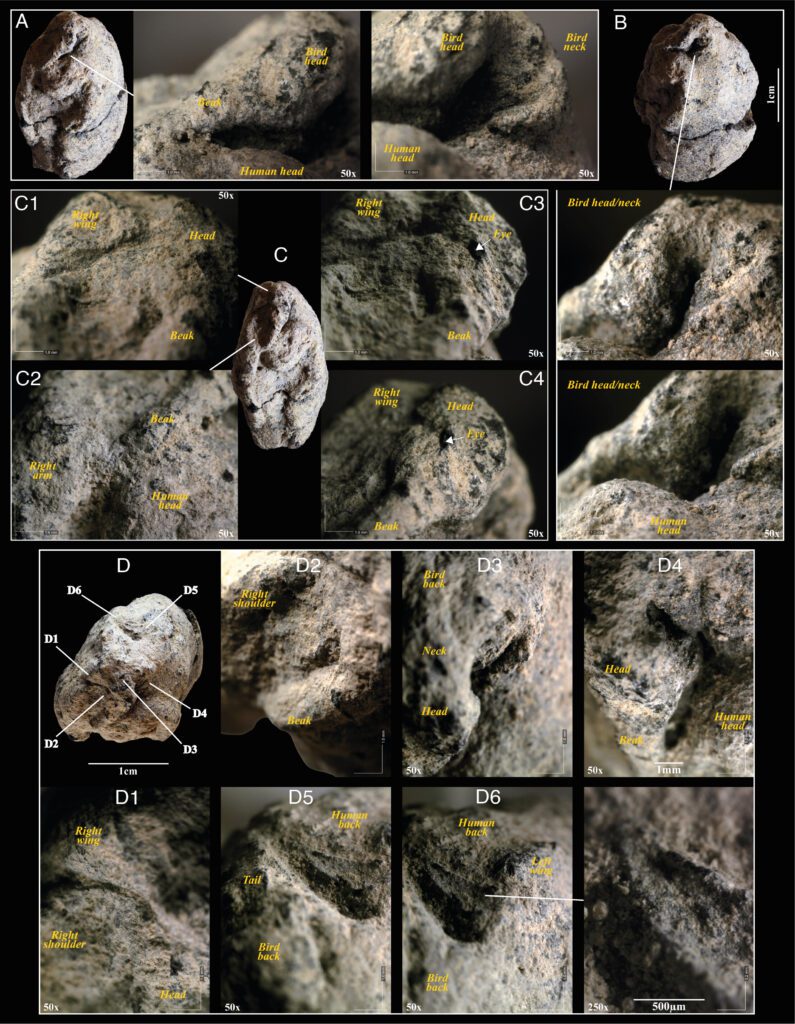
That realism tells us the figurine wasn’t inspired by myth alone. It stemmed from lived observation — then transformed into symbolic narrative. And the Natufians had the geese to justify it: excavations at Nahal Ein Gev II show an unusual focus on greylag goose remains, especially wings and feathers used for ornamentation and possibly ritual attire. Their preference wasn’t dietary; it was cultural.
A Glimpse Into Natufian Spiritual Logic
In many hunter-gatherer cosmologies, animals are not mere prey; they are persons with agency. The NEG II figurine aligns squarely with this worldview. It reflects animism — not anatomy — guiding artistic choice.
The timing is critical: this was just before the symbolic explosion of sites like Göbekli Tepe. Natufians were experimenting with architecture, identity and ritual in ways that would soon reshape human history. The figurine is a snapshot from the threshold — when imagination was becoming technology and stories were becoming objects.
Long Before Leda
Greek poets love their metaphors, but archaeology keeps reminding us they rarely invent from scratch. In fact, they were late to the party.
Thousands of years before Zeus put on feathers, Natufian communities were already envisioning worlds where human and bird domains merged — not as distant fantasies, but as part of a lived spiritual landscape.
And they left that worldview in the palm-sized body of a goose and a woman, crafted in clay 12 millennia ago.
Davin, L., Munro, N. D., & Grosman, L. (2025). A 12,000-year-old clay figurine of a woman and a goose marks symbolic innovations in Southwest Asia. Proceedings of the National Academy of Sciences, 122(47), e2517509122. https://doi.org/10.1073/pnas.2517509122
Cover Image Credit: Davin et al., 2025 (PNAS). (Photos L.D., Technical drawing Dasha Lokshin, Artistic drawing Vic Oh).