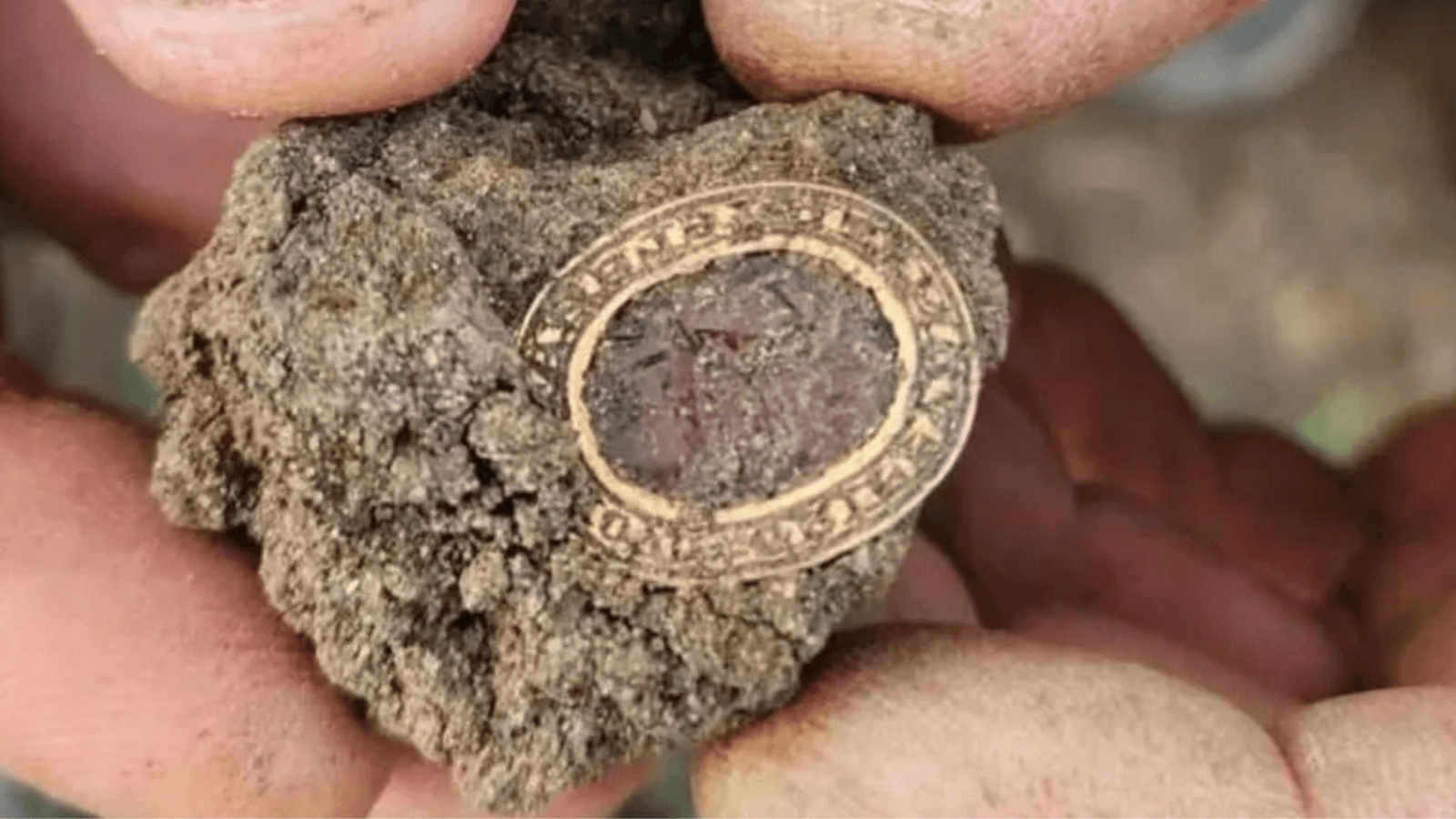
A frustrating morning in a Suffolk field took an extraordinary turn when two metal detectorists uncovered a medieval gold seal ring. Its inscription and proximity to two religious houses have raised an intriguing possibility: the ring may once have belonged to Matilda of Lancaster, Countess of Ulster.
The 13th- or 14th-century object was found in a ploughed field near Stoke Ash in eastern England by friends Aaron Pizzey and James Race. According to an account published by BBC News, the pair had already searched two fields without success and were close to giving up when Pizzey’s faulty headset produced a strong signal.
Moments later, a flash of gold appeared inside a clod of earth. What emerged was the surviving face of a personal seal ring, its band missing but its engraved gemstone and inscribed gold bezel still intact.
A Griffin Surrounded by a Mysterious Name
At the centre of the ring is a reddish-orange carnelian carved with a griffin walking to the left. The mythical creature, combining the body of a lion with the head, wings and talons of an eagle, remained a powerful symbol of authority and vigilance throughout the Middle Ages.
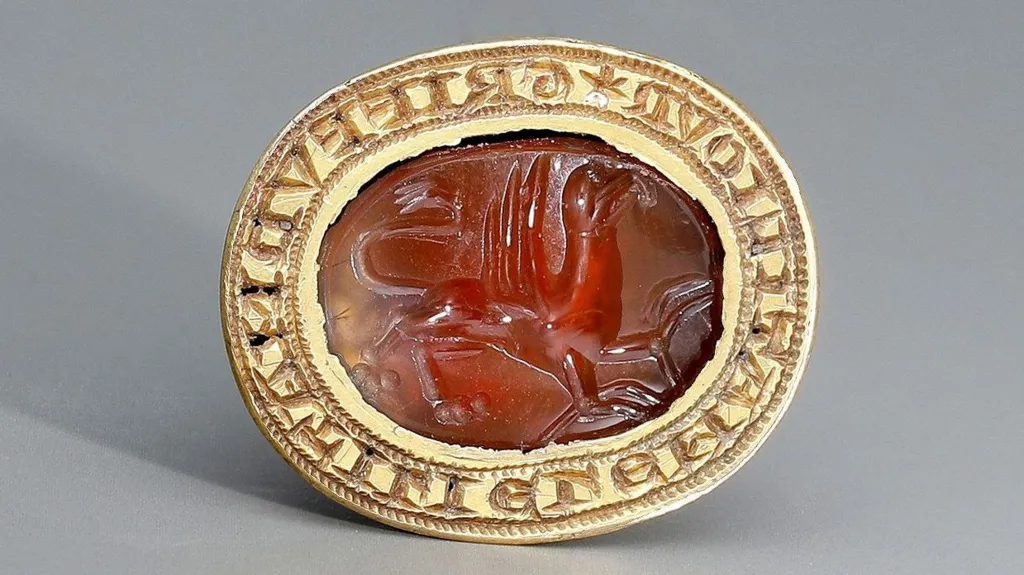
The stone is mounted in an oval gold bezel bordered by an inscription in retrograde Lombardic lettering. This reversed script was intended to appear correctly when the ring was pressed into wax.
The surviving inscription reads “GRIFFVnMATILIELEMATILIOVR,” although its division and translation remain uncertain. Noonans Mayfair, which will offer the ring at auction, suggests it could be interpreted approximately as “Griffin—Matilda—the maternal countess.”
That reading has led specialists to consider Matilda of Lancaster, also known as Maud of Lancaster, as a possible former owner. The identification is not proven, but the name, the status of the object and the location of its discovery form a compelling set of clues.
Could It Have Belonged to Matilda of Lancaster?
Born around 1310, Matilda was a great-granddaughter of the English king Henry III. Her marriage to William Donn de Burgh, 3rd Earl of Ulster, in 1327 made her Countess of Ulster.
William was murdered in 1333, helping to trigger a period of civil conflict in Ireland. Their young daughter, Elizabeth de Burgh, inherited the earldom in her own right, while Matilda returned to England and lived at the royal court of Edward III. This relationship may help explain the unusual reference to a “maternal countess” in the proposed translation.
After the death of her second husband, Sir Ralph de Ufford, Matilda took religious vows. In 1347 or 1348, she became a canoness at the Augustinian Campsey Priory in Suffolk.
She later received papal permission to establish a community of Poor Clares at Bruisyard Abbey, where she died and was buried in 1377. Both religious houses are close to the discovery site: Stoke Ash lies about 20 miles from Campsey Priory and approximately 15 miles from Bruisyard.
Geography cannot establish ownership, and medieval jewellery could travel through inheritance, exchange or accidental loss. Still, the inscription and the ring’s proximity to places associated with Matilda make the proposed connection worthy of further investigation, even if her ownership can never be proved.

A Rare Personal Seal
The surviving bezel measures approximately 19.7 by 16.3 millimetres, while the entire object weighs just 2.43 grams. The carnelian remains in relatively good condition, although the gold mount shows wear and damage and only parts of the ring’s shoulders survive.
According to the auction catalogue, finely made medieval gold seals are rare, and examples designed to be worn as finger rings are rarer still. Their smaller impressions suggest that they may have served a more personal or informal purpose than the large seals attached to official documents.
The discovery was reported and recorded by the Portable Antiquities Scheme under reference SF-0F739C. It was also assessed through the Treasure process before being disclaimed, allowing it to be returned for sale.
According to the Noonans auction catalogue, the ring will appear as Lot 89 in a London sale on September 22, 2026, with an estimate of £10,000 to £12,000. The proceeds are expected to be divided between the two detectorists and the landowner.
The name of its medieval owner may never be established with certainty. Yet the tiny griffin, reversed inscription and worn gold setting have preserved enough clues to connect a Suffolk field with the turbulent life of one of medieval England’s most prominent noblewomen.
Cover Image: The medieval gold seal ring moments after it was uncovered in a ploughed field near Stoke Ash, Suffolk. Credit: Aaron Pizzey