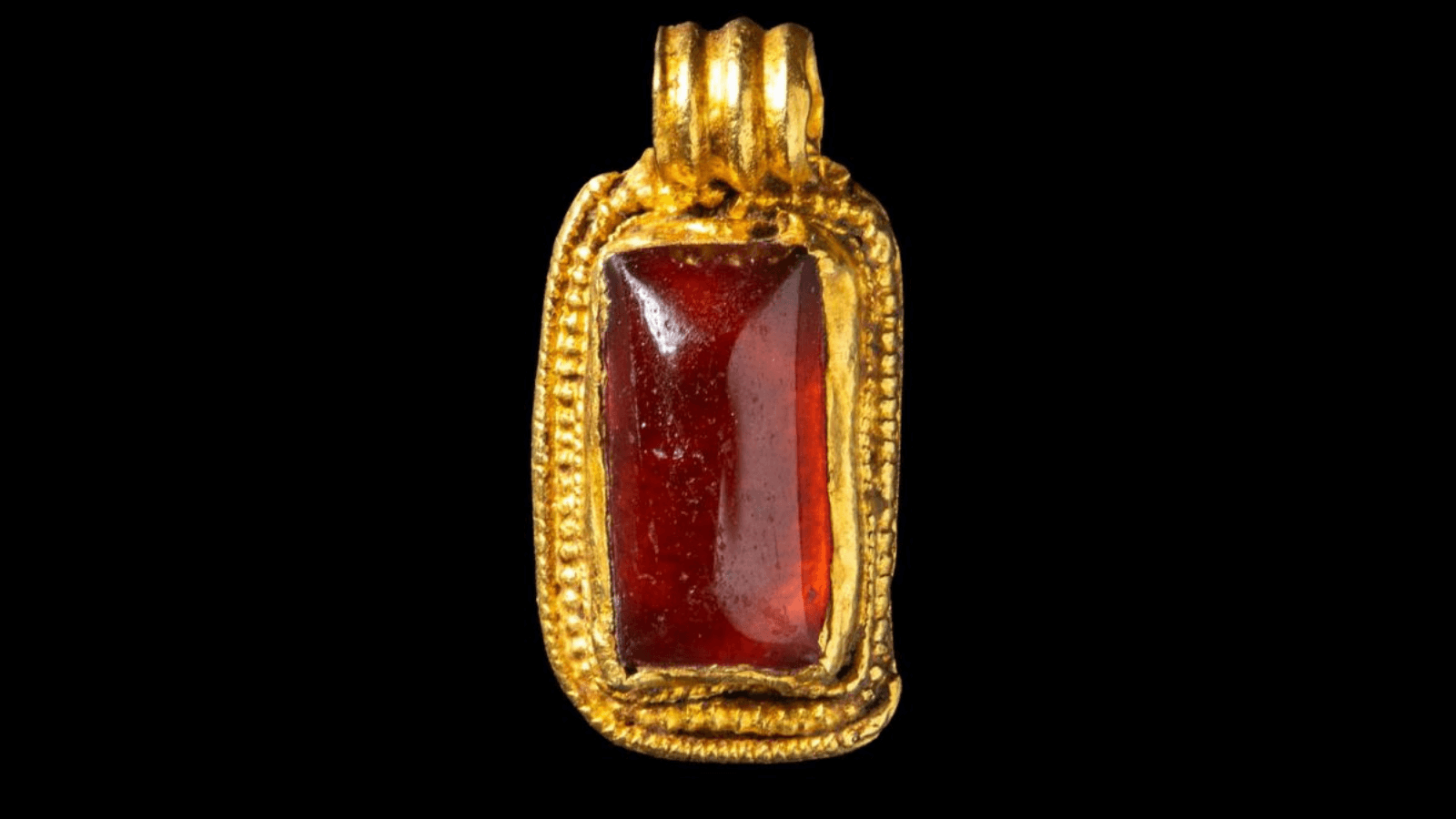
A teenage girl buried in eastern England around 1,400 years ago wore a necklace containing garnets that had travelled thousands of miles from India and Sri Lanka. Her grave, the richest in a previously unknown Anglo-Saxon cemetery in Lincolnshire, reveals how even a small rural community was connected to trade networks extending far beyond Britain.
The cemetery was uncovered at Callow Carr during archaeological work along the British section of Viking Link, the electricity interconnector between Great Britain and Denmark. Despite the project’s name, the burials predate the Viking Age and belong mainly to the sixth and seventh centuries.
The findings have now been published in Marsh, Wold and Fen: The Archaeology of the Viking Link Interconnector in South-East Lincolnshire. According to Wessex Archaeology, Callow Carr is the first Anglo-Saxon cemetery from the southern Lincolnshire Wolds to be excavated and fully published using modern methods.
A teenager with an extraordinary necklace
The cemetery contained 22 graves holding 23 people. Its richest burial belonged to a girl aged approximately 14 to 16, who was laid on her left side with her body flexed. Radiocarbon dating places her burial most probably between AD 640 and 660.
Beside her was a boy aged between about five and seven. The pair had been placed back-to-back in the same grave, but the contrast between their burials was striking. No surviving grave goods were associated with the boy, while the girl was accompanied by the most elaborate collection found anywhere in the cemetery.
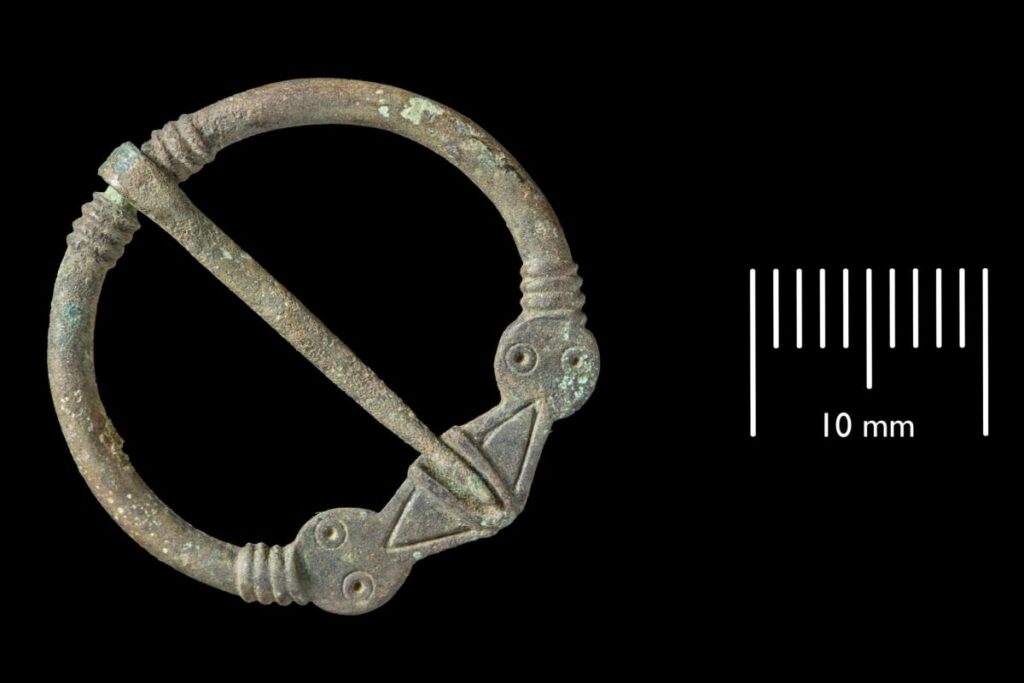
Her jewellery appears to have formed a necklace consisting of two turquoise-coloured glass beads, a silver-mounted amber pendant and two garnets set in gold. A copper-alloy penannular brooch was also discovered near the centre of her chest.
Microscopic and chemical analysis confirmed that the red stones were garnets. Their composition pointed to two different origins: one was probably obtained from northern India or Rajasthan, while the other most likely came from Sri Lanka.
The stones had therefore crossed an extraordinary distance before reaching seventh-century Lincolnshire. They probably travelled through networks connecting the Indian Ocean with the Mediterranean, Merovingian Francia and Anglo-Saxon England.
Gold-and-garnet pendants have been found in a limited number of wealthy female and child burials from early medieval England. The Callow Carr necklace suggests that the girl belonged to, or was closely associated with, a socially elevated group able to obtain rare materials from distant regions.
A child buried without possessions
Ancient DNA added another layer to the double burial. The young boy was maternally related to a woman aged between 30 and 40 who had been buried elsewhere in the cemetery. Researchers believe he may also have been related to the teenage girl, although the available results could not confirm this.
Why the two young people were buried together, and why their funerary treatment differed so sharply, remains unknown. The shared grave could reflect a close family connection, but it does not explain why the girl received valuable jewellery while no surviving objects accompanied the boy.
The wider cemetery contained brooches, buckles, beads, knives, combs, whetstones, textile-working equipment and several types of container. Another adolescent, a boy aged about 14 to 16, was buried with a single-edged iron weapon known as a seax. Researchers believe it may already have been around a century old when it was placed in his grave, suggesting that it had been preserved as an heirloom.
Burials beside a prehistoric monument
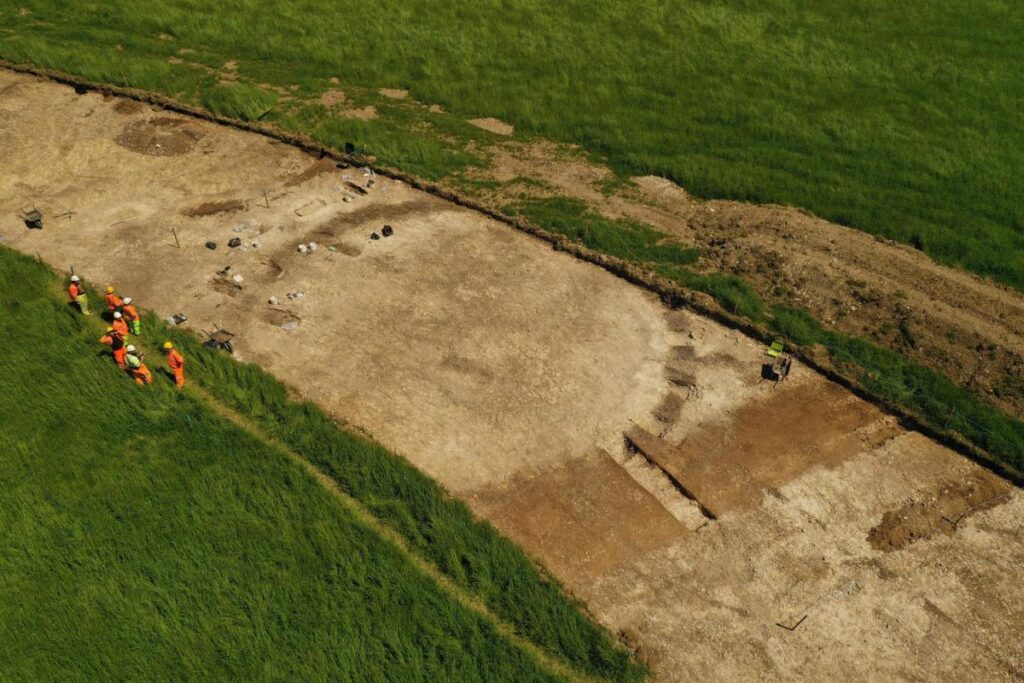
The Anglo-Saxon community established its cemetery beside the remains of a much older Bronze Age burial mound. Although the mound itself had disappeared through centuries of ploughing, its surrounding ring ditch remained visible enough to influence the arrangement of the later graves.
Reusing prehistoric monuments for burial was a familiar practice in Anglo-Saxon England. Ancient mounds served as prominent landmarks and may have helped communities express their connection to the surrounding landscape.
Isotope analysis indicates that most of the people buried at Callow Carr grew up locally. One man appears to have spent his early childhood elsewhere, possibly in northeastern Britain or continental regions such as Germany or France, before later moving to Lincolnshire.
The cemetery was used while the Anglo-Saxon kingdom of Lindsey was undergoing significant political and religious change. Burial there appears to have ended during the later seventh century, around the period when Christianity became more firmly established in the region.
The Callow Carr cemetery belonged to a small community, but the teenage girl’s jewellery tells a much larger story. Its gold, amber and South Asian garnets reveal a world in which precious materials could move across continents before reaching a young woman’s grave in rural England.
Cover Image: A gold and garnet pendant recovered from the Anglo-Saxon cemetery at Callow Carr in Lincolnshire. Analysis suggests that the gemstone originated in Sri Lanka. Credit: Wessex Archaeology