
The story began not in a museum storeroom or a church attic, but in the quiet interior of a countryside cottage in northwestern Bohemia. When the current homeowners stumbled upon an unfamiliar wooden statue in 2022, they assumed it was a simple old carving left behind by previous occupants. Instead, they had unknowingly uncovered a missing 14th-century masterpiece: a delicately carved Madonna that had vanished from the historical record for generations.
Today, after three years of meticulous restoration, the Madonna of Havraň—also known as the Madonna on the Angelic Throne—is finally on public display at the Convent of St. Agnes of Bohemia in Prague. Its recovery and revival offer an extraordinary glimpse into the devotional art that flourished in the capital during the reign of Holy Roman Emperor Charles IV.
A Forgotten Treasure Hidden by History’s Upheavals
The house in which the statue resurfaced once belonged to Sudeten German residents, members of the Nazi Party who were expelled after World War II under the decrees of President Edvard Beneš. Their properties were confiscated, leaving behind scattered belongings—one of which, astonishingly, turned out to be this medieval Madonna.
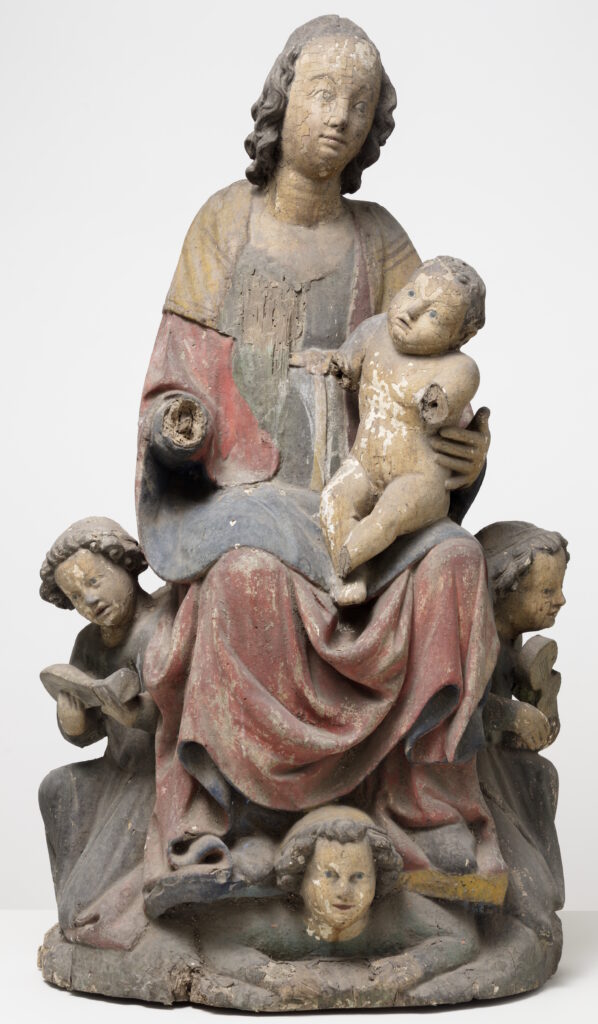
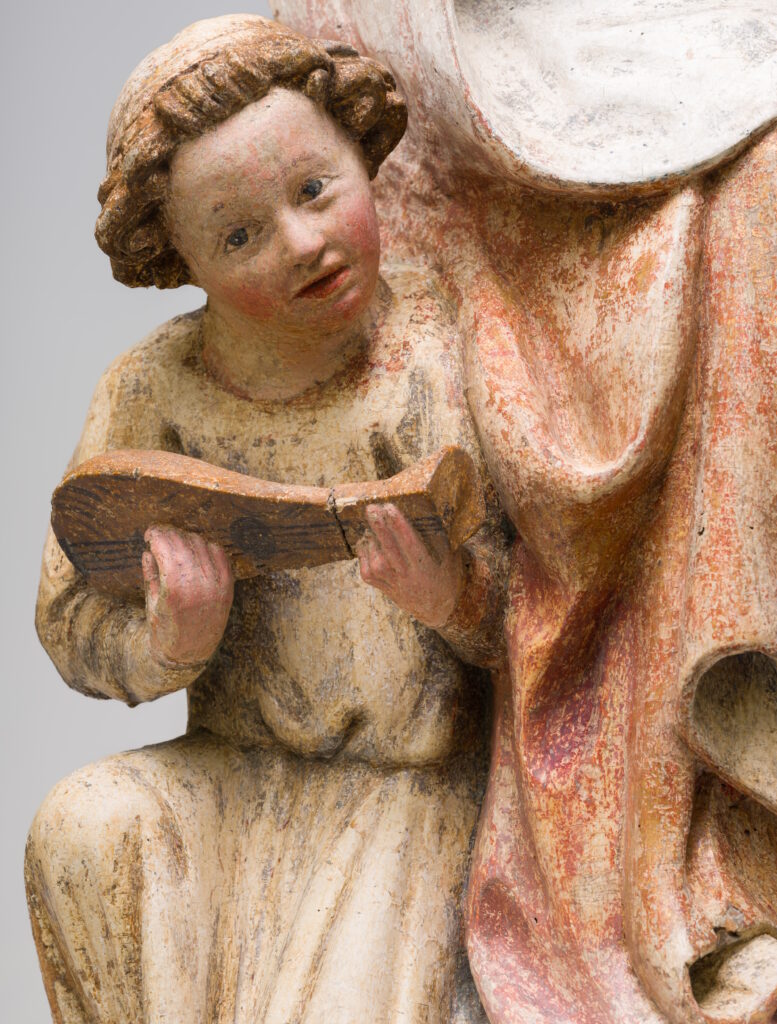
Measuring just over three feet (95 cm) and carved from high-quality linden wood, the sculpture depicts the Virgin enthroned with the Christ Child on her lap. Three angels surround her: two at her sides, each playing an instrument—a fiddle and a quiterna—and one positioned beneath her feet. Her high forehead, wavy hair, and gentle facial proportions all point to a stylistic lineage deeply rooted in the Prague workshops of the late 14th century.
Experts date the piece to the 1360s or 1370s. Its morphology aligns closely with works attributed to the Master of the Bečovský Madonna, a sculptor active near the imperial court in Prague. His patrons included high-ranking courtiers of Charles IV and the Archbishops of Prague—suggesting this statue was originally created for an elite religious setting.
Layers of Time: CT Scans Reveal the Sculpture’s True Face
When the National Gallery in Prague acquired the statue in 2022 for CZK 4.5 million (about USD 218,000), the Madonna no longer resembled the delicate Gothic carving it once had been. Over centuries, it had been coated with several layers of crude paint, masking its medieval character beneath heavy reds, greens, yellows, and blues.
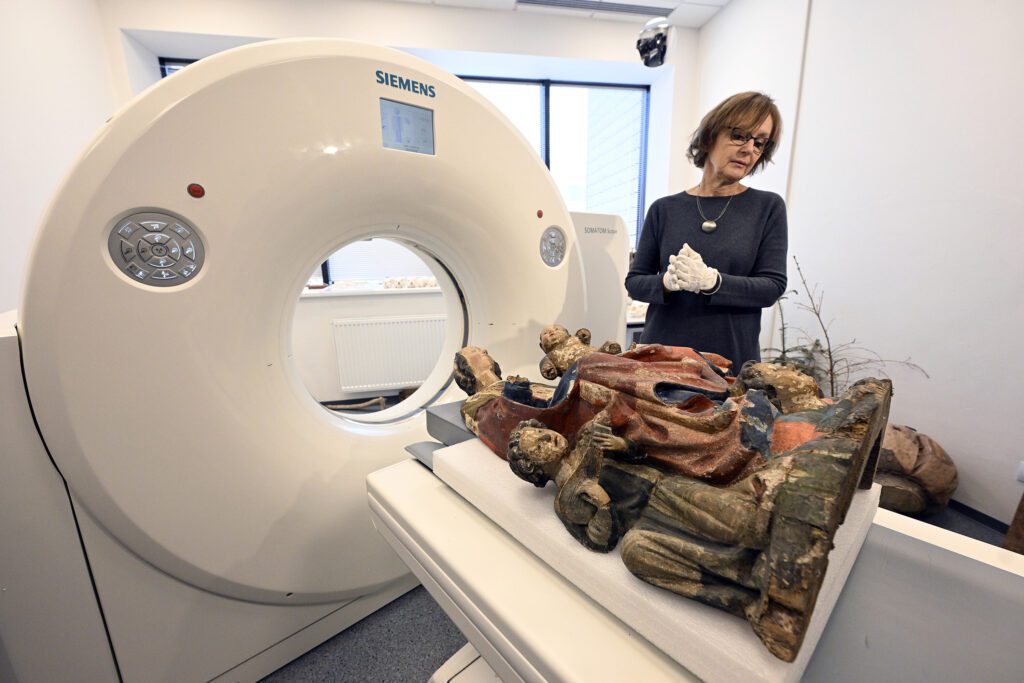
To separate history from later intervention, conservators first subjected the statue to CT scanning. These images allowed the team to distinguish original polychromy from later repaintings. Beneath the modern layers lay traces of shimmering silver garments and a golden cloak—faint but unmistakable hints of the sculpture’s once-radiant presence.
Dendrological analysis confirmed the wood’s exceptional quality, and the scans revealed that the core structure was still completely sound. What remained, however, was a complex puzzle of paint layers, broken details, and alterations from past centuries.
Restoring a 14th-Century Madonna Sculpture: A Renewed Vision
Lead restorer Markéta Pavlíková and her team then embarked on a painstaking, three-year effort to recover the original medieval surface. In the process, they uncovered evidence of lost elements: part of the Virgin’s right hand, sections of her dark wavy hair, and a carved wooden crown that once rose directly from the same block of linden.
Pavlíková believes these features were deliberately removed in later centuries and replaced with metal accessories. The Christ Child, too, once received a metal crown, a modification that altered the sculpture’s silhouette and obscured its Gothic craftsmanship.
Removing centuries of overpaint required microscopic precision. Each layer corresponded to a different phase in the sculpture’s long and turbulent history. Only after the final additions were lifted away did the remnants of 14th-century polychromy reappear—muted yet unmistakably elegant.

A Medieval Madonna Rejoins Prague’s Cultural Landscape
With restoration complete, the Madonna now stands in the Convent of St. Agnes of Bohemia, a setting whose own medieval heritage mirrors the sculpture’s origins. The work’s reemergence not only enriches the National Gallery’s Gothic collection but also restores a piece of Prague’s artistic past that had been presumed lost.
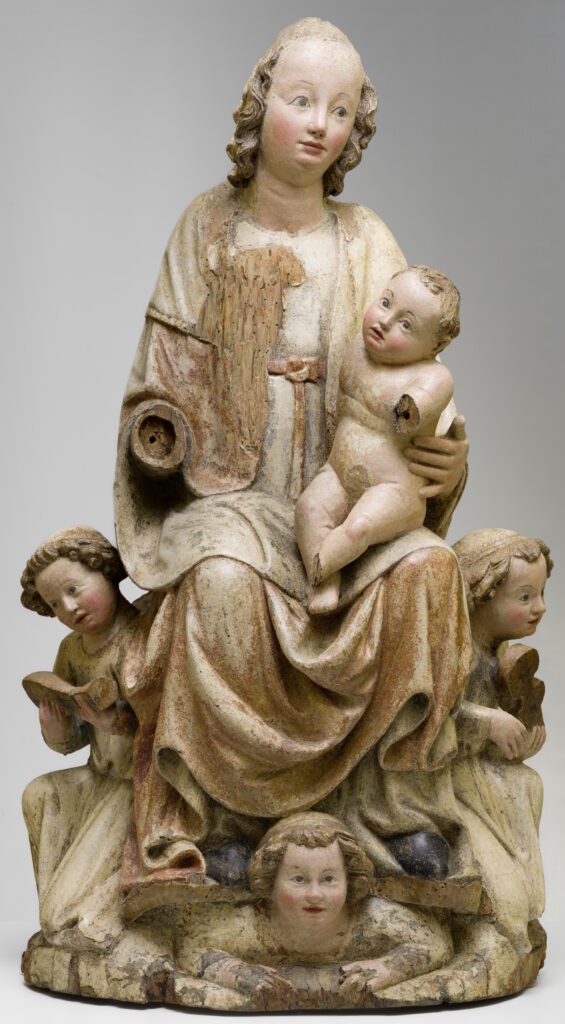
Three angels once played music at her side, their instruments echoing the refined devotional culture of Charles IV’s capital. Thanks to the patience of conservators and an entirely accidental discovery in a rural cottage, that melody now finds its way back into the present.