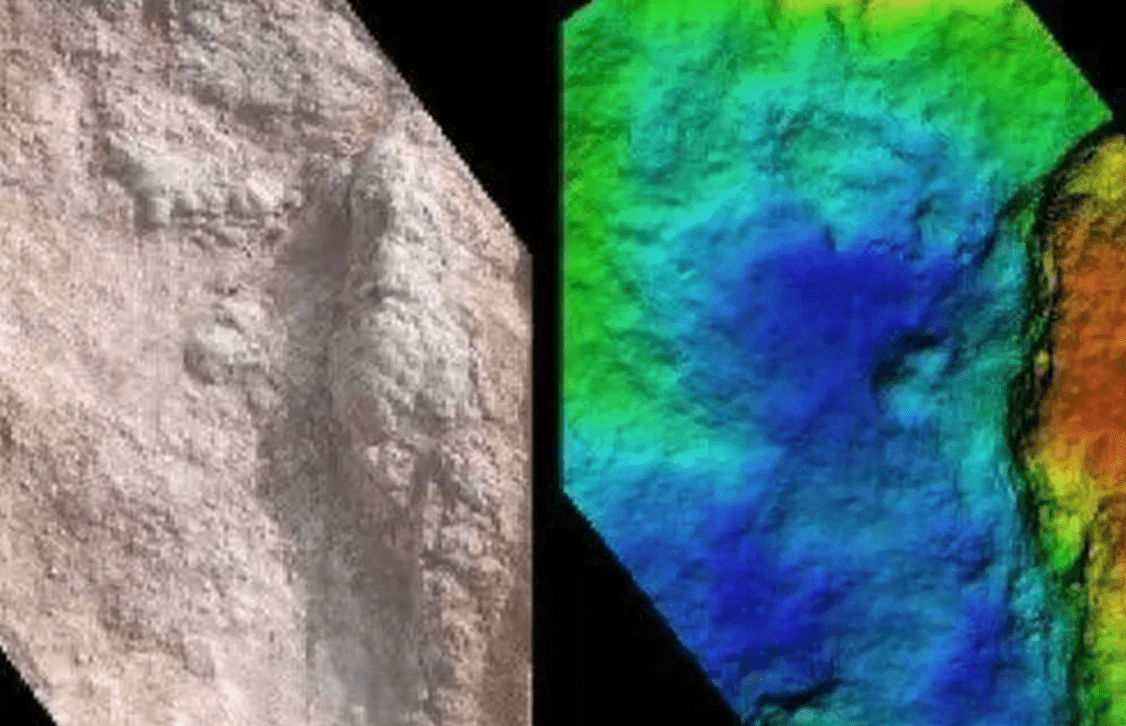
Northern Arabia’s windswept desert has revealed a moment frozen in deep time: seven remarkably preserved human footprints stamped into the floor of an ancient lake that vanished more than 100,000 years ago. According to a new study, these prints represent the earliest known evidence of human presence anywhere in the Middle East — a fleeting encounter with a lakeshore long before the Ice Age reshaped the region.
A short visit to a water source that no longer exists
The site, known locally as Alathar, lies in the Nefud Desert of northern Saudi Arabia. Today it is an arid expanse of dunes and gravel, but during a wetter phase of the last interglacial period, it held a shallow freshwater lake. As the climate fluctuated, migrating animals returned repeatedly to drink — and, on at least one occasion, so did early humans.
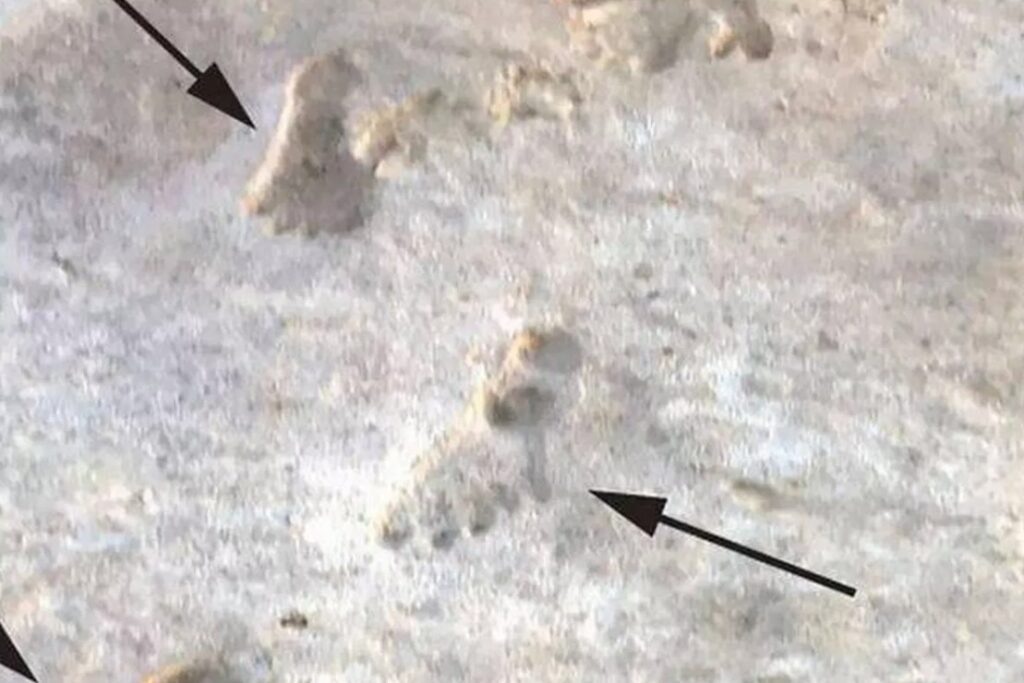
Archaeologists identified seven hominin footprints, preserved with exceptional clarity in the hardened lakebed. Their sharp edges and anatomical detail indicate that they were created during a brief moment when the sediment was still soft, then rapidly sealed by drying conditions.
The clarity of the impressions is surprising. Modern experimental studies show that footprints in wet mud begin losing detail within days. Yet here, after more than 115,000 years, the prints remain readable, marking where ancient humans paused at the water’s edge.
Why these prints almost certainly belong to Homo sapiens
Although multiple hominin species lived across Eurasia at the time, the research team argues that these tracks were made by Homo sapiens, not Neanderthals.
Their reasoning is twofold. First, fossil and archaeological datasets show that humans — not Neanderthals — were present in Arabia between 130,000 and 80,000 years ago. Second, the footprint dimensions align far more closely with early H. sapiens anatomy.
This places the Alathar prints within a crucial chapter of human migration: one of the early expansions of modern humans out of Africa, moving through the Levant and into Arabia along freshwater corridors that no longer exist.
No sign of hunting — only a need for water
Intriguingly, researchers found no tool marks, cut bones, or evidence of butchery at the site. While the lakebed is full of ancient animal tracks, including those of large mammals, there is no indication that humans hunted here.
This absence tells its own story. The stop at Alathar was probably brief — the kind of visit made by small groups searching for drinking water in a dry landscape. In the words of the study, use of the lakeshore appears to have been “transient,” tied directly to the need for potable water.
A moment before the Ice Age changed everything
The footprints date to roughly 115,000 years ago, falling just before harsher climatic conditions swept across the region. The researchers speculate that these people may have belonged to one of the last human groups passing through northern Arabia before environmental shifts made future migrations impossible.
In that sense, the Alathar site preserves a vanishing world: a humid, life-supporting landscape later erased by the advance of Ice Age aridity. All that remains is a set of tracks — a literal imprint of the last humans to walk this route before the climate closed it off for millennia.
Cover Image: The discovery site also contained numerous animal trackways preserved in the same ancient lakebed sediments (Stewart et al., Science Advances).