
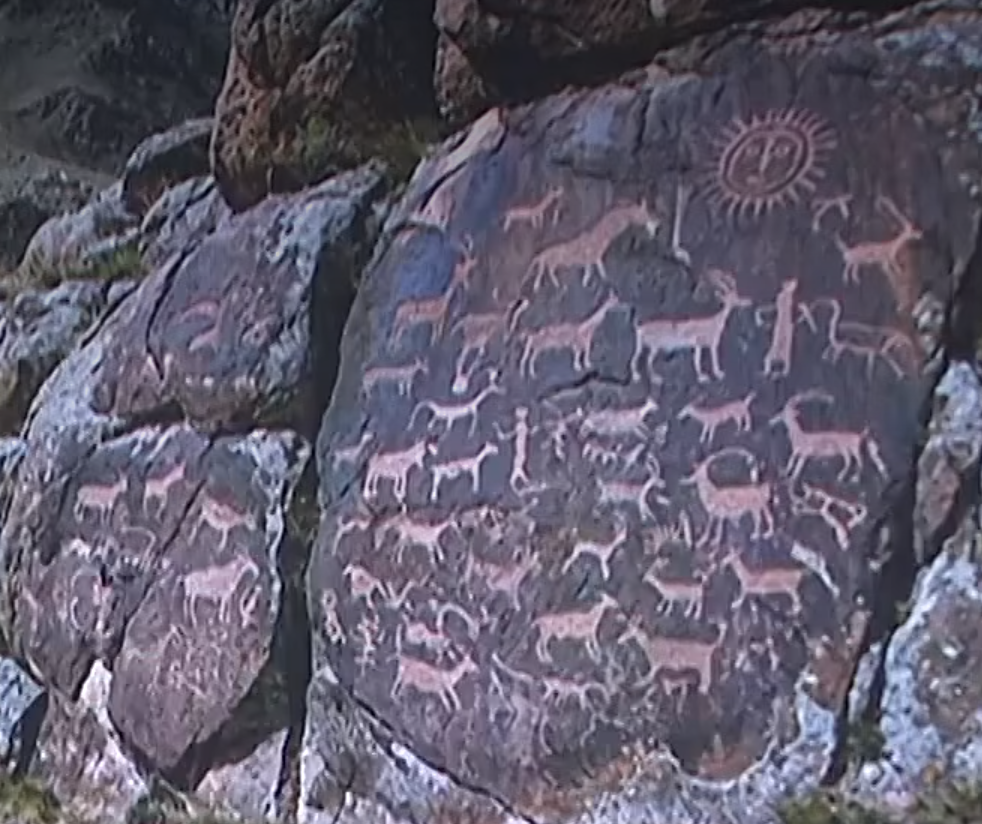
More than a thousand years ago, someone named Aba carved his name into a rock in southern Kazakhstan. Archaeologists have now found that short Old Turkic sentence among more than 1,200 petroglyphs in Burkhansai Gorge.
The discovery was made in the Jambyl Region, in Zhualy District, where researchers began systematic work in 2024. The site has revealed a dense rock art landscape with images dating from the late 3rd millennium BC to the medieval period and later historical phases.
The most striking find is a rare Old Turkic runic inscription. It consists of five runiform signs and appears to read “Er atym Aba,” translated as “My name is Aba.” For a site already marked by thousands of years of rock art, the inscription adds a human voice that is unusually direct.
A Gorge Marked Across Thousands of Years
Burkhansai Gorge is not a single-period archaeological site. Researchers have identified five groups of petroglyphs extending along the course of a stream. The carvings include wild goats, one-humped camels, hunting scenes, and other images linked to animals, movement, and life in the mountain landscape.
The earliest images are thought to date back around 4,000 years. Their themes suggest a world shaped by herding, hunting, and repeated use of natural routes through the region. In Central Asian rock art, such animal scenes often reflect both daily life and symbolic meaning.
The area also contains three burial grounds known as Burkhansai 1, Burkhansai 2, and Burkhansai 3. These are associated with the Early Iron Age and the medieval period. That makes the gorge more than a gallery of images. It appears to have been part of a wider cultural landscape connected with burial, memory, travel, and seasonal activity.
A Turkic Name Carved Into the Rock
The Old Turkic inscription is the discovery that gives Burkhansai wider significance beyond rock art studies. According to researchers, the short text was written in the Talas script, a regional form of Old Turkic runiform writing.
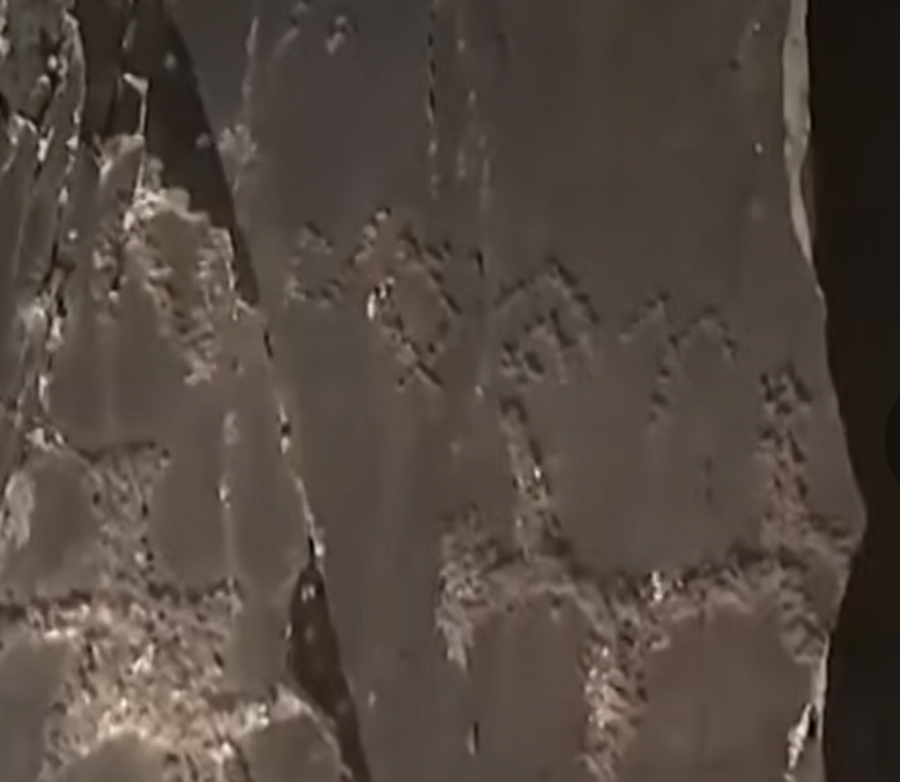
Boris Zheleznyakov, a leading researcher at the A. Kh. Margulan Institute of Archaeology, described the inscription as unique. He suggested that the person who carved it may have been regarded as the owner or guardian of the area.
The inscription was sent to Vladimir Tishin, a recognized specialist in Old Turkic writing, who interpreted the text. Its message is brief, but powerful: “My name is Aba.”
That simplicity is what makes it memorable. This is not a royal proclamation or a formal monument. It is a personal name cut into stone, left in a landscape that had already carried meaning for thousands of years.
A Rare Trace of the Talas Script
Old Turkic runic writing is one of the key writing systems of early Turkic history. It is best known from the Orkhon inscriptions in Mongolia, but related inscriptions are also known from the Yenisei, Altai, Talas, and other parts of Central Asia.
The Burkhansai inscription is important because it places a short Turkic text inside a much older rock art complex. Long before Aba’s name was carved, the gorge had already been marked by Bronze Age and Iron Age images. The inscription shows that the site continued to matter in the medieval Turkic world.
For anyone following early Turkic heritage, the find is unusually tangible. It preserves not an abstract cultural label, but a personal identity. A man named Aba stood there, chose the rock, and left his name behind.
Jambyl Region and the Talas World
The location strengthens the importance of the find. Jambyl Region lies in southern Kazakhstan, close to the historical Talas Valley and the old city of Taraz. This part of Central Asia was long connected with steppe routes, mountain corridors, pastoral communities, Turkic polities, and Silk Road networks.
Such geography helps explain why Burkhansai contains traces from different periods. A gorge with water, rock surfaces, and natural passage routes could attract people again and again. Some carved animals. Some buried their dead nearby. At least one person carved his name.
Researchers Plan Further Study and Protection
The work at Burkhansai is still at an early stage. Archaeologists are now studying the petroglyphs in detail, classifying them by period, and examining the burial grounds. They also plan to search for associated settlements that could explain how ancient communities used the wider landscape.
After the full study is completed, researchers plan to publish a monograph on the petroglyphs and the Old Turkic inscription. They also intend to propose that the finds be placed under state protection.
Source: 24 kz