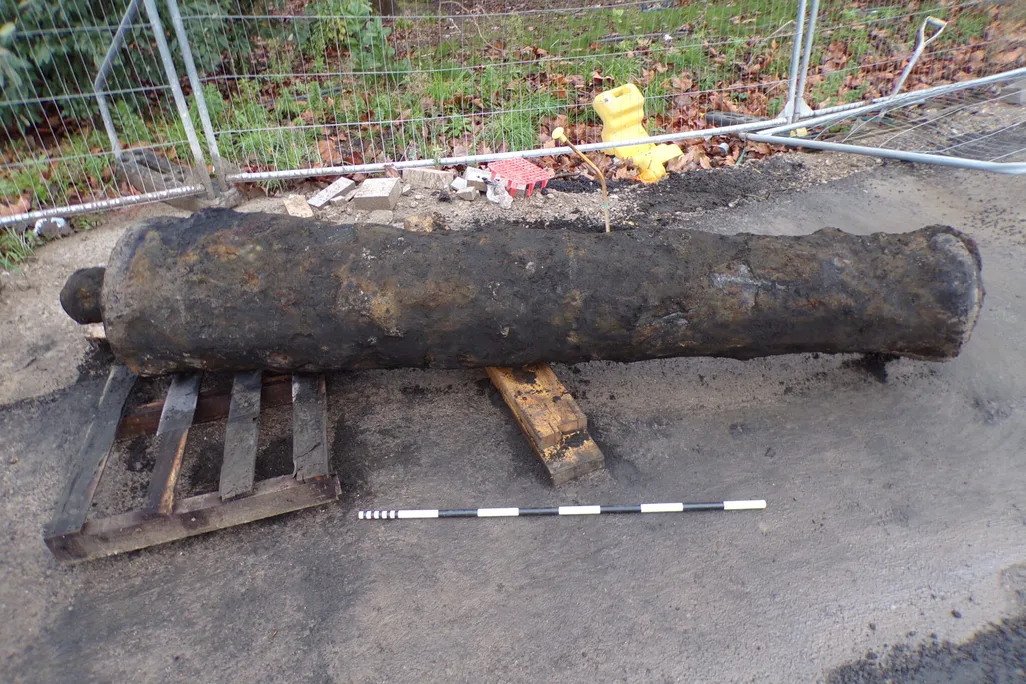
A one-ton cannon found beneath an English park has revealed a forgotten layer of Hull’s waterfront history, hidden below the lawns and pathways of Queen’s Gardens.
The discovery was made during restoration work in the heart of the northern English city, where construction crews were excavating for a new water management tank. What began as another stage in a modern landscaping project soon turned into something far stranger. Beneath the surface, workers encountered a massive cast-iron cannon, heavily encrusted with soil and corrosion, lying in ground that once formed part of one of Hull’s most important dockside landscapes.
The cannon measures about 2.6 meters in length and weighs more than a tonne. Early investigations suggest it may date to the 17th or 18th century, a period when Hull was shaped by sea trade, harbor defense and the movement of ships through the Humber estuary.
But the story is more complex than a cannon simply lying undisturbed for 300 years. Experts believe the weapon was probably buried much later, after it had been taken out of military use and repurposed for work along the docks.
A routine excavation reaches the old waterfront
The cannon was uncovered at Queen’s Gardens, a public green space now undergoing major transformation works. Local contractors C R Reynolds were digging for an attenuation tank, used to manage stormwater, when they struck the large iron object embedded below ground level.
At first, the find could have been mistaken for heavy industrial debris. Urban ground in former dock districts often contains rubble, metalwork and traces of past redevelopment. Yet the shape of the object soon made clear that this was not ordinary construction waste.
Archaeologists from Humber Field Archaeology examined the cannon after its discovery. Their initial assessment placed it in the late 17th or 18th century, although further study is needed to determine its exact date, origin and manufacturer.
The find adds another physical trace to Hull’s long relationship with the sea. In a city whose identity was built around ships, cargo, fishing and defense, even a buried cannon can open a route back into a vanished urban landscape.
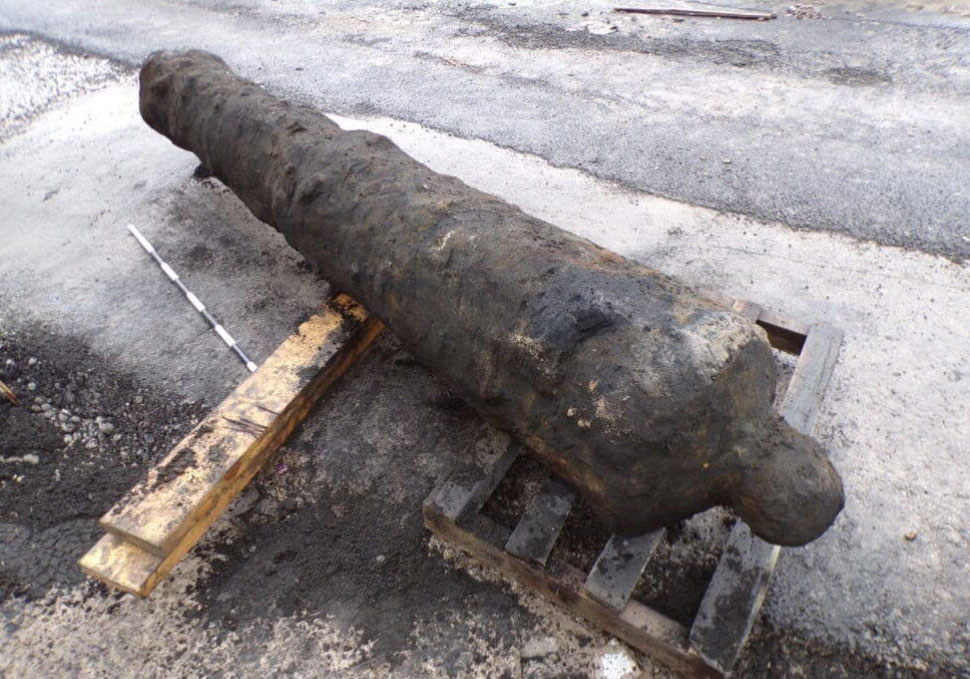
The cannon’s second life at the dock
One of the most revealing details is that the cannon appears to have been deliberately decommissioned. Its muzzle had been capped, suggesting that it was no longer intended to fire.
That small technical clue changes the story. This was not simply a weapon dropped and forgotten. It may have had a second life after its military purpose ended.
Archaeologists believe the cannon was likely reused as a mooring post, a practical dockside fixture used to secure vessels. This kind of reuse was common in the late 19th and early 20th centuries. Old cannons were heavy, durable and already associated with maritime environments, making them useful objects along working waterfronts.
The Hull cannon may therefore have moved through several identities. It may have started as a weapon, perhaps mounted on a ship or used in coastal defense. Later, with its muzzle sealed, it may have stood at the edge of a dock while ropes from vessels were tied around it. Only after the former dock was filled in during the 1930s was it likely pushed into the ground and buried beneath what would become Queen’s Gardens.
That afterlife makes the object more interesting, not less. It shows how military technology could be absorbed into the ordinary infrastructure of a port city.
Queen’s Gardens was once Queen’s Dock
Today, Queen’s Gardens is a landscaped civic space. Its open lawns and paths give little immediate sense of the industrial and maritime activity once concentrated there. Before it became a park, however, the site was Queen’s Dock, a major part of Hull’s historic waterfront.
That hidden dockland past gives the discovery its strongest appeal. The cannon was not found in a battlefield, fortress or museum store. It emerged from beneath a modern public park, in a place where the city had softened and covered its older working identity.
Hull’s position on the Humber made it one of England’s significant port cities. Ships, goods, sailors and defensive concerns passed through its docks for centuries. A cast-iron cannon in this setting is not an isolated curiosity. It belongs to a larger story of maritime labor, military readiness and the practical reuse of obsolete objects.
Queen’s Gardens is therefore not just the setting of the discovery. It is part of the evidence. The park itself marks the transformation of a working dock into a modern urban landscape.
A heavy object with a layered history
Historic cannons have been found in Hull before, but they remain rare enough to attract serious attention. This latest discovery is especially valuable because it links several phases of the city’s past in one object.
It speaks first to the age of artillery and harbor defense, when cannons protected ships, ports and trade routes. It also speaks to the later life of the docks, when old weapons could become practical tools. Finally, it reflects the 20th-century reshaping of the city, when old dock areas were filled, leveled and turned into civic space.
That layered history is what makes the find more than a dramatic construction-site surprise. The cannon is a reminder that cities do not erase their past all at once. They bury it in stages. A weapon becomes a mooring post. A dock becomes a garden. A garden becomes a restoration site. Then, suddenly, an iron object breaks through the surface and forces the older map back into view.
Further analysis may reveal more about where the cannon was made and how it was used before it reached Queen’s Dock. For now, its importance is already clear. Beneath Queen’s Gardens, Hull has recovered not only a large piece of cast iron, but a fragment of its lost dockside world.
Cover Image Credit: Hull City Council