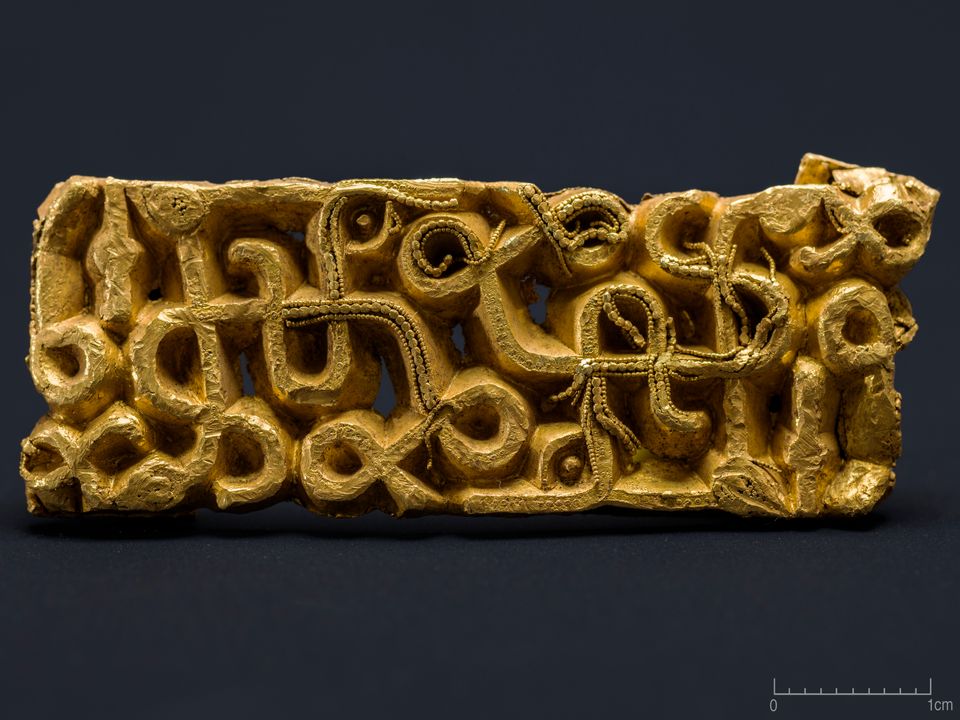
A rare gold sword fitting found beneath the roots of a storm-felled tree in Norway has brought one of the country’s most remarkable Migration Period discoveries back into the light.
The discovery was made in Austrått, a district of Sandnes in Rogaland county, where a local walker noticed exposed soil beneath an old tree torn from the ground by a storm. What first appeared to be a small metal object soon turned out to be a richly decorated gold fitting from a sword scabbard, dating to the first half of the 6th century.
Archaeologists at the Archaeological Museum, University of Stavanger, say the object once belonged to an elite weapon. Small in size but heavy with meaning, it offers a rare glimpse into the warrior aristocracy that shaped western Norway around 1,500 years ago.
A rare discovery from the Migration Period
The gold fitting measures about six centimeters wide, a couple of centimeters high and only a few millimeters thick. It weighs 33 grams. In purely physical terms, it is modest. In archaeological terms, it is extraordinary.
Only 17 comparable pieces are known from Northern Europe, and this is the first object of its kind ever found in Rogaland. That makes the discovery important not only for Sandnes, but for the wider study of elite power in Migration Period Scandinavia.
According to Håkon Reiersen, archaeologist and associate professor at the Archaeological Museum, University of Stavanger, the chances of finding such an object are extremely small. Its material, craftsmanship and findspot all point toward a high-status environment.
The fitting likely came from the scabbard of a prestigious sword, the kind of weapon carried by a man at the top of local society. In the 500s, such swords were not ordinary military equipment. They marked rank, loyalty and command.
A weapon that signaled authority
The Austrått fitting appears to have belonged to a leader connected with the Hove area, a landscape already known for remarkable finds from the same broad period. A man carrying such a sword would probably have commanded followers and used ornate weaponry to express his position within a competitive political world.
Migration Period Norway was shaped by local rulers, warrior groups and shifting alliances. Power was displayed through gold, weapons, feasting, ritual and control over important landscapes. A sword with a gold-mounted scabbard would have been visible evidence of authority.
One feature makes the object especially interesting. It is heavily worn.
Many gold sword fittings of this type survive with little sign of use, suggesting that some were made for display, ceremony or deposition rather than repeated carrying. The Austrått fitting tells a different story. Its worn surface suggests that the object may have been used over time, perhaps attached to a sword that accompanied its owner in public life.
That wear brings the find closer to the person who once carried it. This was not simply gold placed in the ground. It may have been part of a weapon that moved through gatherings, negotiations and displays of rank.
Animal art in gold
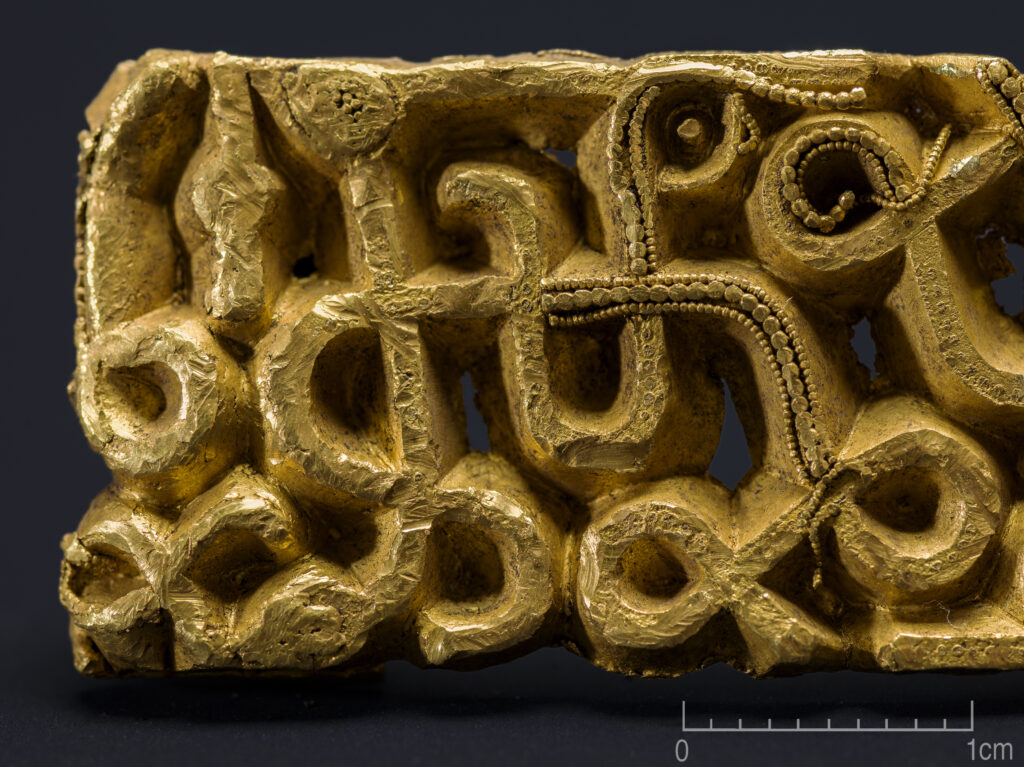
Although damaged by time, the surface still preserves traces of refined craftsmanship. Fine filigree work once followed the lines of the decoration, with delicate beaded gold wires creating a shimmering effect across the fitting.
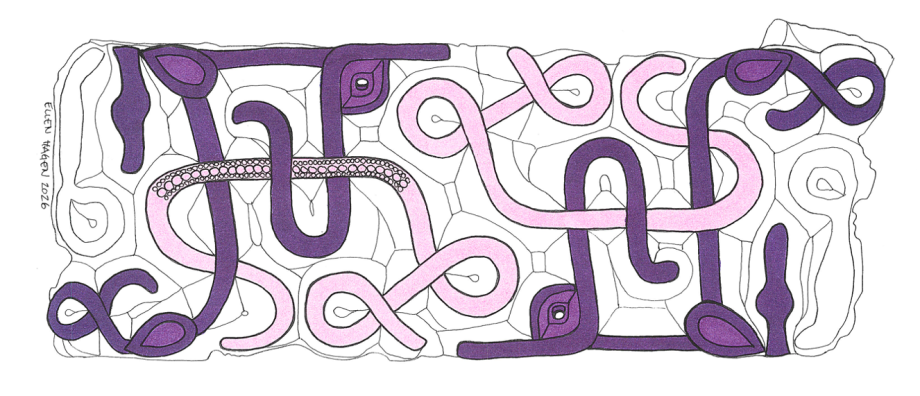
The main field is filled with animal ornamentation, one of the defining visual languages of Migration Period Scandinavia. These designs can look abstract at first, but close study reveals carefully arranged creatures. Archaeologists often identify the animal by finding the eye, then following the head, body, limbs and interlaced bands.
On the Austrått fitting, two profile animals appear to face one another. Their narrow bodies extend across the object, with thighs, forelegs and hind legs worked into the composition. The style belongs to a later phase of Scandinavian animal art and supports a date in the first half of the 6th century.
Such decoration was not merely decorative. Animal forms and hybrid figures formed part of an elite symbolic language. On a sword, they gave the weapon visual force and cultural meaning.
A deliberate offering in the landscape
The place where the fitting was found may be just as important as the object itself. Archaeologists believe it was probably placed in a crack in the bedrock, rather than lost by chance. That points toward a deliberate deposit, possibly a ritual offering.
The interpretation fits the wider pattern around Riaren and Hove. In the 19th century, silver neck rings decorated with gold were found in nearby marshland. In 1907, an unusually large Roman bronze cauldron was discovered at the neighboring farm of Høyland. The vessel had been made near the Rhine around AD 300.
Together, these finds suggest that the area was not an ordinary settlement zone. It was a place where wealth, ritual and local authority overlapped. Valuable objects may have been placed in the landscape during periods of crisis, poor harvests or political uncertainty.
To sacrifice gold was not a simple act of devotion. It was also a statement of status. Only powerful families could afford to remove such objects from circulation and offer them to the gods.
New evidence for a power center at Hove
Museum director and archaeology professor Kristin Armstrong-Oma has described the discovery as new evidence for a Migration Period power center at Hove. The object strengthens the idea that this part of Rogaland held a prominent role in western Norway during the 6th century.
The fitting also connects Austrått with a rare group of Scandinavian gold objects known from elite deposits and hoards. Comparable material includes finds from the Vindelev hoard in Jutland, Denmark, discovered in 2020, as well as the Bergsaker find from Lyngdal in Agder. It also invites comparison with prestigious sword equipment such as the famous Snartemo sword.
Yet the Austrått fitting may not fit neatly into one category. It resembles gold fittings known from ritual deposits, but its size and wear also match mounts used on elite swords. If it once belonged to a weapon of Snartemo-level quality, the lost sword would have ranked among the most prestigious objects of its age.
The Archaeological Museum plans to make the object available to the public as soon as possible. When displayed, it will represent more than a beautiful piece of gold. It will stand as evidence of a society where weapons carried political meaning, ritual shaped authority and a leader’s status could be read from the object at his side.
A fallen tree exposed it by chance. But the gold fitting had been waiting in the Norwegian soil for 1,500 years, preserving a fragment of a world ruled by warrior elites, sacred landscapes and symbols of command.
Cover Image Credit: Annette Græsli Øvrelid, Arkeologisk museum, Universitetet i Stavanger