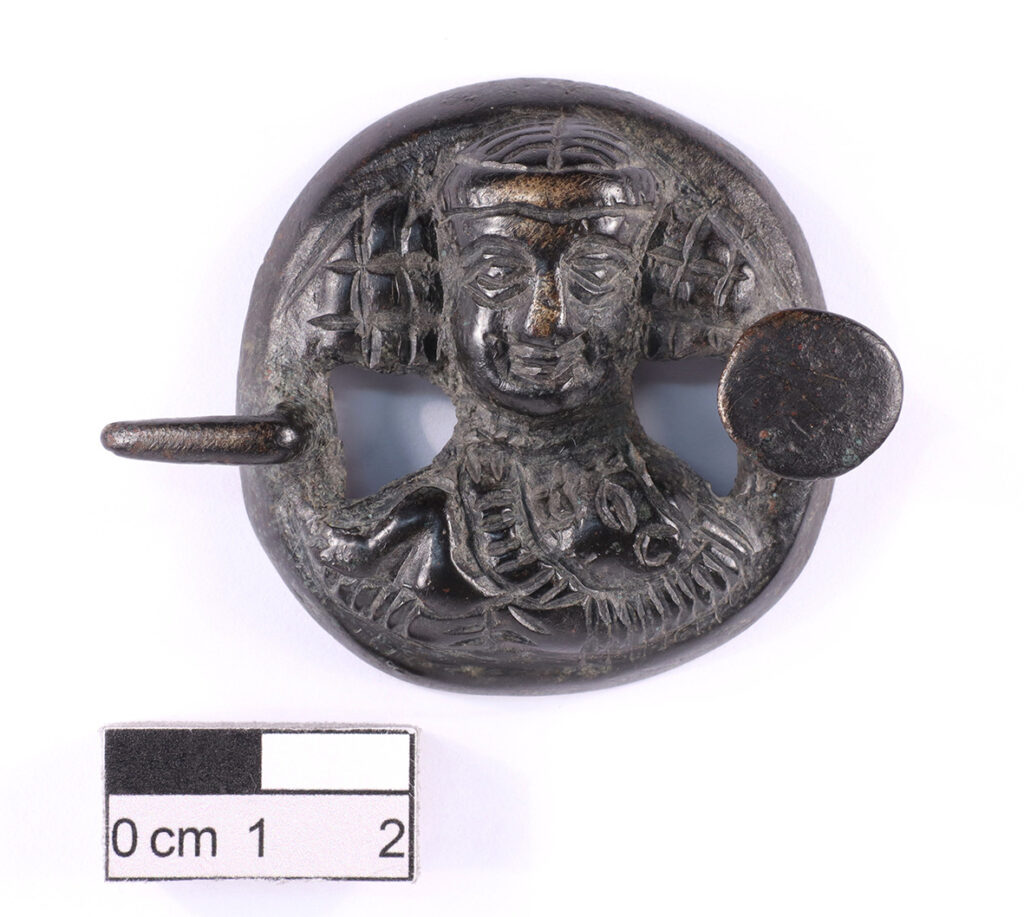
A golden shimmer on a hairpin. A thin metal strip on a helmet. A small rivet hidden inside an old museum object. At first glance, these details may seem minor. But new scientific research suggests they preserve a neglected chapter in the technological history of the Sasanian Empire.
A study of copper-alloy finds from Merv and Nineveh indicates that Sasanian brass technology was more developed than previously recognized. Metalworkers in the empire were not simply continuing older bronze traditions. They appear to have been selecting, shaping and testing brass for color, prestige, structural use and possibly military equipment.
The finding is subtle, but important. It does not come from a newly discovered palace or a spectacular gold treasure. It comes from the careful re-examination of objects that had long been grouped under broad labels such as “bronze” or “copper alloy.”
That difference matters. Brass is an alloy of copper and zinc. Unlike bronze, which is usually based on copper and tin, brass can produce a brighter, gold-like appearance. It also behaves differently under the hammer. For ancient craftspeople, those qualities could turn it into more than a decorative substitute. It could become a practical material with its own technological value.
Scientific analysis changed an old classification
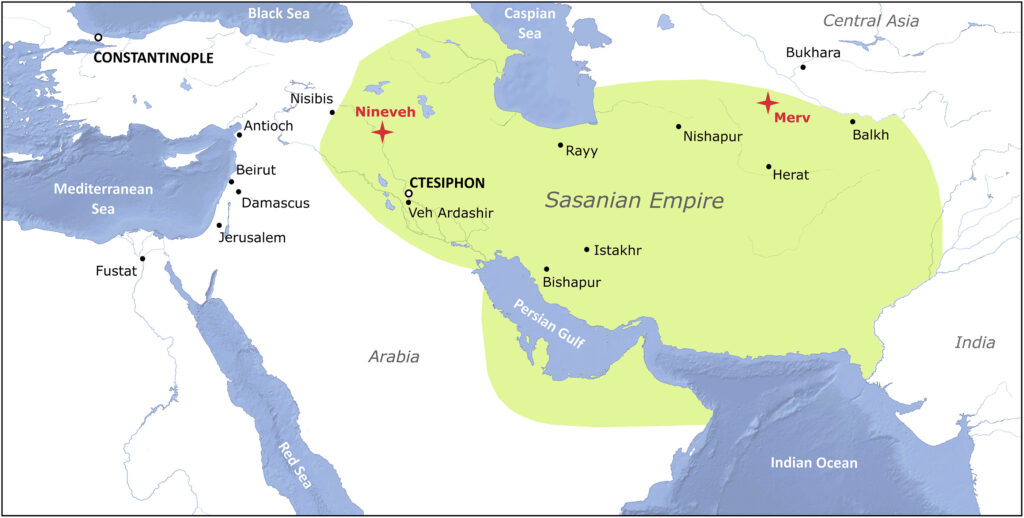
The new study, published in Archaeological Research in Asia, examined copper-alloy objects from two important frontier zones of the Sasanian world: Merv, in present-day Turkmenistan, and Nineveh, in northern Iraq.
The research team used X-ray fluorescence analysis, scanning electron microscopy and digital radiography to identify the composition and construction of selected objects. These methods revealed evidence for brass in both cast and hammered forms.
That distinction is central to the discovery. Cast brass may point to visual appeal, especially the desire for a warmer, more golden surface. Hammered sheet brass suggests something more technical. It shows that Sasanian metalworkers understood how the alloy could be cut, shaped, pierced and fitted into complex objects.
In other words, this was not only about making objects look valuable. It was also about knowing how a material performed.
Merv points to brass as a material of prestige and practice
Merv was one of the great cities of northeastern Iran and Central Asia. Positioned near routes linking Khurasan, northern Afghanistan, the Amu Darya and the wider Silk Road world, it was a place where goods, crafts and technologies could move across cultural and political frontiers.
The researchers examined a small group of copper-alloy fragments from Sasanian contexts at Merv. Several showed likely evidence of brass. The finds included personal ornaments and fittings, among them a hairpin inlaid with lapis lazuli and colored glass, a bangle fragment, beads, fittings and a pinhead.
Some objects came from fourth- and fifth-century contexts. Others belonged to the sixth and seventh centuries. Their zinc content varied widely, from low levels to much higher concentrations. The variation is not a minor technical detail. Higher zinc levels may indicate the use of primary cementation brass, while lower levels may reflect recycling or mixing with other copper alloys.
That pattern suggests a craft environment in which brass was known, but perhaps not always available in a stable or standardized form. Sasanian metalworkers may have worked with inconsistent supplies, reused older metal and adapted materials according to need.
The earliest examples from Merv were mostly cast. This points to the visual power of the alloy. Brass could resemble gold more closely than bronze, making it useful for objects that carried prestige without belonging to the highest level of elite luxury.
A brass hairpin or bangle did not need to compete with royal gold. It could still create a sense of refinement, status and visual warmth. In that middle space between luxury and everyday use, brass may have found one of its earliest Sasanian roles.
Nineveh helmets reveal the military dimension
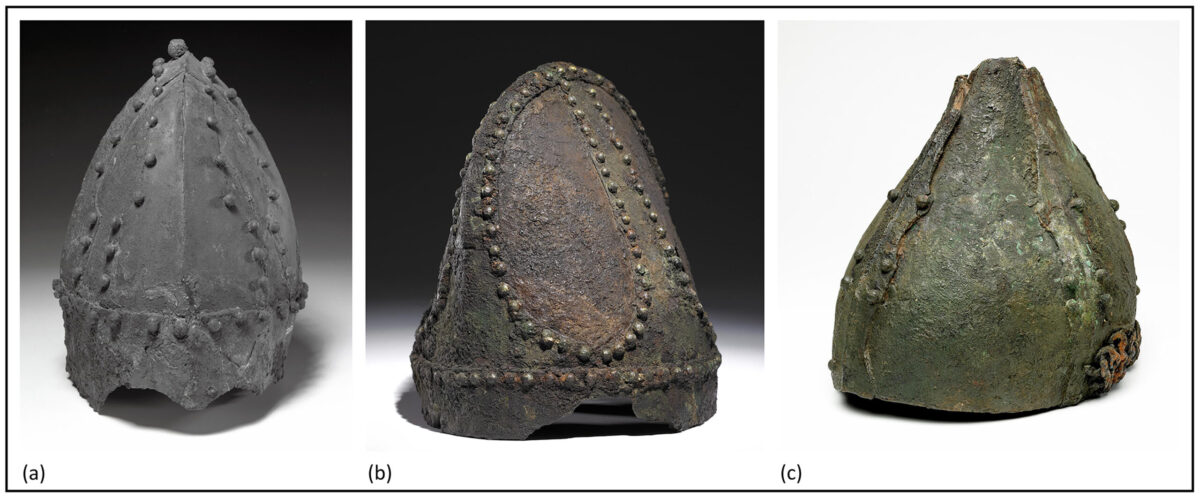
The strongest evidence comes from a very different type of object: Late Sasanian helmets from Nineveh, now held in the British Museum.
These helmets, broadly dated to the sixth and seventh centuries CE, belong to a rare group of segmented or banded military headgear from Late Antiquity. They were not simple pieces of iron protection. Scientific imaging shows that they were built from multiple plates, strips and rivets, combining different metals in a carefully engineered structure.
The new analysis suggests that brass or low-tin brass-like alloys were used in support strips, rivets and, in some cases, sheet coverings placed over iron components.
This is where the story becomes more than decorative. Iron provided protection. Brass could add brightness, surface finish and workable structural elements. The result was armor that may have combined function with controlled visual impact.
In the Sasanian world, military appearance mattered. Royal rock reliefs, silver plates and seals repeatedly present power through dress, weapons and carefully staged imagery. A helmet with bright metal components would not have been only a technical object. It could also speak to rank, identity and imperial presence.
The study does not prove that brass was standard across the Sasanian army. The evidence is still limited. But it raises an important possibility: brass may have played a wider role in military equipment than previously understood.
A bridge toward early Islamic metalwork
The discovery also helps explain a larger historical transition.
By the early Islamic period, brass became one of the major copper alloys across Western Asia. It appeared in vessels, fittings and decorated objects, eventually becoming central to the region’s metalworking traditions. Yet the earlier stages of that development have remained difficult to trace.
The Sasanian evidence from Merv and Nineveh may represent part of that missing phase. It suggests that before brass became more common in the Islamic world, Sasanian craftspeople were already testing its visual and mechanical possibilities.
This does not mean bronze disappeared. Older copper-alloy traditions clearly continued. But brass was gaining ground where its properties made sense: in ornaments, sheet fittings, rivets and composite objects that required both appearance and performance.
At Merv, later early Islamic material shows a stronger presence of high-zinc brass. That may indicate more regular supply, improved production or changing workshop habits by the ninth century. The Sasanian period, then, may have been a crucial experimental stage rather than a technological dead end.
Old museum objects still have new stories to tell
One of the most revealing parts of the research is not only what was found, but how it was found.
Many ancient metal objects were catalogued long ago, often with broad terms such as bronze or copper alloy. Those labels are not wrong in a general sense, but they can hide important technological differences. When modern scientific tools separate bronze from brass, the historical picture changes.
A small ornament becomes evidence of taste and social aspiration. A helmet rivet becomes evidence of technical choice. A sheet covering becomes part of a wider story about materials, workshops and military production.
The Sasanian Empire is often remembered for silver plates, monumental kingship, elite weapons and its long rivalry with Rome and Byzantium. This study adds something quieter to that image. It shows craftspeople working with a golden-looking alloy, learning its behavior and using it in ways that connected beauty with function.
The result is not a dramatic rewriting of Sasanian history. It is something more precise. Scientific testing has revealed that inside small fragments and old helmets, Sasanian metalworkers were already exploring a material that would later help define the metal culture of the Islamic world.
Davis, M. E., Mongiatti, A., Simpson, S. J., & Martinón-Torres, M. (2026). Brass in the Sasanian frontiers: Assessing metallurgical innovation through archaeological finds at Merv and Nineveh. Archaeological Research in Asia, 46, 100688. https://doi.org/10.1016/j.ara.2026.100688
Cover Image Credit: Davis et al., 2026