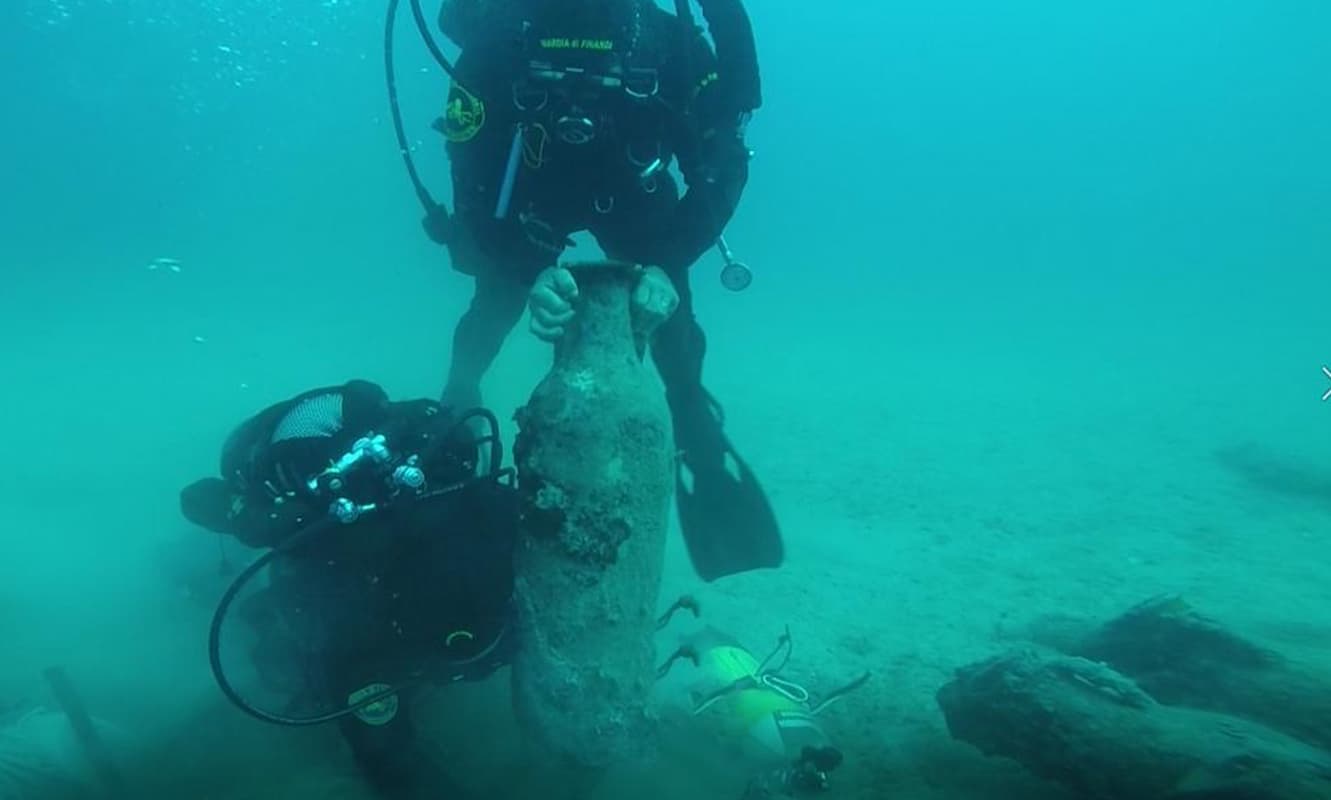
Beneath the clear, unforgiving waters of the Ionian Sea, a silent witness to Rome’s maritime economy has been waiting for centuries. A large Roman merchant ship, discovered a few miles off the coast of Gallipoli in southern Italy, is now being revealed to the public after months of deliberate secrecy. The wreckfound in June 2025, remained classified until dedicated funding was secured—an unusual but calculated decision aimed at shielding the site from looting and disturbance.
What has come to light is not a fragmentary wreck, but an exceptionally preserved cargo vessel, one of the clearest underwater snapshots yet of long-distance trade in the Roman imperial Mediterranean.
Found by chance, protected by design
The discovery did not come from a planned archaeological expedition. Instead, it emerged during a routine maritime patrol by Italy’s Guardia di Finanza. Advanced onboard detection systems registered an anomaly on the seabed—an irregular signal that, upon closer inspection, proved to be a shipwreck of remarkable scale and integrity.
From the outset, authorities opted for restraint. Rather than announcing the find, institutions coordinated quietly, prioritizing protection over publicity. Specialized divers confirmed the nature of the wreck, while naval units maintained constant but non-invasive surveillance, ensuring the site remained untouched in its original context.
A ship built for commerce—and garum
Preliminary assessments indicate that the vessel was a large Roman cargo ship, designed to carry substantial, standardized loads. Its hold was filled almost entirely with amphorae used for transporting garum—the fermented fish sauce that was both a culinary staple and a luxury commodity across the Roman world.
Far from a trivial detail, this homogeneous cargo tells a focused story. Garum production and distribution formed a complex economic network linking coastal workshops, ports, and urban markets. A ship devoted almost exclusively to this product reflects industrial-scale trade, not casual exchange.
From silence to science: €780,000 for research
The period of secrecy has now ended with the approval of €780,000 in public funding by Italy’s High Council for Cultural Heritage. The allocation clears the way for a full scientific investigation and long-term safeguarding of the wreck and its surrounding context.
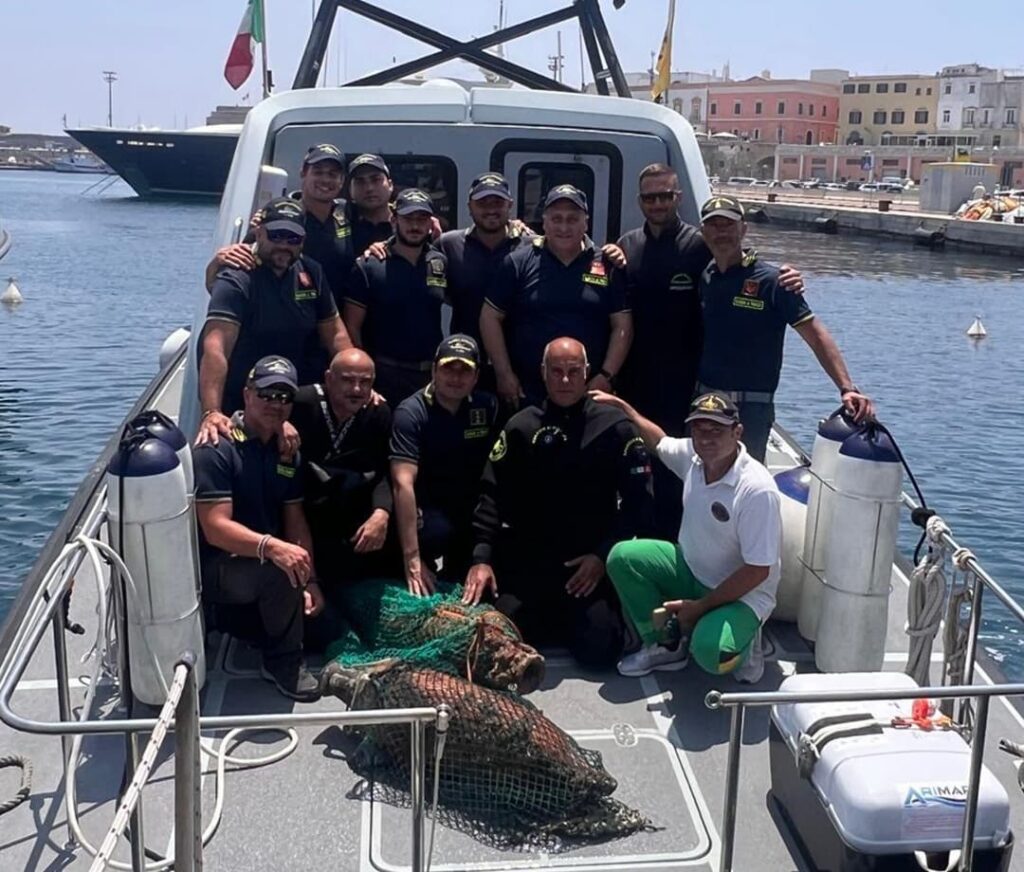
The project operates within a formal cooperation framework between Italy’s Ministry of Culture and the Guardia di Finanza—a model already tested successfully in previous underwater recoveries. It combines enforcement, surveillance, and archaeological research from the very first stage, rather than treating protection as an afterthought.
Document first, disturb later—if at all
The upcoming work will follow the strictest international standards, in line with the principles of the UNESCO Convention on the Protection of the Underwater Cultural Heritage. The initial phase will be entirely non-destructive.
Using high-resolution photogrammetry and 3D laser scanning, researchers will create a precise digital model of the shipwreck—its hull, cargo layout, and spatial relationships frozen in virtual form. This digital twin will guide every subsequent decision, from stratigraphic interpretation to conservation strategy.
Only after exhaustive documentation will specialists assess whether selective recovery of materials is justified. Any objects raised from the seabed will require careful stabilization and restoration, having spent centuries in a salt-saturated environment.
An underwater archive of Roman life
The Gallipoli shipwreck is not a treasure in the conventional sense. It is an archive sealed by the sea. Its amphorae record production systems, trade routes, and consumption patterns. Its hull preserves knowledge about Roman shipbuilding, cargo capacity, and life aboard vessels that sustained an empire.
As research begins, this silent cargo ship has the potential to refine—perhaps even rewrite—what we know about Roman maritime commerce. Not through spectacle, but through patient documentation, institutional cooperation, and a commitment to letting the past speak on its own terms from the depths of the Ionian Sea.
Cover Image Credit: Italian Ministry of Culture Via Facebook