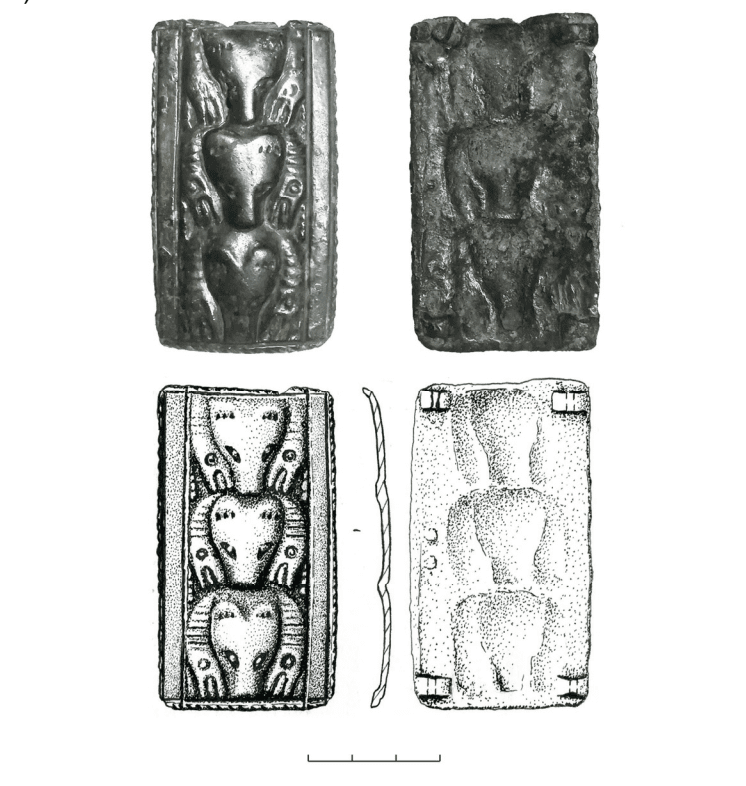
For more than thirteen centuries, it lay unnoticed in the soil along a quiet Siberian river. When it resurfaced, the object was small—a bronze plaque no wider than a hand—but its implications reach far beyond its size.
Unearthed at the Chumysh-Perekat burial ground in southern Siberia’s Altai region, the plaque depicts three bears arranged in a rigid ritual pose, their forelegs folded beneath them. Dated to the 7th or early 8th century AD, it is now considered one of the southernmost known examples of a bear-cult tradition usually associated with the taiga forests of northern Eurasia.
What makes the find remarkable is not the motif itself, but where it appears. Objects of this type are well documented in northern forest zones. They are not expected in the forest-steppe belt bordering the Turkic world.
A cemetery between taiga and steppe
Chumysh-Perekat lies in a landscape long overlooked by archaeologists. Neither fully taiga nor fully steppe, the region fell between research priorities for decades.
That changed only after erosion along the Chumysh River exposed human remains, leading to excavations between 2014 and 2019. Researchers uncovered a compact cemetery preserving burials from the Neolithic through the early medieval period. Among them were seventeen early medieval graves that had largely escaped looting—an exceptional circumstance in the forest-steppe Altai.
These intact burials offer a rare glimpse into life on the northern margins of early Turkic political influence.
The woman and the bears
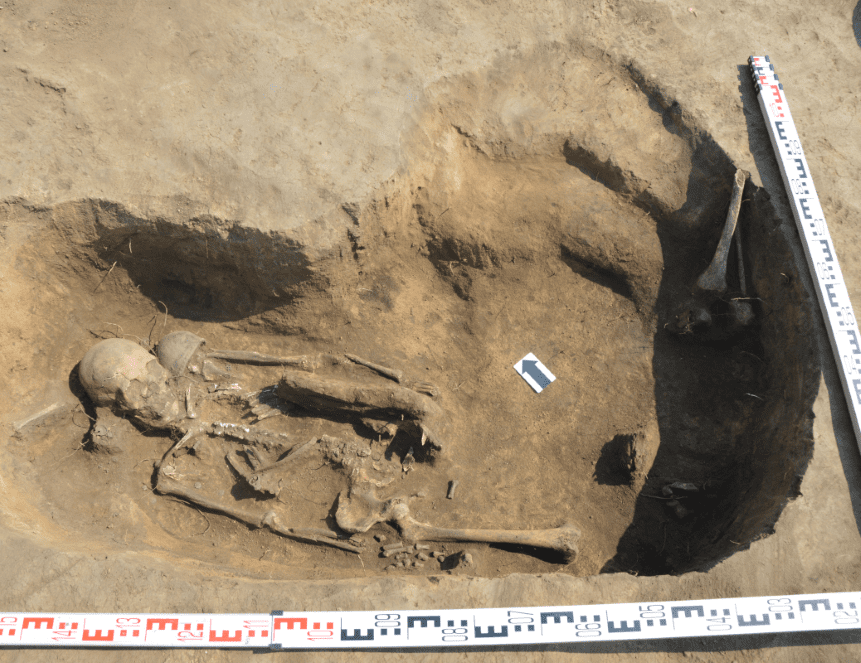
The bronze plaque was found in the grave of a woman aged between 35 and 50. Although the burial had been disturbed in antiquity, most grave goods remained in place, suggesting a ritual intrusion rather than simple robbery.
The plaque shows three bear heads positioned vertically, their forelegs folded beneath the body in what archaeologists describe as a “sacrificial pose.” Similar plaques are known from western Siberia’s taiga regions, where bears held central roles in ritual belief and cosmology.
What sets this example apart is its context.
Not an import, but an identity
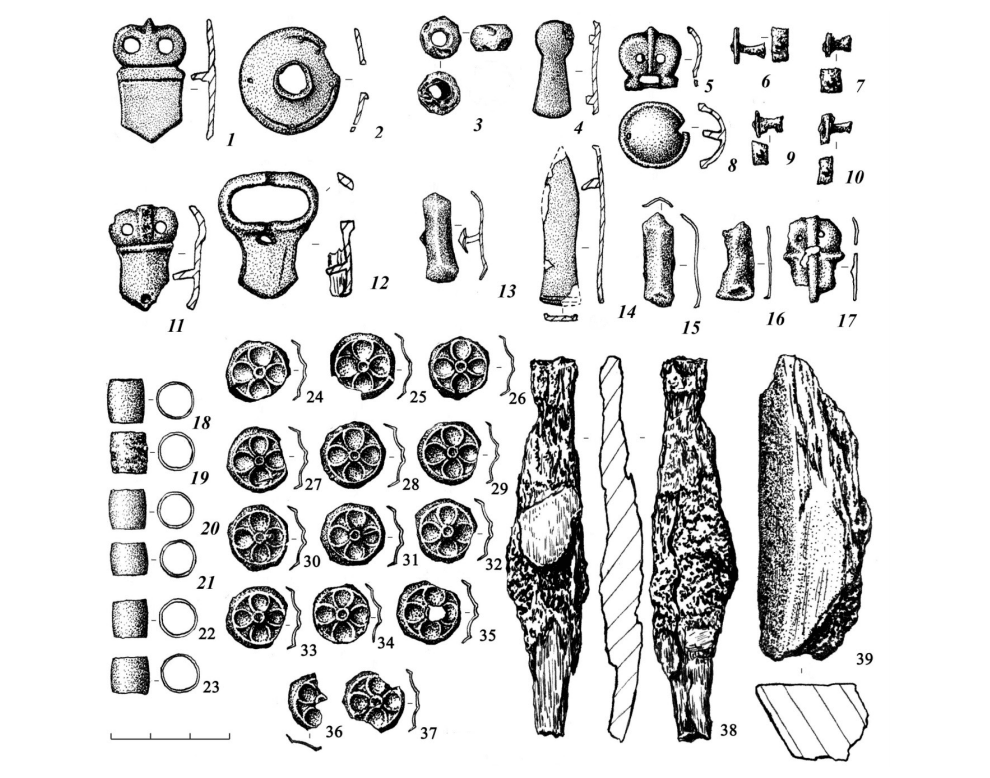
The woman was buried with objects typically associated with southern nomadic dress, including decorative belt fittings and pseudo-kolts linked to early Turkic costume traditions. Placed among them, the bear plaque appears out of place—and yet it clearly was not.
Its position within the grave suggests it carried meaning within the local community itself, not merely as an exotic object acquired through contact or trade.
Elsewhere in the cemetery, the same pattern emerges. Horses accompany some male burials, reflecting Turkic funerary ideas, but the animals were deposited in segmented form. Ornate belts—normally markers of male warrior status—also appear in women’s and children’s graves.
These choices point to adaptation rather than imitation. Local forest-steppe communities were selectively reworking new customs, fitting them into older social and ritual frameworks rather than abandoning existing traditions.
A frontier, not a boundary
Across northern Eurasia, bears carried deep spiritual significance tied to ancestry, protection, and cosmic order. That symbolism did not disappear with the northward spread of Turkic political influence during the 7th century.
Chumysh-Perekat instead suggests a cultural frontier rather than a fixed boundary—a place where forest and steppe traditions overlapped in daily life, burial practice, and belief.
Further analysis of organic materials and planned genetic studies may soon clarify who lived here and where their roots lay. For now, a single bronze plaque offers the clearest insight.
Three bears, pressed into metal and placed in the ground more than thirteen centuries ago, mark a moment when different worlds met—and neither fully replaced the other.
Fribus, A. V., & Grushin, S. P. (2025). Between taiga and steppe: A new find of a plaque depicting “bears in a sacrificial pose” from the Upper Ob region. Vestnik of Archaeology, Anthropology and Ethnography, 1(68), 81–95. https://doi.org/10.20874/2071-0437-2025-68-1-6
Cover Image Credit: Grave 30 at the Chumysh-Perekat cemetery, Early Medieval Altai. Photo by Alexey Fribus.