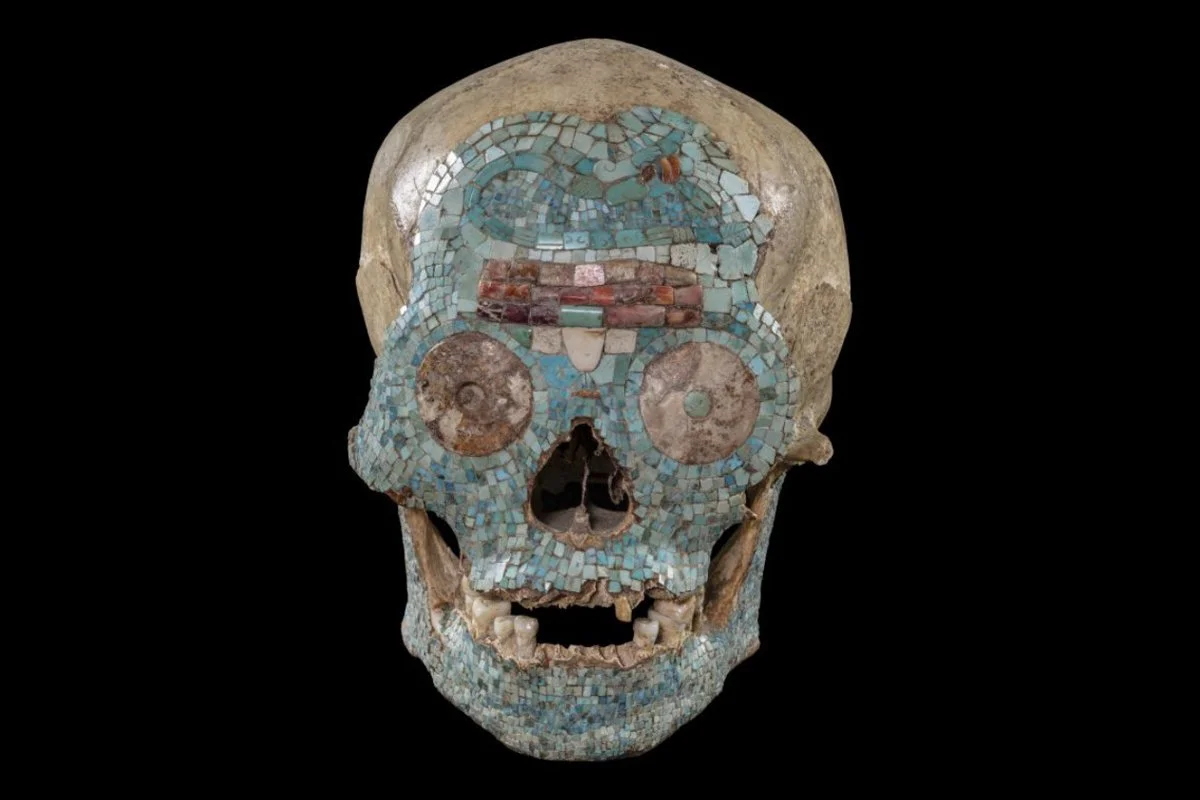
A human skull covered with turquoise, shell, jadeite and rock crystal spent six decades in a museum in the Netherlands. Now back in Mexico, it is now being documented in three dimensions as researchers confront a more difficult question: who was the man behind the mosaic?
Mexico’s National Institute of Anthropology and History (INAH) announced that the pre-Hispanic skull has now been formally registered, inventoried and recorded in three dimensions after its return from the Wereldmuseum in Leiden.
The object was repatriated in May 2025, but its return has opened a new phase of scientific study.
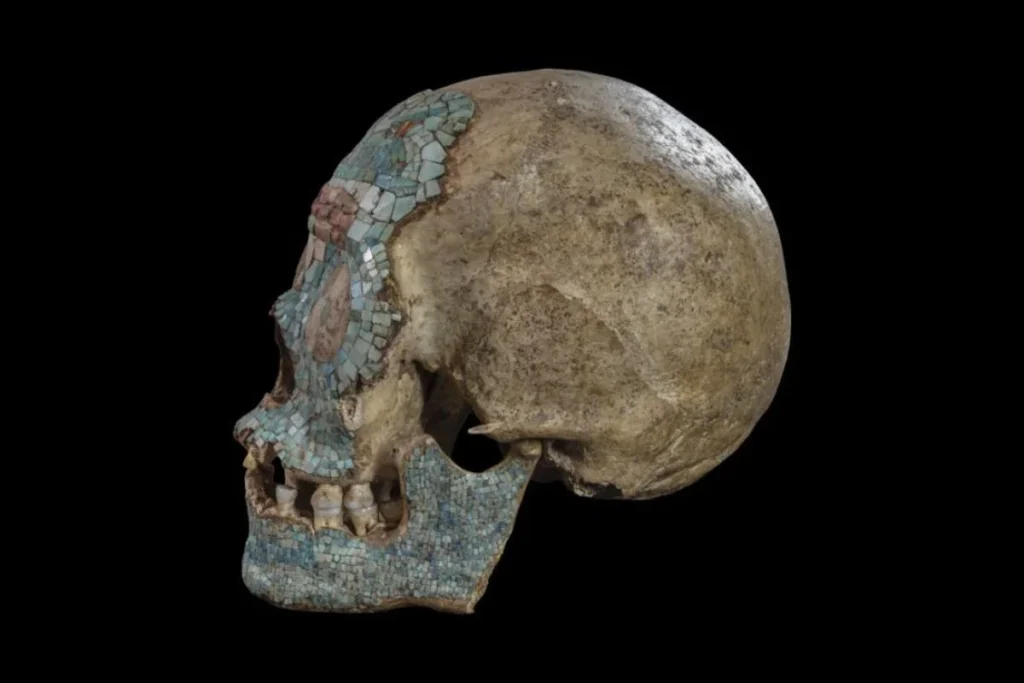
The skull is one of the more unusual surviving examples of Mesoamerican mosaic work. Small tesserae partially cover the bone, forming the schematic image of a serpent across the forehead.
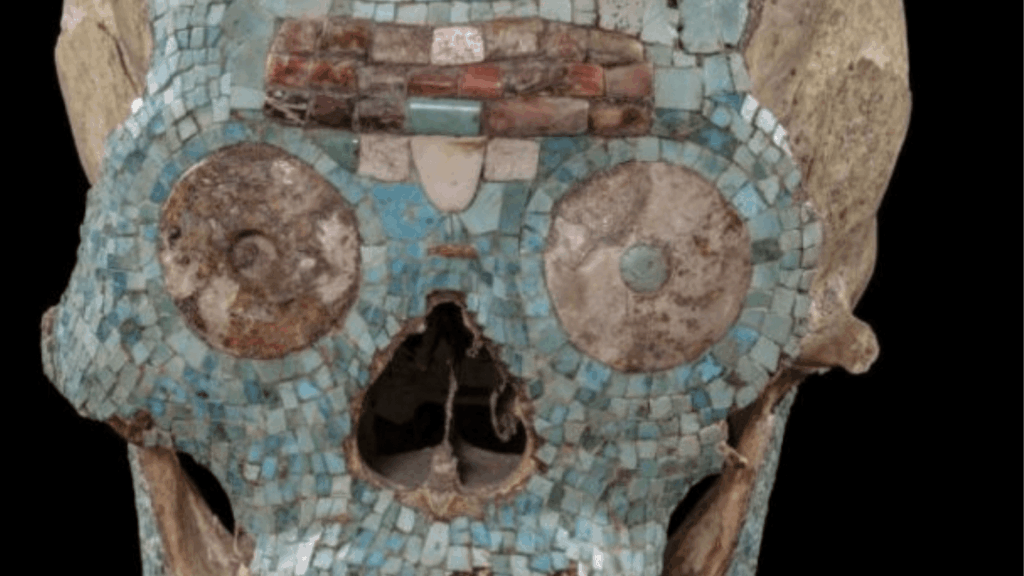
Blue pieces are made from turquoise, while reddish and pale elements around the brow and eyes were fashioned from shell. Jadeite survives in the left eye socket, while rock crystal was used for the serpent’s eye.
The technique belongs to a tradition documented in Mesoamerica during the Late Postclassic period, between AD 1200 and 1521, particularly in areas of what are now Puebla and Oaxaca.
Its exact place of origin, however, remains unknown.
A skull without an archaeological context
That uncertainty begins with the object’s modern history.
The museum in Leiden acquired the skull through the art market in 1962, without reliable information about where it had originally been found. It subsequently remained in the Netherlands for roughly six decades.
The absence of an archaeological context makes it difficult to connect the skull with a particular tomb, settlement or community.
Between 2011 and 2012, the Dutch museum worked with the Centre for Research and Restoration of the Museums of France to investigate the object.
Isotope studies, X-ray fluorescence and osteobiographical analysis indicated that the skull belonged to a man who died between approximately 25 and 40 years of age. Researchers also determined that the skull and the materials used in the mosaic were pre-Hispanic.
Modern adhesive substances were detected in some areas, suggesting that parts of the mosaic may have been rearranged or reused before the skull entered the Leiden collection.
Who was the man beneath the turquoise?
INAH physical anthropologist Olaf Bello Cardoso has said that the remains could provide both biological and social information about the individual.
Radiocarbon dating could refine the chronology, while samples from the teeth or dense temporal bone may preserve ancient DNA suitable for analysis.
Such work could move research beyond the striking mosaic itself and toward the individual to whom the skull belonged.
INAH specialists have already created the first three-dimensional digital model of the skull, providing a detailed record that can support future analysis while reducing the need for repeated physical handling.
The object has also received specialized packaging for its long-term conservation.
Its future may eventually bring it closer to the region with which its artistic tradition is associated. INAH is in contact with the Museo Comunitario Yucu Saa in Villa de Tututepec, Oaxaca, which has expressed interest in housing and displaying the skull if appropriate conservation and exhibition conditions can be met.
For now, the turquoise serpent remains the most visible part of the object. The man beneath it is still largely unknown.
After decades in a European museum and an uncertain journey through the art market, the next stage of the skull’s history may depend on what researchers can still learn about the person to whom it once belonged.