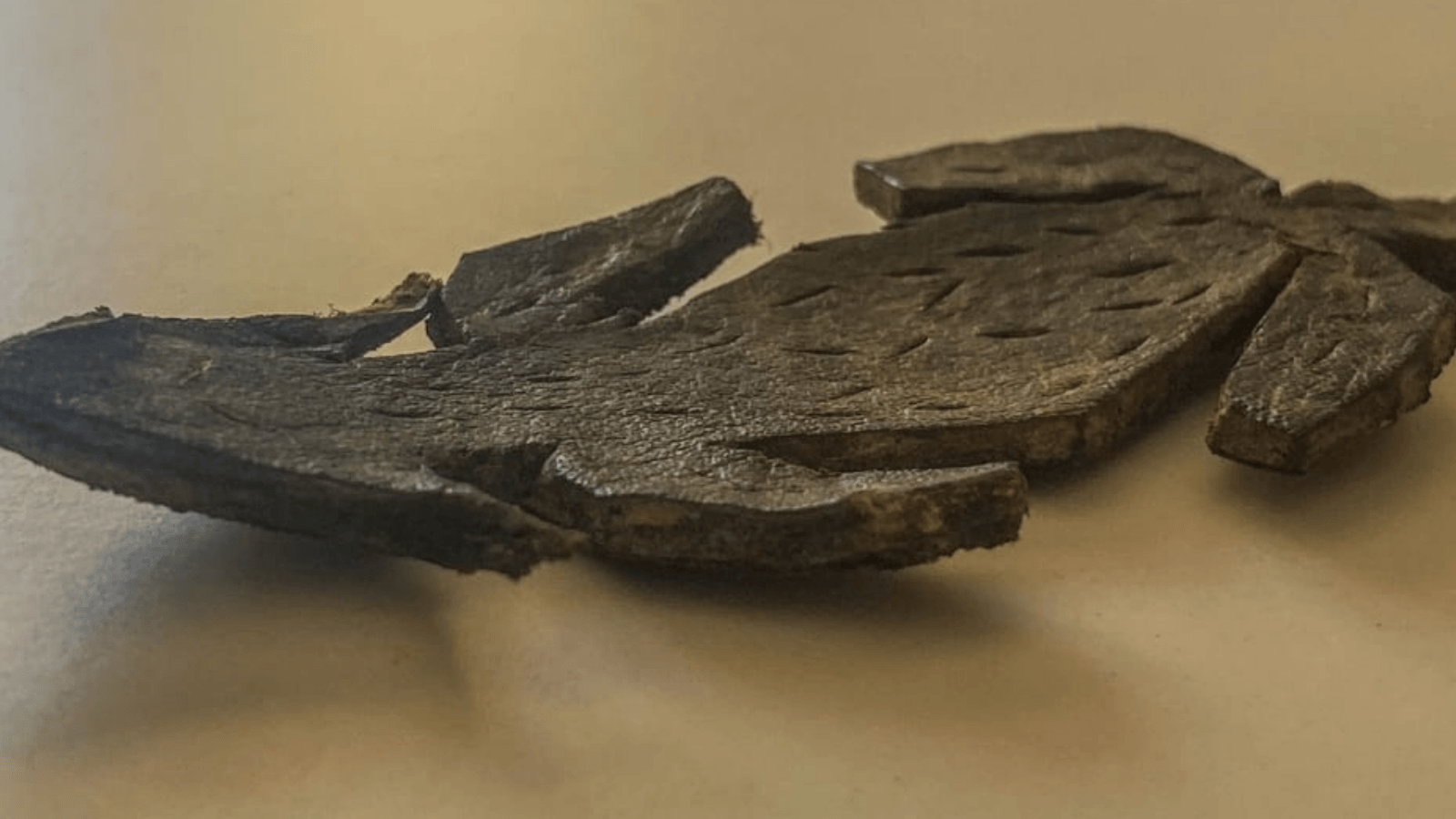
A tiny piece of leather cut into the shape of a mouse has emerged from the vast collections of Roman Vindolanda, offering an unusual glimpse into the lighter side of life on Rome’s northern frontier.
The Vindolanda Trust highlighted the object this week as part of its weekly “Shoesday” series, which celebrates the site’s remarkable collection of Roman leather.
Measuring just 12.2 centimeters long and 2.6 centimeters wide, the little animal was deliberately shaped from leather and marked with lines representing its fur and eyes. Whether it was a child’s toy, a joke, or something made for another purpose remains uncertain.
Hidden among Roman leather scraps
The mouse has an unusual history of discovery. The leather scraps surrounding it were excavated in 1993 from a room in the Period IV/V commanding officer’s residence at Vindolanda. At the time, the site was occupied by the First Cohort of Tungrians, a Roman auxiliary unit recruited from an area corresponding broadly to modern Belgium. This archaeological context dates the object to the early second century AD.
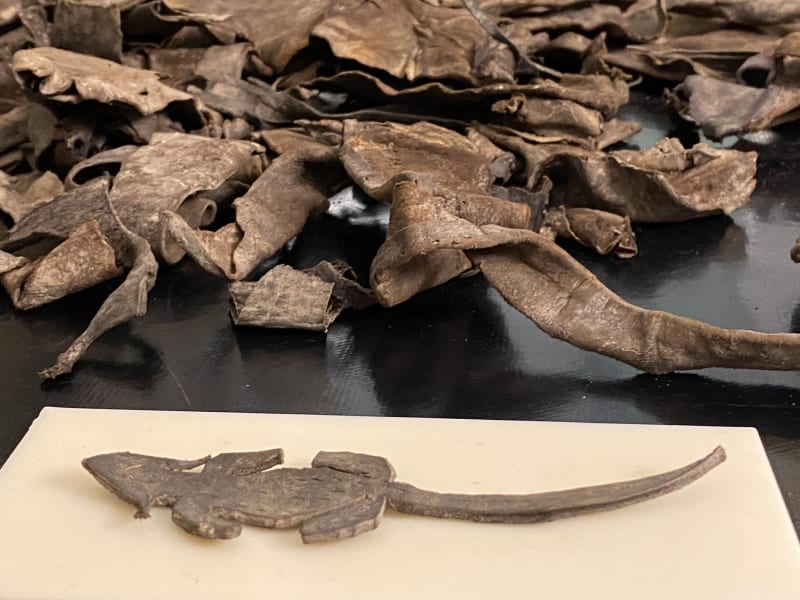
But the mouse itself went unnoticed for decades. During the 2020 lockdown, Vindolanda’s curatorial team began re-examining bags containing hundreds of leather offcuts and manufacturing scraps. Among them they spotted the carefully shaped fragment.
The discovery illustrates why Vindolanda’s collections can continue to produce surprises long after excavation. More than 7,000 leather objects and fragments have been recovered from the site, including shoes and boots, tent panels, horse equipment, patches, decorations and manufacturing waste.
A toy — or a Roman practical joke?
When the object was identified in 2020, Vindolanda curator Barbara Birley suggested it might have been a child’s toy, although another possibility was that someone had fashioned the leather mouse as a practical joke.
The toy interpretation is particularly intriguing because archaeologists have found considerable evidence for children living at Vindolanda, yet objects that can confidently be identified as toys are rare.
There is also an amusing archaeological connection.
Real mice were part of everyday life at the Roman fort. When Vindolanda’s granaries were excavated in 2008, archaeologists discovered the bones of thousands of mice beneath the floors. The animals had apparently lived below the flagstones, feeding on grain that fell through the gaps.
Nearly two millennia later, one Roman inhabitant’s leather version has survived alongside the shoes, scraps and discarded pieces left behind at the frontier fort — a small object whose original purpose may never be known.
The nearly 2,000-year-old leather “mouse” from Roman Vindolanda. Credit: The Vindolanda Trust