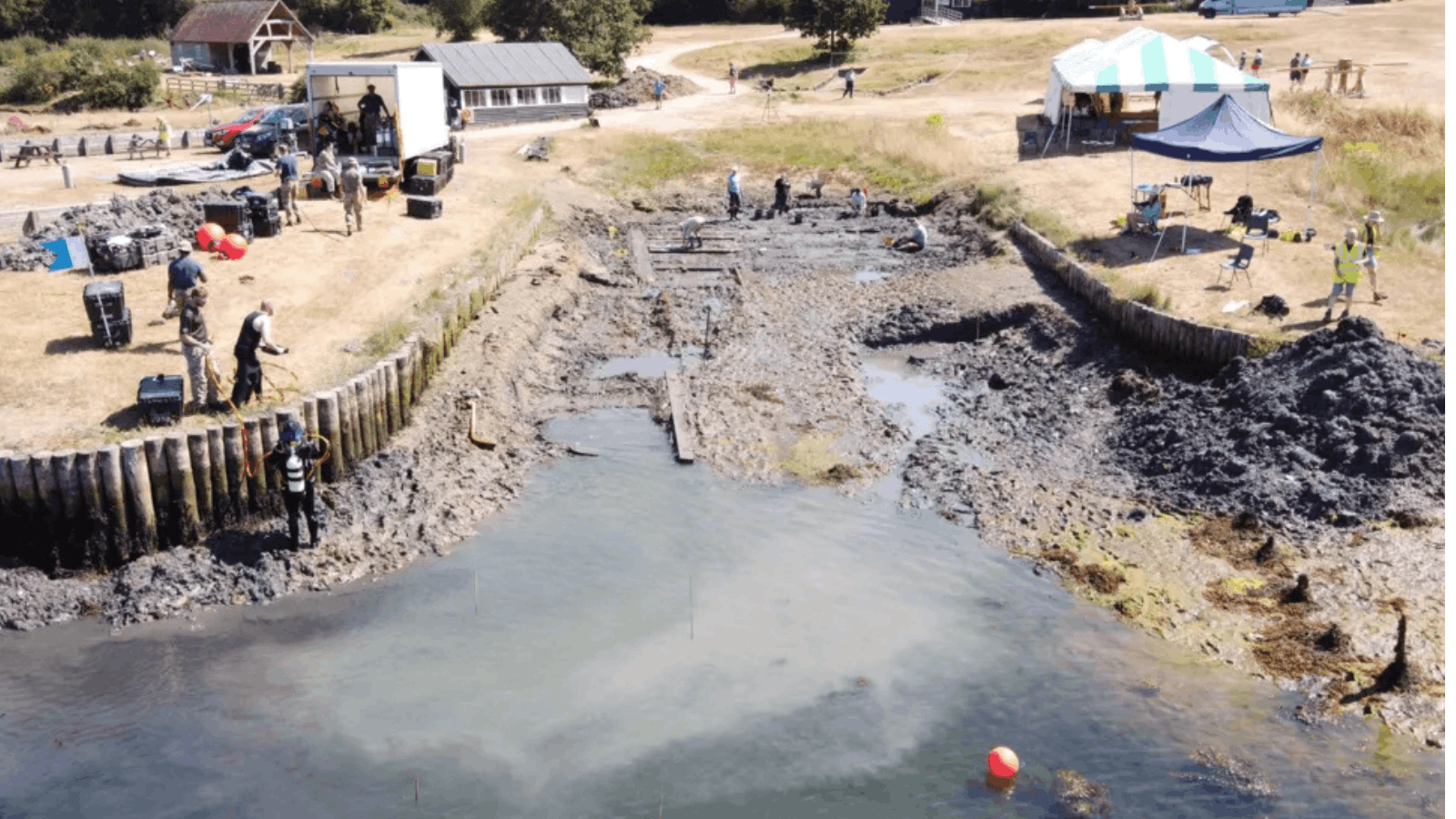
At low tide on the Beaulieu River, volunteers are scraping away layers of dark mud from a structure that once carried Royal Navy warships into the water. When the tide rises, British Army divers continue the search below the surface.
The excavation is taking place at Buckler’s Hard in Hampshire, one of Britain’s most important private shipbuilding centres during the 18th and early 19th centuries. Archaeologists are tracing the remains of Slipway No. 2 from the riverbank into the tidal zone, where more of its original timber framework may still survive.
The Buckler’s Hard Shipyard Trust is leading the 2026 project with the Maritime Archaeology Trust. Divers from the British Army’s 17 Port and Maritime Regiment Royal Logistic Corps are examining the lowest section of the slipway, beyond the reach of the land-based team.
Researchers want to establish how far the structure continues into the Beaulieu River and how shipbuilders moved enormous wooden hulls from the yard into the water nearly three centuries ago.
Seventeen massive timbers beneath the riverbank
Slipway No. 2 became the focus of a much more extensive excavation in 2025, although archaeological work at Buckler’s Hard goes back decades. Between 1993 and 1998, researchers surveyed the surviving slipways and quay, partially excavated Slipway No. 1 and carried out underwater investigations at the riverward ends of Slipways 1 and 2.
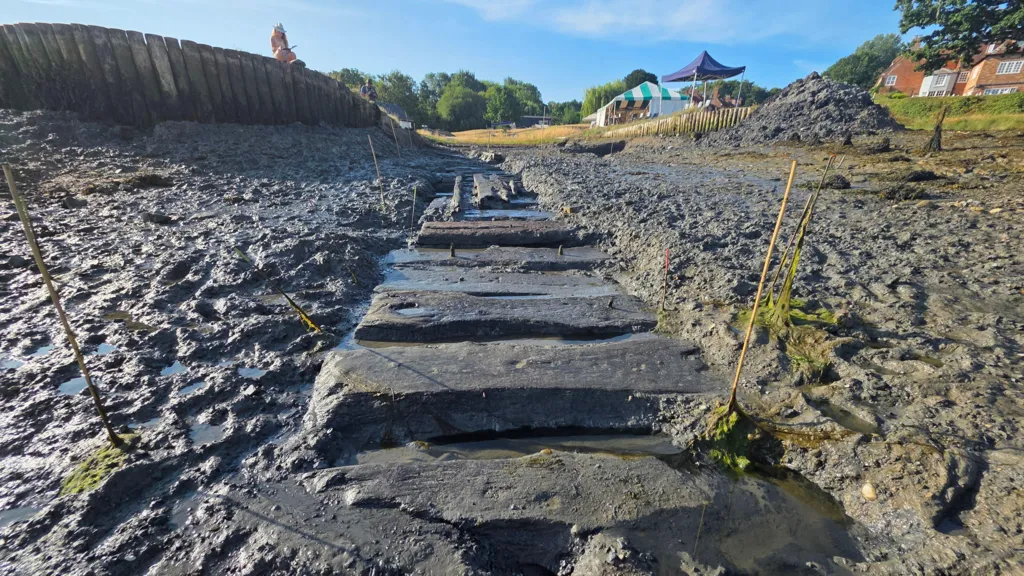
The 2025 excavation, led by the University of Southampton’s Centre for Maritime Archaeology, exposed 17 substantial groundway timbers beneath layers of soil and sediment. Some were more than six metres long and over one metre wide. Iron fittings, treenail holes and surviving patches of bark provided unusually detailed evidence of how the structure had been assembled.
Samples were taken from the timbers for dendrochronological analysis, which could help refine the chronology of the surviving structure. Timber retaining walls on both sides showed that the slipway was approximately 13.5 metres wide.
The structure had also been carefully aligned. Rather than running directly toward the opposite bank, it angled upstream, allowing newly launched vessels to enter a broader section of the river. The University of Southampton described the site as what is believed to be the first slipway of its period to be fully uncovered in the UK.
Once the excavation was completed, the exposed timbers were documented and covered again to protect the waterlogged remains.
The shipyard that built HMS Agamemnon
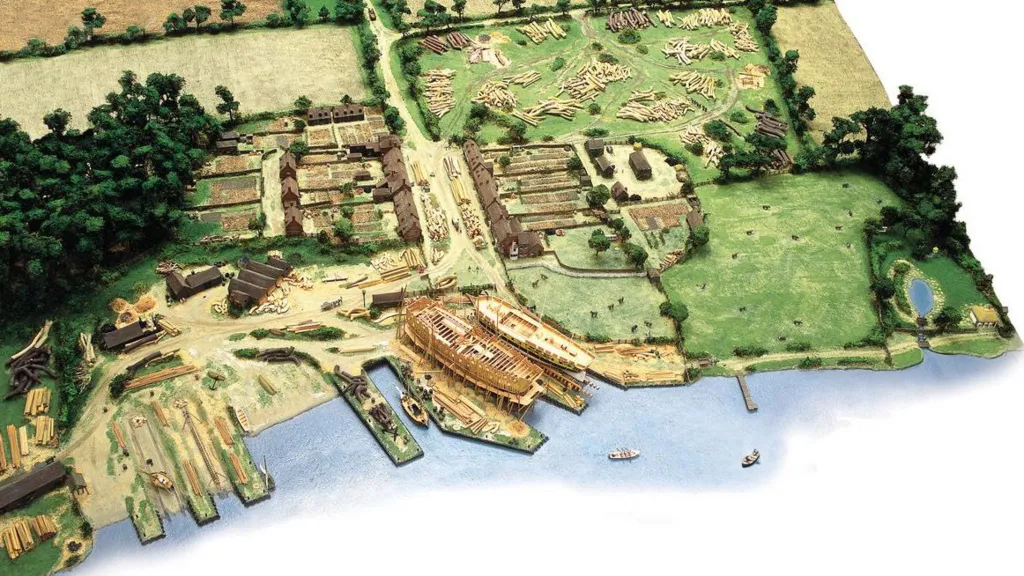
Buckler’s Hard is a quiet riverside settlement today, but between 1744 and 1815 its shipyard produced 55 vessels for the Royal Navy.
They included heavily armed 64- and 74-gun warships built during a period when Britain’s military and commercial power depended heavily on control of the sea. Constructing and launching such vessels required large quantities of timber, skilled labour and a carefully organised system of supports, ropes and machinery.
The best-known ship built at Buckler’s Hard was HMS Agamemnon, launched in 1781. Horatio Nelson later commanded the 64-gun warship during operations in the Mediterranean and became closely associated with the vessel.
The current excavation is not intended to identify the slipway used for one particular ship. Its importance lies in the evidence it preserves about the wider workings of the yard.
The dramatic moment when a ship first entered the water depended on infrastructure that usually remained out of sight. At Buckler’s Hard, the surviving beams and retaining walls reveal the engineering beneath that process.
Archaeologists search for buildings and capstans
On higher ground, archaeologists are opening test trenches over anomalies detected by ground-penetrating radar. The team is looking for evidence of a former shipyard building as well as additional capstan positions around Slipway No. 2.
Capstans were essential pieces of shipyard machinery, using ropes and human power to haul ships, timber and other heavy loads. Archaeologists already uncovered a well-preserved ground capstan pit near Slipway No. 2 in 1997. Finding further examples could help establish how these machines were arranged around the slipway and how vessels were moved through the yard.
Earlier excavation around the slipway also produced iron nails, staples, copper plate, tools, ceramics, glass bottles, clay pipes and bones. Not all of this material belongs to the 18th-century shipyard, however. The assemblage also includes 20th-century debris associated with the site’s later use, including the Second World War, as well as material deposited after shipbuilding had ended.
Army divers examine the submerged section
The site remained active long after the age of wooden warships. Boatbuilding continued at Buckler’s Hard until operations moved farther upstream in 1971, while material connected with Second World War military activity has also been found.
Parts of the riverbank can be reached only during low tide. The lowest section of the slipway remains underwater, making specialist diving support essential.
The army divers are clearing sediment and checking whether the timber framework continues beneath the river. The permanently waterlogged conditions may have preserved this lower section more effectively than the parts closer to dry land.
By the end of the excavation season on August 7, the team hopes to have a clearer plan of Slipway No. 2 and the structures that once surrounded it.
The mud of the Beaulieu River may still hold the missing section of one of Britain’s best-preserved historic naval shipyards.