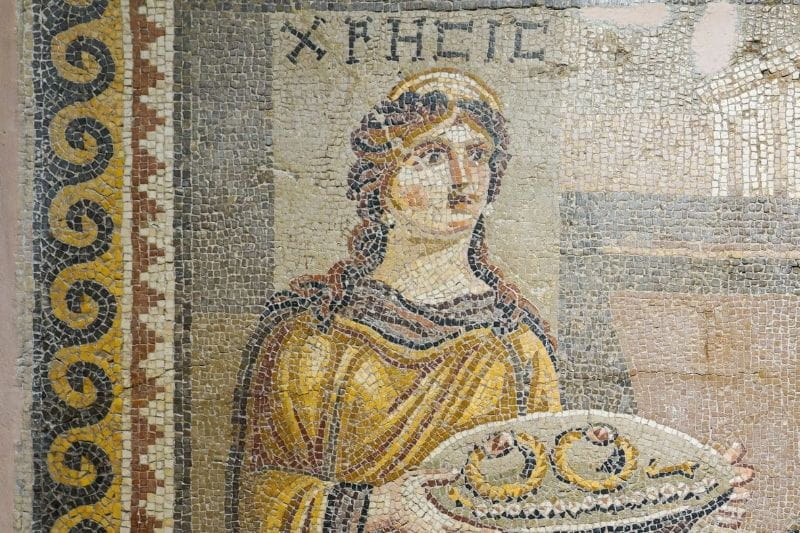
At the center of the Khresis Mosaic, a woman stands holding a tray heavy with gold and gemstones. There is no movement, no chaos—only a deliberate gesture. And yet, behind that stillness lies a story of conquest, memory, and the enduring idea of wealth taken from a fallen city.
Discovered in the ancient city of Daphne (Harbiye) in southern Turkey, the 4th-century Khresis Mosaic is far more than a decorative Roman floor. It offers a rare visual narrative tied to one of antiquity’s most persistent legends: the riches of Troy.
Today, the mosaic is exhibited at the Hatay Necmi Asfuroğlu Archaeology Museum, where it continues to draw attention not only for its craftsmanship, but for the layered meaning embedded in its imagery.
A Name That Carries an Idea
Above the central figure appears a single word: “KRESIS.”
In Ancient Greek, the term means “acquired wealth.” It is a precise and revealing choice. In Late Antique art, such inscriptions were not merely labels—they guided interpretation.
Here, Khresis is widely understood as the personification of wealth obtained through conquest. The idea would have been immediately recognizable to ancient viewers, especially within a cultural world where the story of Troy—its destruction and its treasures—remained deeply embedded in collective memory.
Mythological traditions reinforce this reading. Khresis is associated with the Trojan War cycle, described as the daughter of a priest of Apollo and taken captive by Agamemnon. Whether taken literally or symbolically, the reference aligns with the mosaic’s central theme: wealth as something seized, transferred, and displayed.
The Language of Objects
The mosaic communicates through objects as much as through figures.
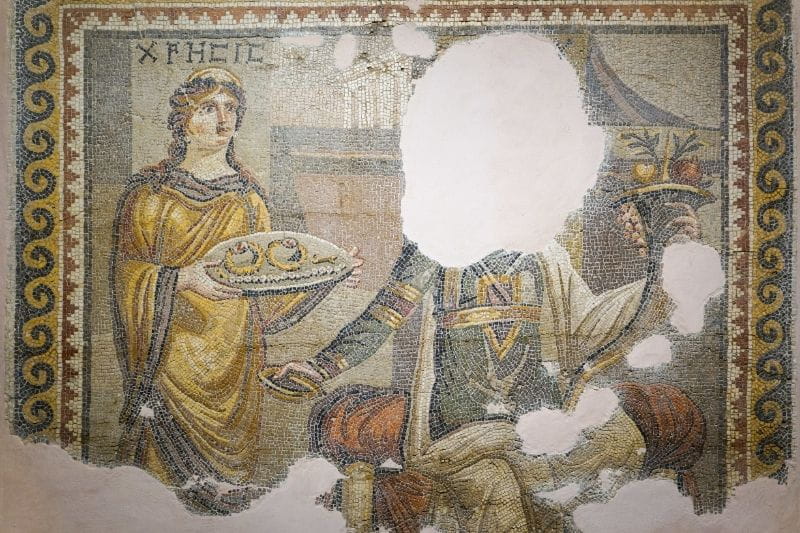
Khresis holds a tray filled with carefully rendered jewelry—gold bracelets set with large stones, a pearl necklace, and a golden clasp. These are not generic ornaments. They are markers of value, refinement, and possession.
Opposite her, a seated figure—its face largely lost to time—offers a different but complementary set of symbols. A cornucopia, overflowing with fruits and grape clusters, signals abundance. A golden bowl extended toward Khresis suggests exchange.
The interaction is subtle, almost restrained. But its meaning is unmistakable. This is not simply a depiction of wealth—it is a reflection on how wealth moves, how it is received, and how it is legitimized.
Daphne: Where Myth Met Elite Life
The mosaic was uncovered in Hatay’s Defne district, part of ancient Daphne, a celebrated suburb of Antioch, one of the Roman Empire’s great eastern metropolises. Known for its villas, gardens, and intellectual life, Daphne was a place where art played a central role in expressing status.
Within the House of the Triumph of Dionysos, the mosaic would have been part of a carefully curated visual program. Themes of abundance, celebration, and divine favor—often associated with Dionysos—shaped the atmosphere of such spaces.
In this setting, the Khresis Mosaic takes on an added dimension. It is not just decorative. It is performative. It communicates identity, education, and a shared cultural language rooted in myth and power.
What Survives—and What It Tells Us
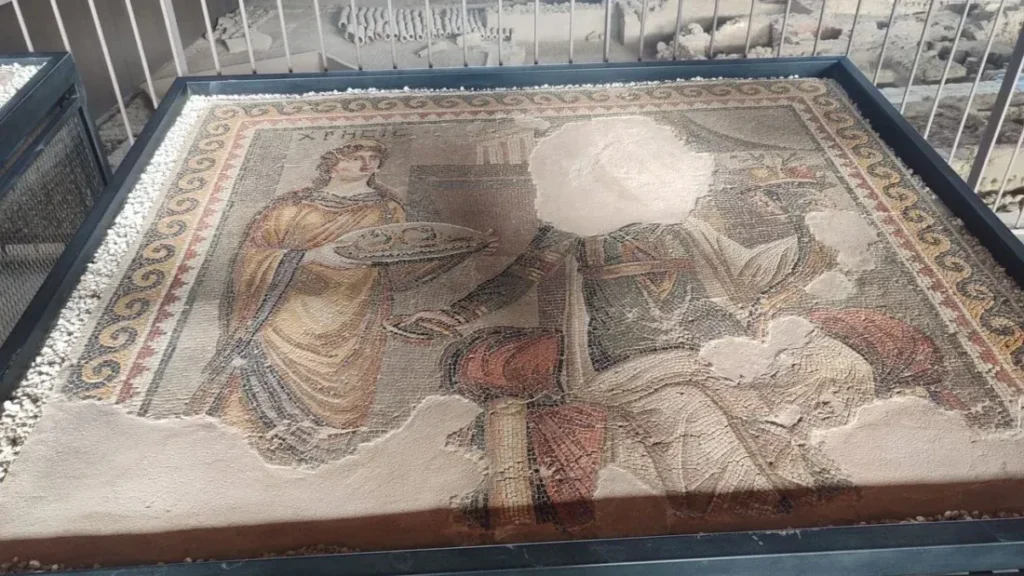
Time has not left the mosaic untouched. Parts of the composition are damaged, and the identity of the seated figure remains uncertain. But enough survives to preserve its core message.
The craftsmanship is still evident in the fine detailing of the jewelry and symbolic elements. More importantly, the conceptual clarity of the scene remains intact.
This is what gives the mosaic its lasting impact.
It does not simply show wealth. It interprets it. It frames wealth as something acquired, transferred, and ultimately displayed within a social and cultural system.
And perhaps that is why the image still resonates.
Because even now, across centuries, the message feels familiar:
wealth is never just owned—it is claimed, shown, and understood through stories.