
A Roman pinecone hairpin discovered in Britain is revealing how a simple personal object could carry powerful symbols of fertility and belief in the Roman world.
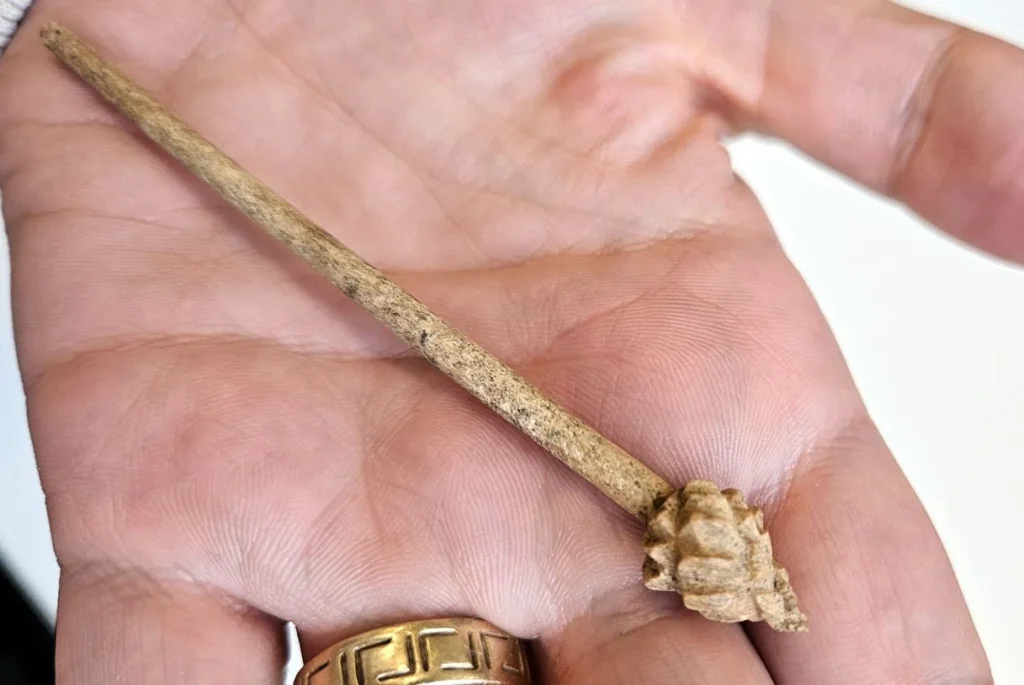
A small bone object uncovered during recent excavations in Britain is now offering a rare, almost personal glimpse into how people in the Roman world expressed belief, identity, and meaning in everyday life. The Roman pinecone hairpin, discovered by archaeologists from Cotswold Archaeology, may have once been worn without a second thought—but its symbolism tells a far more complex story.
The artifact was unearthed in the ancient Roman city of Glevum, modern Gloucester, and is thought to date to before AD 250. Its defining feature—a carefully carved pinecone-shaped head—immediately stands out. Not because it is unusual, but because it was meaningful.
A Symbol Hidden in Plain Sight
Hairpins were everyday items in Roman society, used to secure elaborate hairstyles. But this example was not just functional. The pinecone motif carried associations with fertility, regeneration, and continuity—ideas that shaped both personal belief and broader religious thought.
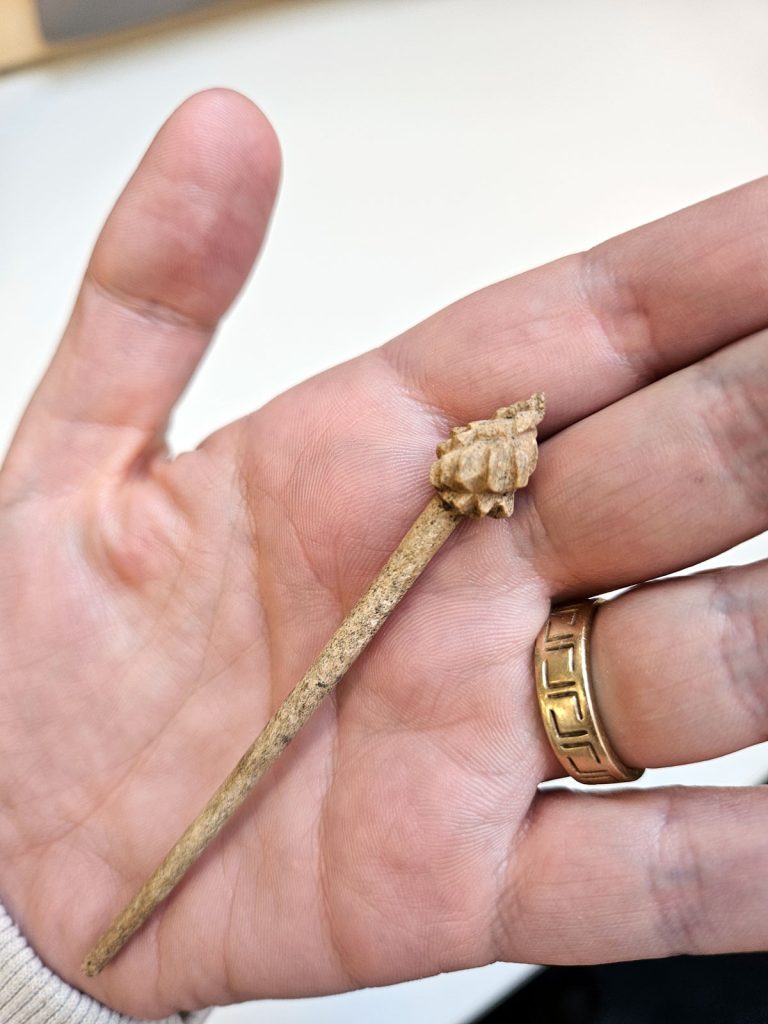
For Romans, the pinecone represented something enduring. Falling from evergreen trees yet holding the seeds of future growth, it became a natural symbol of renewal and life cycles. Worn on the body, such imagery may have served as a quiet form of protection or expression—something understood without needing to be explained.
Between Ritual and Belief
The same symbol appears across Roman religious culture, often linked to figures such as Bacchus, Mithras, and Cybele. These associations placed the pinecone within a wider spiritual framework tied to rebirth, transformation, and cosmic order.
In ritual contexts, followers of Bacchus and Cybele carried the thyrsus, a staff topped with a pinecone. The motif also appears in funerary monuments and temple decoration, suggesting it was more than symbolic—it was embedded in how Romans understood life, death, and what lay beyond.
Closer to Britain, a terracotta pinecone ornament found at Great Witcombe Roman Villa indicates that this imagery was not confined to the Mediterranean heartlands. It had travelled—along with ideas, beliefs, and cultural identities.
A Symbol Far from Its Origins
Many pinecone depictions in Roman art are believed to represent the stone pine (Pinus pinea), a tree native to the Mediterranean. It provided food, oil, and shade, and was a familiar presence in Roman landscapes.
In Britain, however, such trees were rare, if present at all. Pine nuts were imported, and while it is possible the species was introduced, there is no clear evidence it ever became widespread. This makes the object even more striking.
The woman who wore this hairpin may never have seen a pine tree in her life.
And yet, she chose—or was given—a symbol that carried the weight of Rome itself.
More Than an Object
Objects like this remind us that Roman life was not divided between the ordinary and the sacred. The two often existed side by side, sometimes in the smallest of things.
This hairpin was not simply an accessory. It was a message—subtle, personal, and deeply rooted in a shared cultural language.
Cover Image Credit: Cotswold Archaeology