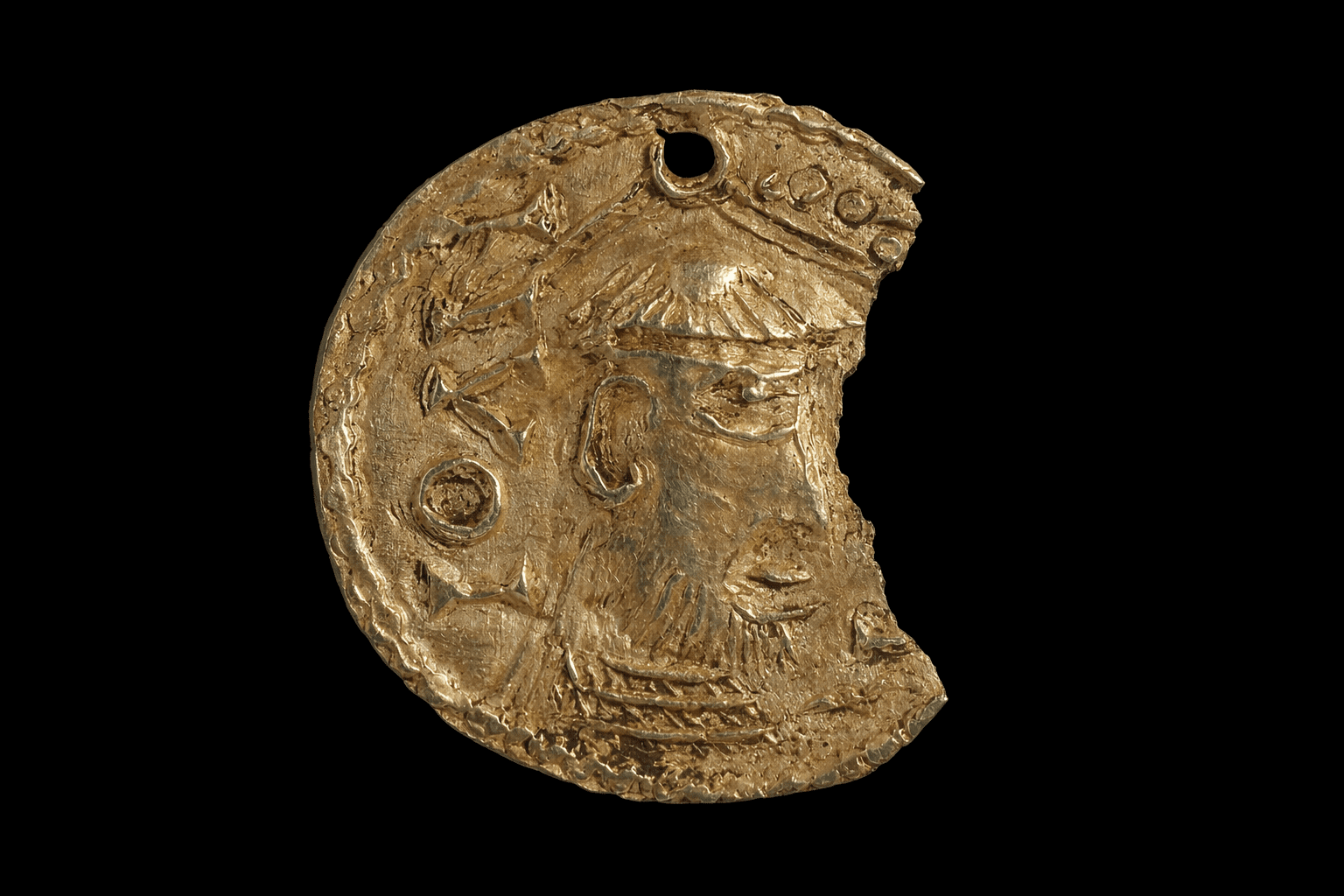
A small gold pendant discovered in eastern England is forcing historians to confront an unexpected contradiction. The object, dated to the 9th century, belongs to a period when Vikings controlled much of the region. Yet it clearly depicts a central figure of Christianity: John the Baptist.
That combination should not exist within the same historical frame.
An Object That Should Not Exist Together
The pendant was found near Dunton, west of Fakenham in Norfolk, by a metal detectorist. Although partially damaged, its essential features remain visible.
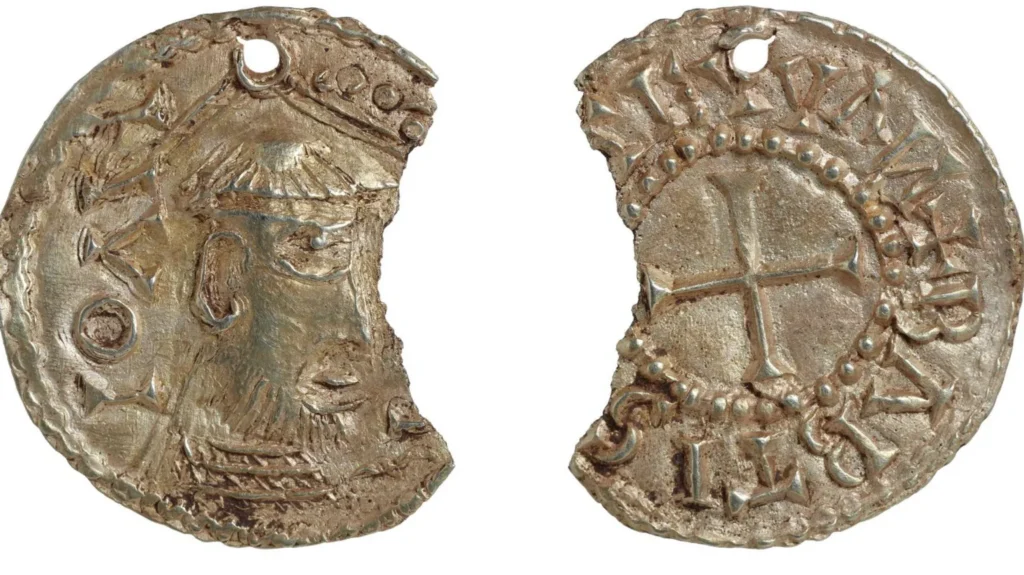
Made of gold, the piece imitates a solidus, the high-value coin used in the late Roman and Byzantine worlds. Unlike a circulating coin, however, it was deliberately pierced, indicating that it functioned as a wearable pendant from the beginning.
On one side appears the profile of a bearded man, identified by a Latin inscription as John the Baptist. The reverse preserves fragments of text interpreted as “Baptist and Evangelist.” Even in its incomplete state, the message is unmistakable.
What stands out is not only the imagery, but where it appears.
Breaking the Rules of Medieval Coinage
In 9th-century Western Europe, especially under Carolingian influence, coins followed a strict visual language. Rulers dominated their surfaces. Kings and emperors were the primary symbols of authority, while religious figures were largely absent.
This makes the Norfolk pendant deeply unusual.
Numismatics expert Simon Coupland described the object as “bizarre” in an interview with the BBC, noting that nothing comparable has been documented from the same period. The lettering style suggests a date in the late 9th century, likely the 860s or 870s, yet the imagery does not align with known minting traditions.
It is not simply rare. It is out of place.
A Viking Context That Raises Questions
The historical setting intensifies the puzzle. By around AD 870, East Anglia had fallen under Viking control. These Scandinavian groups had not yet fully adopted Christianity.
This creates a clear contradiction.
Why would an object featuring one of Christianity’s most significant figures appear in a region dominated by non-Christian elites?
One possible explanation lies in cultural contact. The pendant may reflect interactions between Viking settlers and local Christian communities, whether through trade, artistic exchange, or early stages of religious transition.
If so, it points to a more complex social landscape than the traditional narrative suggests.
A Rare and Unfamiliar Image
John the Baptist holds a central place in Christian tradition as the figure who baptized Jesus and announced his ministry. Despite this importance, his appearance on coin-like objects in Western Europe during this period is virtually unknown.
This absence makes the discovery particularly striking.
The pendant does not just add a new example to the record. It introduces something that does not fit established categories, forcing researchers to reconsider how religious imagery may have circulated in early medieval Europe.
What Happens Next
The object is currently undergoing the United Kingdom’s official treasure evaluation process. A coroner will determine whether it qualifies as legal treasure. If approved, it may enter a public collection, with Norwich Castle Museum already expressing interest.
Even in its damaged state, the pendant is regarded as a significant find.
A Small Object with Larger Implications
This gold pendant does not provide clear answers. Instead, it raises a more fundamental question.
Was 9th-century Europe really divided along strict cultural and religious lines, or were those boundaries more fluid than we assume?
For now, the discovery suggests the latter.
And that uncertainty may be the most important finding of all.
Cover Image Credit: Andrew Williams/Norfolk County Council