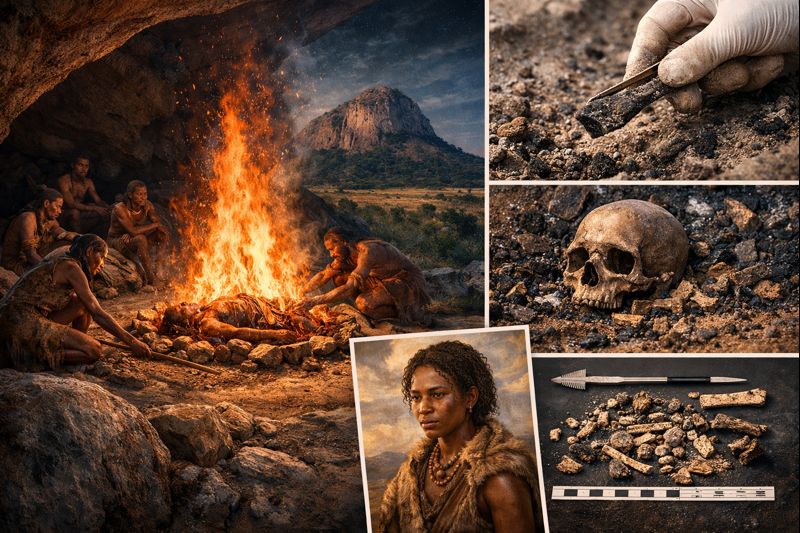
Archaeologists working in northern Malawi have identified what is now considered Africa’s oldest known intentional human cremation, dating to around 9,500 years ago. The discovery, reported in Science Advances, challenges long-held assumptions about the social organization, ritual life, and labor capacity of early hunter-gatherer communities.
The cremation was uncovered at Hora 1, a rockshelter located beneath a granite inselberg on the slopes of Mount Hora, overlooking the plains of northern Malawi. The site has been known since the 1950s as a burial ground for prehistoric foragers, but recent long-term research has revealed a far more complex mortuary history.
A labor-intensive ritual in an unexpected setting
According to Jessica Cerezo-Román, an associate professor of anthropology at the University of Oklahoma and the study’s lead author, cremation is extremely rare among both ancient and modern hunter-gatherers.
“Cremation among ancient and modern hunter-gatherers is very rare,” Cerezo-Román explains, “at least in part because it requires an enormous amount of labor, time, and fuel to reduce a body to fragmented, calcined bone and ash.”
This is precisely what makes the Hora 1 discovery so striking. The cremated remains were not scattered or incidental. Instead, they formed part of a queen-size ash deposit, containing the highly fragmented remains of a single individual. There is no evidence that cremation was practiced at the site before or after this event.

A single woman, deliberately burned
Analysis of 170 human bone fragments, most of them from arms and legs, indicates that the cremated individual was an adult woman, likely between 18 and 60 years old and approximately 150 centimeters tall. Thermal alteration patterns show that her body was burned shortly after death, probably within days, before decomposition had begun.
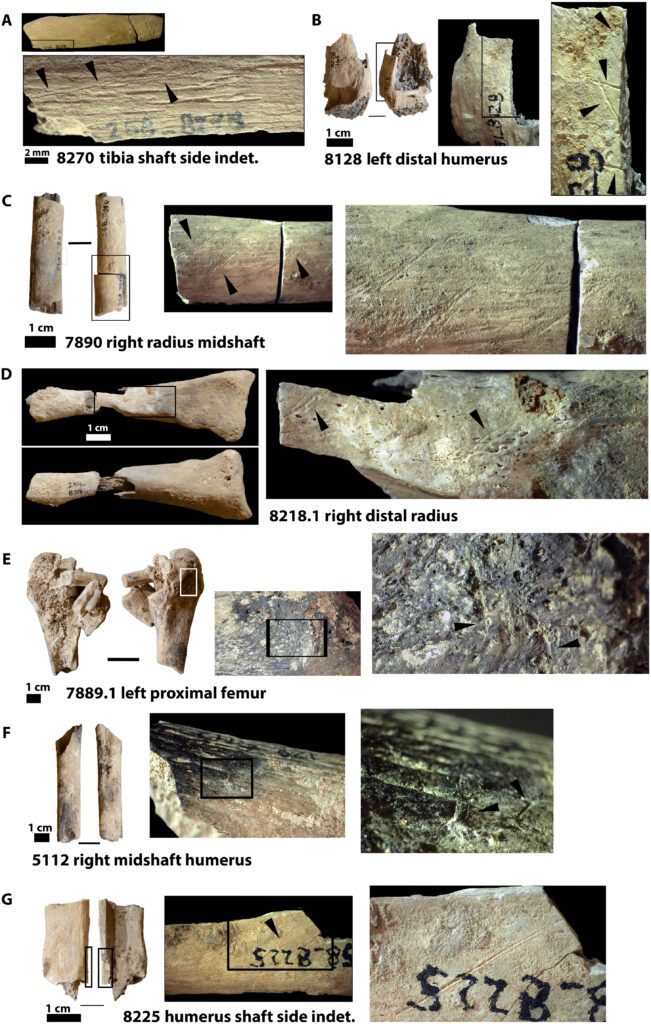
Several limb bones display cut marks, suggesting that parts of the body were deliberately defleshed or removed prior to cremation. Even more striking is what archaeologists did not find.
“Surprisingly, there were no teeth or skull fragments in the burned assemblage,” says Elizabeth Sawchuk, a biological archaeologist at the Cleveland Museum of Natural History and a co-author of the study. “Because these elements often survive cremation, we believe the head may have been removed before the burning took place.”
Ritual, memory, and social meaning
Such hands-on manipulation of the body may appear disturbing from a modern perspective, but the researchers caution against simplistic interpretations. Cerezo-Román emphasizes that practices such as removing flesh or separating the head could have carried profound symbolic meaning.
“These manual interventions can look gruesome,” she notes, “but there are many possible motivations, including commemoration, social memory, and respect for ancestors.”
Growing evidence from Malawi suggests that some hunter-gatherer groups practiced complex mortuary rituals involving the post-mortem removal, curation, and secondary burial of body parts, possibly as symbolic keepsakes or focal points of remembrance.
Why this cremation matters
Before the Hora 1 discovery, the earliest secure evidence for cremation in Africa dated to around 3,500 years ago, associated with Neolithic pastoralist communities in eastern Africa. Cremation has generally been linked to societies with more advanced technologies and more elaborate funerary traditions than those typically attributed to foragers.
Globally, the oldest known on-site cremation comes from the Xaasaa Na’ (Upper Sun River) site in Alaska, dating to about 11,500 years ago, and involving the remains of a young child. The Malawian example now stands as Africa’s earliest—and one of the world’s most unexpected—cases.
Rethinking early hunter-gatherer societies
For Jessica Thompson, an assistant professor at Yale University, the implications go far beyond a single burial. Thompson, who leads the long-term research project at Hora 1 in collaboration with the Malawi Department of Museums and Monuments, argues that the cremation forces a reassessment of how archaeologists view early forager communities.
“This isn’t just the oldest cremation in Africa,” she says. “It was such a monumental event that it compels us to rethink group labor, ritual coordination, and social complexity among ancient hunter-gatherers.”
Excavations show that people first occupied the Hora area around 21,000 years ago, using the rockshelter as a cemetery between roughly 16,000 and 8,000 years ago—almost always burying individuals intact. Against this backdrop, the single, dramatic cremation stands out as a deliberate and meaningful departure from established tradition.
Far from being socially simple, the people of ancient Malawi now appear capable of organizing large-scale, symbolically charged rituals—long before farming or herding reshaped human societies.
Jessica Cerezo-Román et al, Earliest Evidence for Intentional Cremation of Human Remains in Africa, Science Advances (2026). DOI: 10.1126/sciadv.adz9554.
Cover image: A reconstructed scene illustrating an exceptional cremation ritual carried out around 9,500 years ago at the foothills of Mount Hora in northern Malawi. The image reflects archaeological evidence associated with Africa’s oldest known cremation and is based on current scientific interpretations. This visual is an AI-generated illustrative reconstruction.