
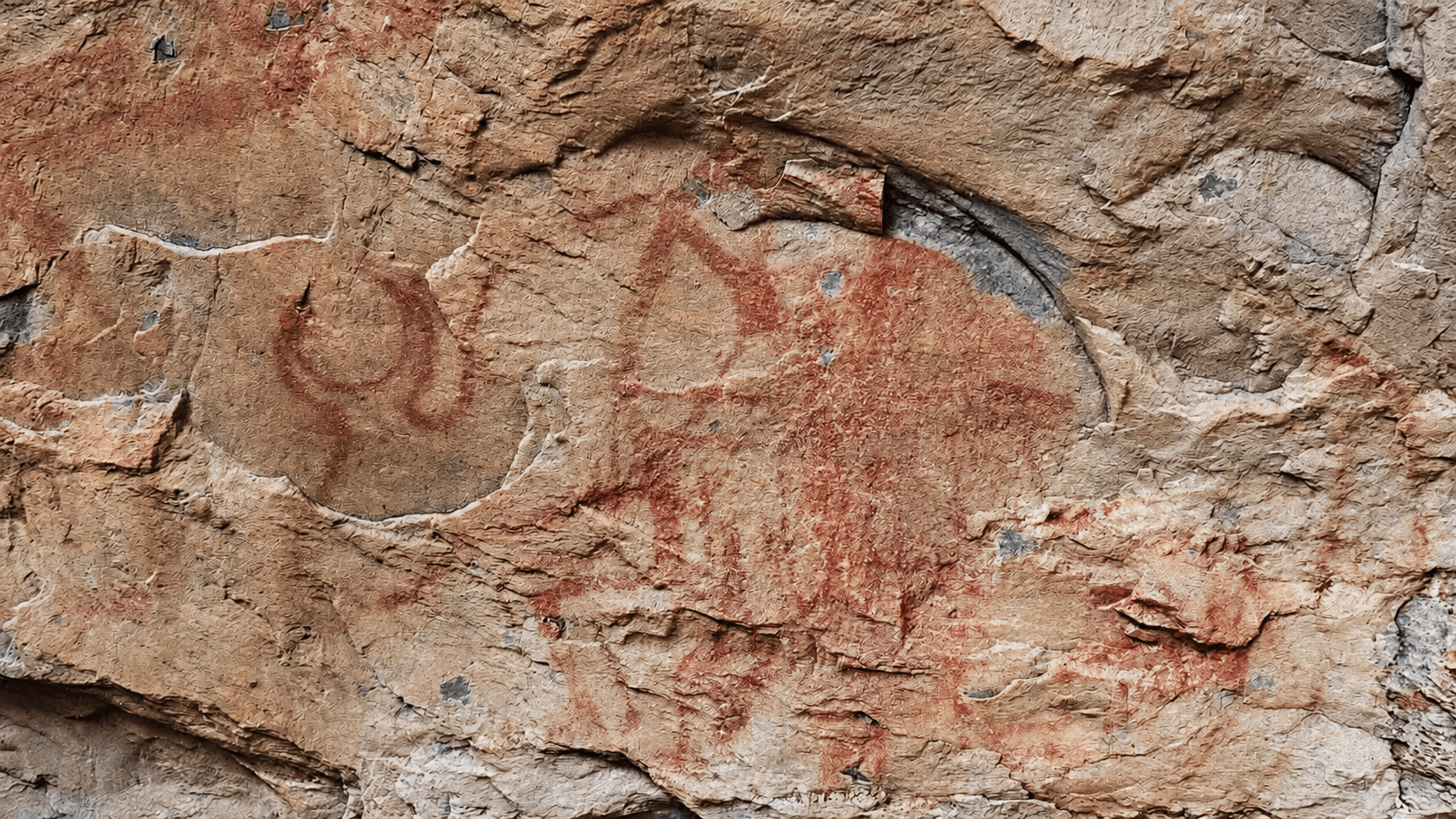
A newly documented group of ancient cave paintings in Thailand depicts monkeys, wild cattle and the handprints of an adult and a child. Overlapping images suggest that people returned to the rock wall during at least three separate phases, repeatedly adding new marks to those left by earlier visitors.
The paintings were identified at the Pha Wiang cave complex in Nong Bua Lamphu Province, northeastern Thailand. Archaeologists believe the location may have stood along a cultural route connecting prehistoric communities around the Loei River basin with the uplands of Phu Phrabat.
Four monkeys emerge from the rock
A team from Thailand’s Fine Arts Department examined the site on September 4 after receiving reports of red markings on a cliff behind Wat Tham Pha Wiang. The paintings were found on a rock wall near the entrance to a smaller cave within the complex, which lies in Na Kae subdistrict of Na Wang district.
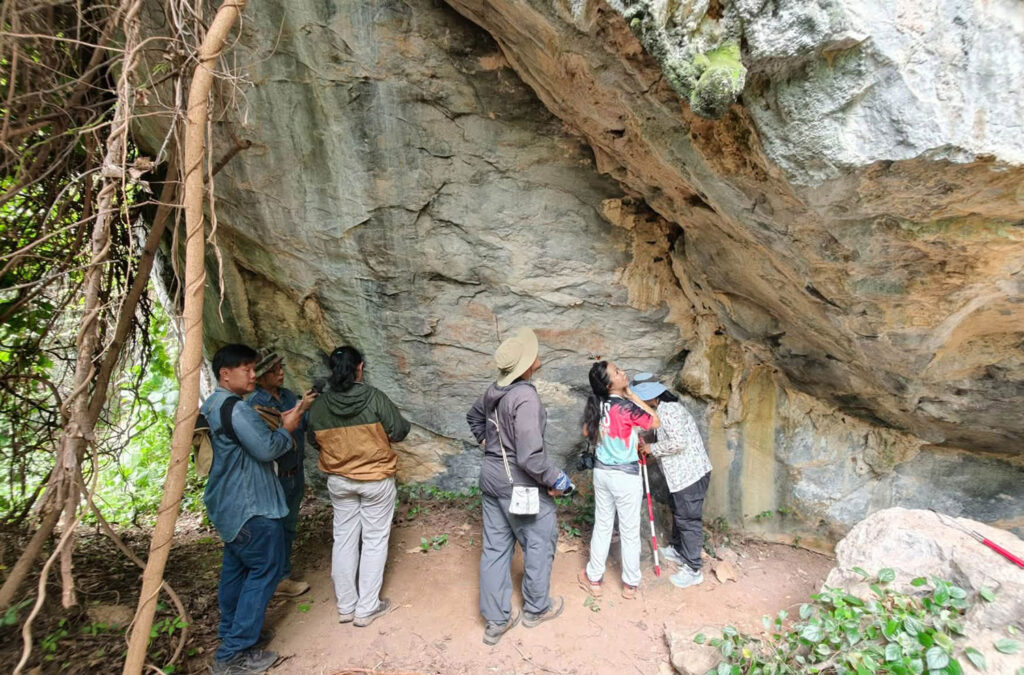
Many of the markings were difficult to distinguish with the naked eye. After documenting the wall and processing photographs with image-enhancement software, archaeologists identified what appeared to be four monkeys climbing or leaping among vines. Beneath them was the outline of a large wild bovine.
The combination may preserve something prehistoric people once observed in the surrounding landscape. It is not yet known, however, whether the figures represent an actual scene, knowledge associated with hunting or part of a ritual narrative.
Tipwan Wongassapiboon, an archaeologist with Fine Arts Office 8 in Khon Kaen, said the images may reflect the animals and activities familiar to the people who used the cave. She suggested that the wall could have played a role in ceremonies before a hunt or in passing hunting knowledge to younger members of the community, although further investigation will be required.
Three phases recorded on one wall
The importance of the discovery lies not only in what was painted, but also in the order in which the images appear to have been added. The animal figures form the earliest visible layer, while abstract zigzag or meandering patterns were subsequently painted across parts of the original composition.
Two handprints—one apparently left by an adult and the other by a child—represent a further phase. Their position indicates that people returned after the animals and geometric designs were already present.
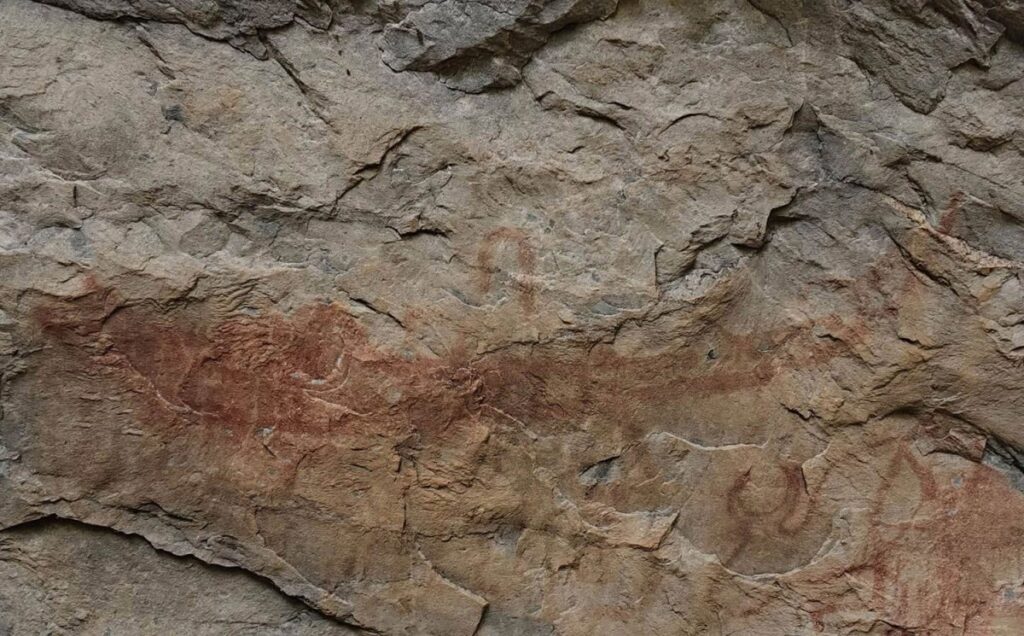
The wall therefore developed over time rather than being created as a single composition. Its overlapping marks provide evidence that the cave retained its importance across more than one period, even as the way people used or understood the location may have changed.
Wongassapiboon compared the handprints to marks showing that someone had visited the place. Although their exact meaning remains unknown, the difference in size suggests that children may have participated in at least some of the activities conducted at the site.
Pottery and possible bone fragments found nearby
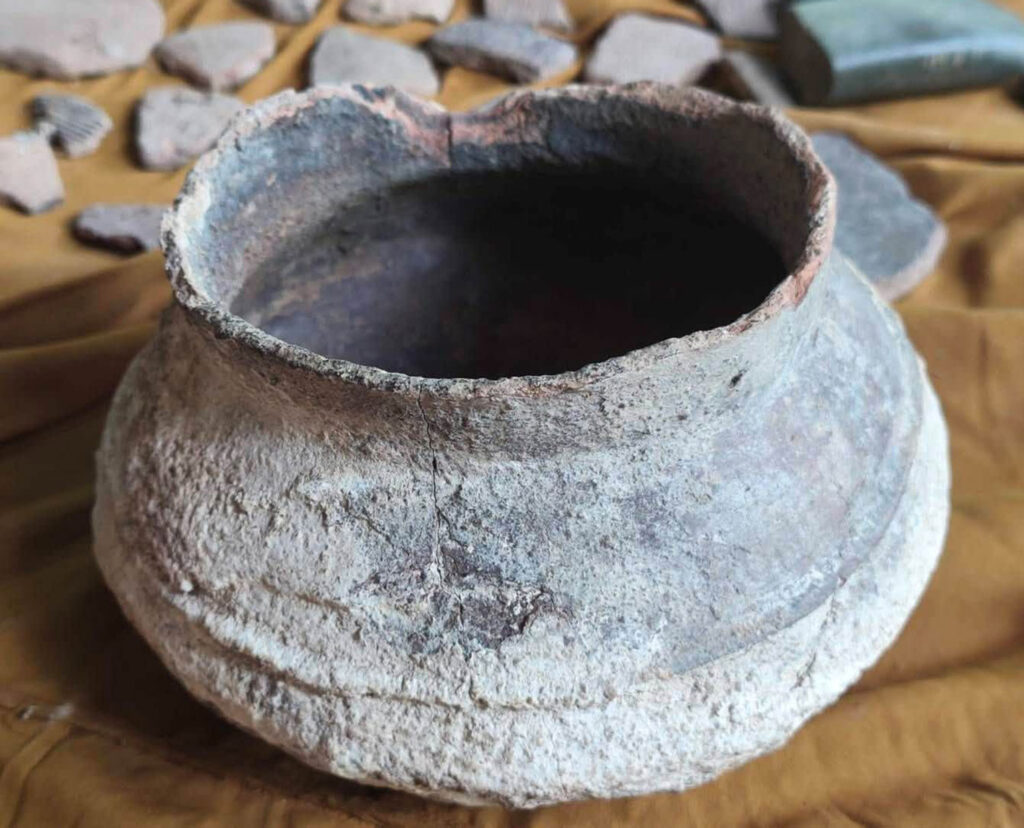
The paintings were not the only archaeological evidence recorded during the survey. Incised pottery fragments were found nearby, including pieces resembling ceramics known from prehistoric sites around Ban Chiang in neighboring Udon Thani Province.
The similarity does not yet prove a direct connection with Ban Chiang. It has nevertheless encouraged archaeologists to examine whether Pha Wiang formed part of a wider network extending from the Loei River basin through Nong Bua Lamphu toward Phu Phrabat.
Pha Wiang’s geographical position strengthens that possibility. The cave lies between two areas already known for prehistoric activity, potentially placing it along a route through which people, objects and cultural traditions moved across northeastern Thailand.
The team also explored the larger Pha Wiang Cave, although darkness and difficult access limited the initial examination. Possible archaeological bone fragments were observed inside and recorded for later study. Their age, species and relationship—if any—to the paintings have not been established.
Scientific analysis of other Asian rock-art sites has shown how pigment composition can reveal both painting techniques and preservation methods, as demonstrated by recent research into the unusual binding formula of China’s Huashan rock art.
Initial reports have proposed dates ranging from approximately 1,500 to 4,000 years ago. No direct scientific dating of the pigments has been announced, however, and the superimposed images may have been created centuries apart. The proposed chronology must therefore remain provisional until the pigments, pottery and archaeological deposits have been examined in greater detail.
The site will be considered for protection
The Fine Arts Department is expected to prepare a preliminary survey report and assess the cave complex for formal registration. Pha Wiang is reportedly only the second rock-art site listed in the department’s database for Na Wang district, increasing its importance for understanding the region’s prehistoric occupation.
Officials have asked visitors not to touch the paintings or remove pottery, bones and other material from the site. The position of each object can preserve information about the date and character of human activity, even when the fragment itself appears insignificant.
Further documentation may reveal whether the animals, abstract patterns and handprints belonged to a continuing local tradition or to communities separated by long intervals. For now, the wall records not one frozen moment from prehistory, but a sequence of returns: animals were painted, later visitors covered parts of them with new signs, and an adult and a child eventually pressed their hands against the same rock.
Cover Image: Red prehistoric paintings recorded on a rock wall at the Pha Wiang cave complex in northeastern Thailand. Credit: Si Bun Rueang District/Facebook