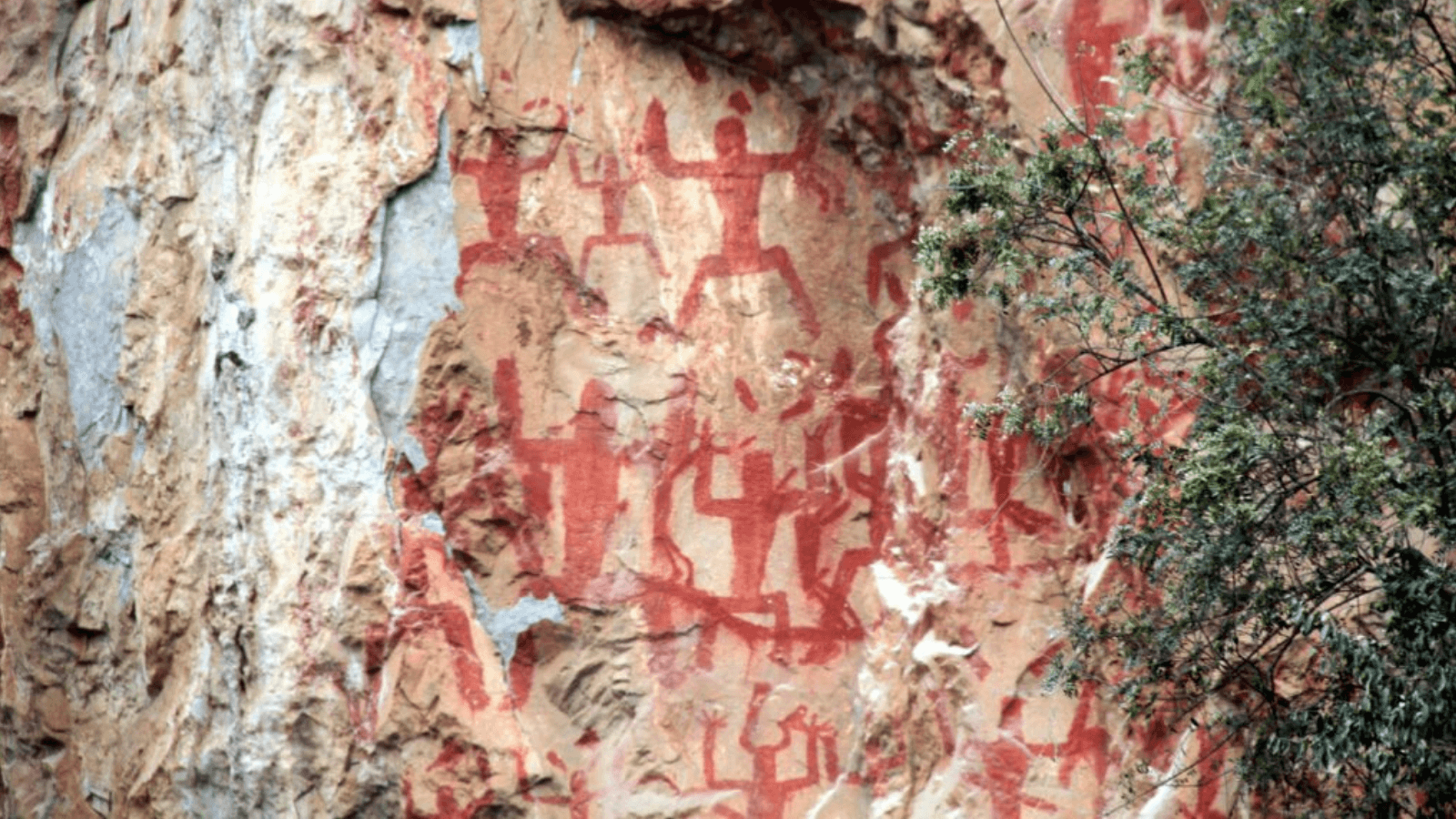
China’s 2,000-year-old Huashan rock art has survived on limestone cliffs above the rivers of southern China despite intense heat, monsoon rains and tropical storms that might normally be expected to destroy exposed pigments.
A new scientific study suggests that part of the answer lies in an unusual ancient painting formula. Researchers examining the Huashan rock art found evidence that its creators combined red clay, lime and blood in a layered system that produced a remarkably durable bond between pigment and stone.
Published in the Journal of Archaeological Science, the research offers a new explanation for the longevity of the Zuojiang Huashan Rock Art Cultural Landscape in Guangxi, near China’s border with Vietnam. Rather than simply brushing red pigment directly onto the cliffs, the ancient artists appear to have prepared the rock with a lime-based mortar containing biological material before applying the colored layer.
A vast landscape of red figures
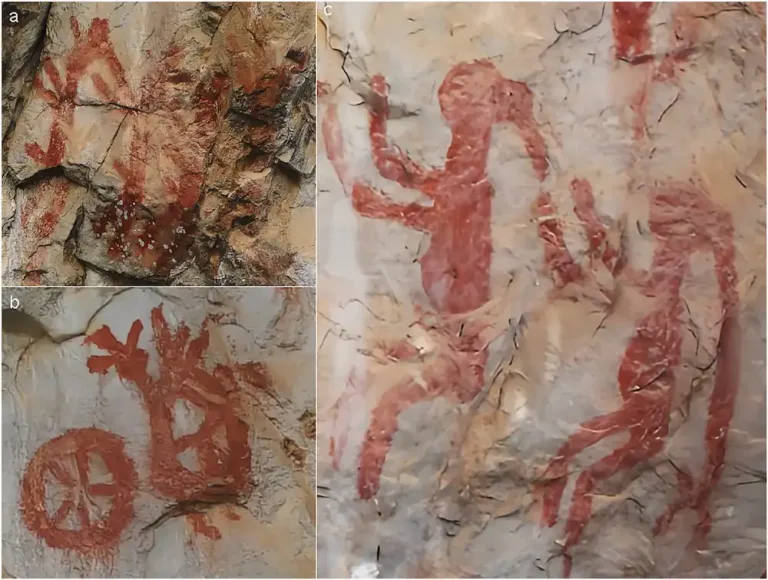
The Huashan paintings belong to a rock-art tradition extending for roughly 260 kilometers along the Zuojiang River and its tributaries. More than 80 sites are known, containing thousands of red images depicting human figures, animals, boats, weapons, bronze drums and other objects. The cultural landscape was added to UNESCO’s World Heritage List in 2016.
Much of the rock art is associated with the Luoyue communities that inhabited the region between the late first millennium BCE and the early centuries CE. Many figures were painted on steep cliff faces rising directly above rivers, sometimes in locations that would have required considerable effort to reach.
The setting has long presented researchers with a conservation puzzle. Guangxi has a hot, humid subtropical climate marked by heavy seasonal rainfall and recurring tropical storms, yet substantial areas of pigment remain firmly attached to the limestone. That unusual durability prompted researchers to investigate the materials and microscopic structure of the paintings.
Scientists uncover a layered painting technique
To avoid damaging surviving images on the cliffs, the research team examined fragments that had already detached from rock-art surfaces at Gaoshan, Daningshan and Tunpingshan. They studied the samples using several analytical techniques, including Raman spectroscopy, scanning electron microscopy, infrared spectroscopy and proteomic analysis.
The results revealed a more complex painting system than simply placing pigment on bare stone. Researchers identified three principal components: the natural limestone surface, an artificially prepared mortar layer and the red pigment above it.
The distinctive color came largely from local red clay containing extremely fine particles of hematite, an iron oxide responsible for the characteristic reddish appearance of the Huashan figures. Beneath that pigment, however, the researchers found evidence for a lime-rich mortar mixed with biological material derived from blood.
According to the proposed reconstruction, the artists probably prepared a mixture containing slaked lime, calcium phosphate and blood and spread it across the limestone surface. Red clay pigment was then applied while this underlying layer was still partly wet, allowing the materials to become closely integrated as they hardened.
Blood may have helped preserve the paintings
The blood appears to have played a more complex role than simply acting as an adhesive. As the lime reacted with carbon dioxide in the atmosphere, calcium carbonate formed, while proteins from the blood appear to have influenced the mineralization process and the development of microscopic crystals.
Those crystals formed around hematite particles and helped bind the painted layer tightly to the limestone, producing what the researchers describe as an organic-inorganic composite material. The process may help explain how the paintings survived centuries of exposure to moisture, heat and biological weathering.
The strength of the bond was particularly striking during laboratory preparation. Researchers reported that some well-preserved painted layers adhered so firmly to the stone beneath them that mechanical tools were required to separate the materials for analysis.
The findings suggest that creating Huashan rock art involved more than selecting a red pigment and finding suitable cliff surfaces. The painters also possessed practical knowledge of how different mineral and biological materials behaved when mixed together, even if the precise chemical mechanisms involved would have been understood through experience rather than modern scientific theory.
Could some of the blood have been connected to childbirth?
Proteomic analysis indicates that both animal and human blood may have been incorporated into the painting material. The researchers also raise the possibility that at least some of the human blood was associated with childbirth, although that interpretation remains considerably less certain than the identification of blood itself.
The hypothesis is linked partly to the cultural and visual context of the Huashan paintings. Among the thousands of figures are images interpreted as pregnant individuals and scenes potentially connected with sexuality or reproduction, leading the researchers to consider whether blood might have carried ritual or symbolic significance in addition to its practical role in the painting mixture.
Such a connection cannot currently be demonstrated directly. Attempts to recover usable DNA from the ancient material were unsuccessful, possibly because the highly alkaline lime mixture degraded genetic material over time. Without DNA evidence, researchers cannot determine the identity, sex or precise biological circumstances of the people whose blood entered the mixture.
The distinction is important: the presence of blood within the binding system is supported by scientific analysis, while its proposed association with childbirth remains a hypothesis requiring further evidence.
What the study establishes more clearly is that the durability of the Huashan paintings was closely connected to the materials used to make them. Their creators combined iron-rich clay, lime and biological substances in a layered preparation capable of forming a strong mineralized bond with the cliff face, helping preserve some of southern China’s most remarkable rock art for roughly two millennia.
The study, “Blood-induced biomineralized calcium carbonate used for binding in the Huashan rock art of Guangxi, Southern China,” by Meng Wu and colleagues, was published in the Journal of Archaeological Science.