
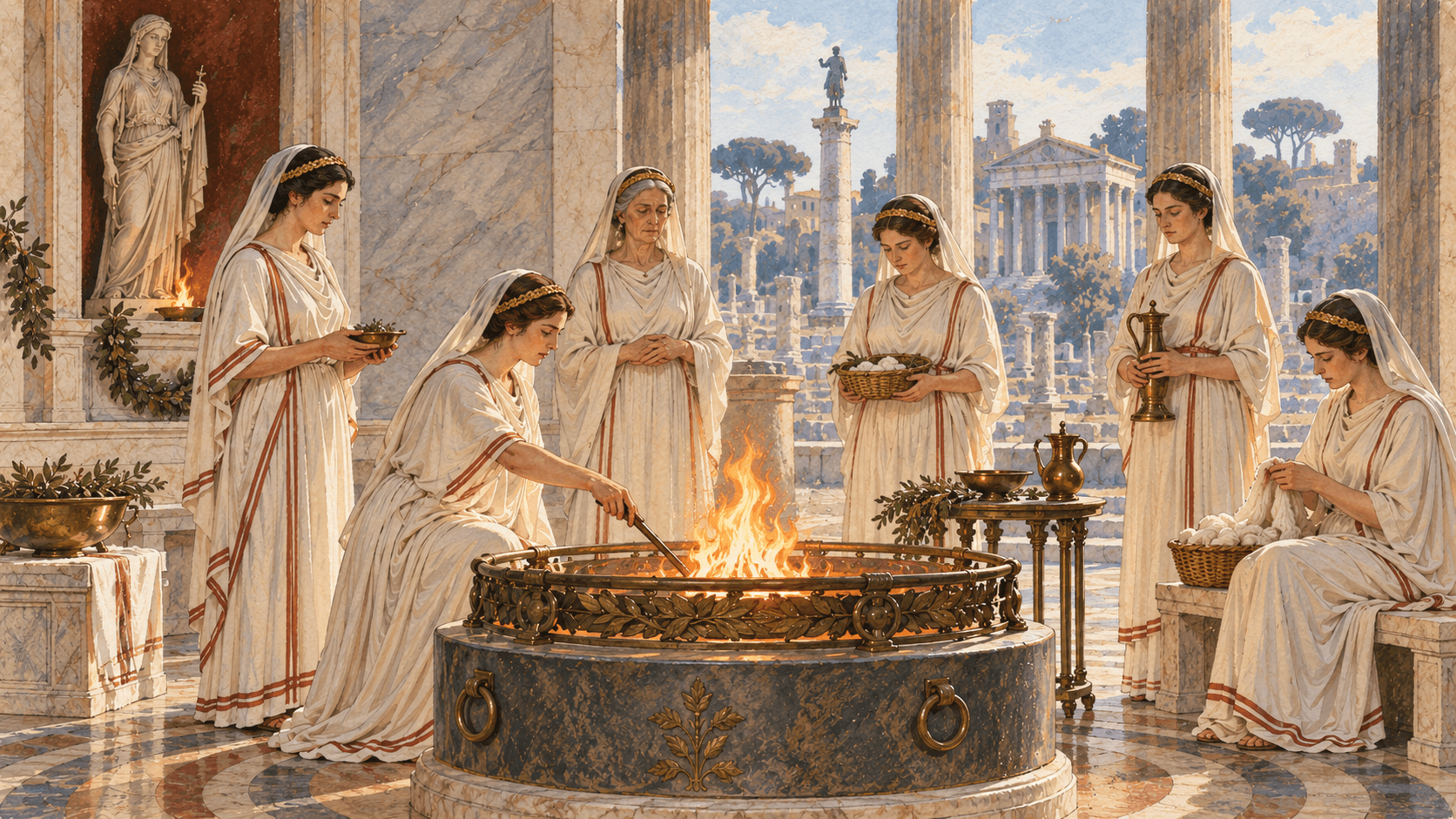
At the eastern edge of the Roman Forum, a small fire carried the symbolic weight of an empire. Its flames belonged to Vesta, goddess of the hearth, but Romans believed they represented something far greater: the security, continuity and divine protection of Rome itself.
Keeping that fire alive was entrusted to the Vestal Virgins, a group of priestesses chosen while they were still children. They received privileges denied to most Roman women, accumulated property, guarded the wills of powerful men and occupied places of honor at public events. Yet their exceptional position came at a severe price. For three decades, their bodies and behavior were treated not as private matters but as concerns of the Roman state.
The Vestals were neither secluded nuns nor simply attendants charged with watching a flame. They stood at the intersection of religion, law and political authority, occupying a unique but carefully regulated place within Roman society.
A Sacred Flame Bound to Rome’s Survival
Vesta represented the household hearth, the place around which a family prepared food, gathered and performed domestic rituals. Like other Roman goddesses associated with women and family life, her influence extended beyond private devotion. In Rome, this intimate idea was transformed into a public institution: the city itself was imagined as an enormous household, and Vesta’s flame became its communal hearth.
Roman tradition credited the organization of the cult to Numa Pompilius, the city’s legendary second king, who was believed to have ruled during the seventh century BCE. Writing many centuries later, Plutarch attributed the appointment of the first Vestals and the regulation of their duties to Numa. His account shows how Romans understood the antiquity of the institution, although it cannot be treated as contemporary evidence for Rome’s earliest history.
The flame burned inside a circular temple whose form may have recalled the round huts of Rome’s early inhabitants. Its accidental extinction could be interpreted as a warning that the relationship between Rome and its gods had been disturbed. A priestess held responsible could be punished by the pontifex maximus, Rome’s chief priest, before the fire was ritually restored.
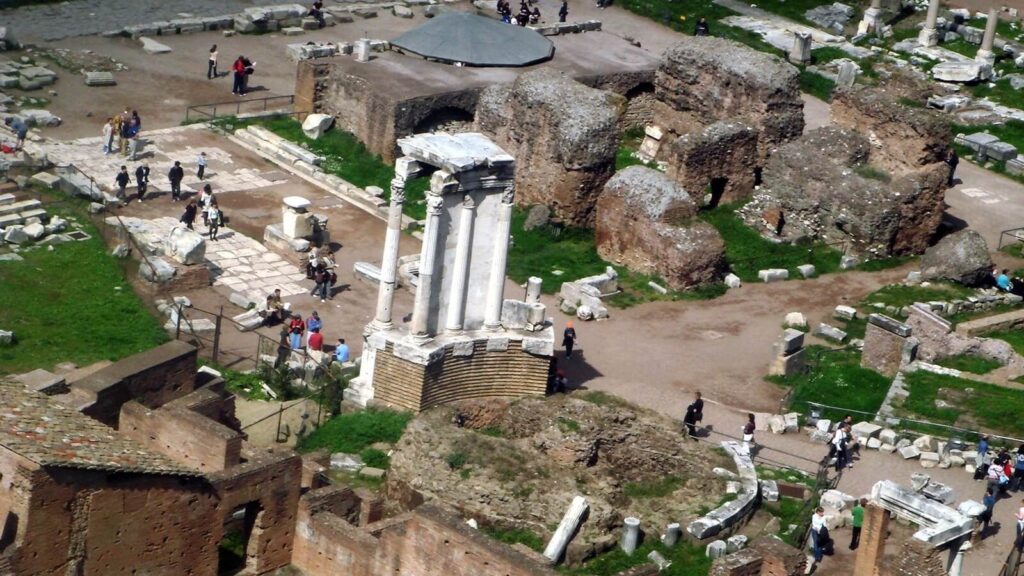
The sacred flame was expected to remain alight outside its prescribed renewal at the beginning of the old Roman year, traditionally associated with March 1. Claims that it burned completely uninterrupted for more than a millennium should therefore be approached cautiously. No continuous record survives, and the temple itself was repeatedly damaged or destroyed by fire.
The surviving architectural fragments largely belong to the reconstruction associated with Julia Domna, wife of Emperor Septimius Severus, after the fire of 191 CE. Part of the temple’s present appearance in the Roman Forum, including its raised columns, also results from modern archaeological restoration. Further information about the Temple of Vesta and the House of the Vestals is available from the Parco archeologico del Colosseo.
Chosen Before They Could Choose for Themselves
A Vestal’s future could be decided when she was between six and ten years old. The second-century Roman author Aulus Gellius recorded that a candidate was required to have both parents living and to be free from physical conditions that Roman religious law considered disqualifying.
The selection ceremony was called captio, a term conveying the sense of taking or seizing. The pontifex maximus formally removed the girl from her family and brought her into the service of Vesta. She left her father’s legal authority, but she did not enter a life free from male supervision. Ultimate religious authority over the priesthood remained with the pontifex maximus.
According to Plutarch, each Vestal served for 30 years. The first decade was devoted to learning, the second to performing the rites and the third to teaching younger priestesses. After completing her service, a woman could leave the priesthood and marry, although ancient writers claimed that few chose to do so.
Their reluctance may not have been difficult to understand. A former Vestal leaving the order would surrender a public identity and degree of legal independence rarely available to women in Rome. Marriage could mean exchanging an honored religious position for a more conventional place within a family structure dominated by male authority.

Far More Than Keepers of the Fire
Maintaining the sacred flame was the Vestals’ best-known responsibility, but it was only one part of their religious work. They collected water for rituals and prepared mola salsa, a mixture of salted flour sprinkled on sacrificial victims during important Roman ceremonies.
The priestesses also guarded sacred objects associated with Rome’s survival. The most famous was the Palladium, a revered image believed to have been brought from Troy by the hero Aeneas. Whether such an object was actually kept inside the temple cannot be demonstrated archaeologically, but Roman tradition counted it among the pignora imperii, sacred pledges upon which the endurance of Roman power supposedly depended.
Their reputation for inviolability and trustworthiness gave the Vestals an additional role in political life. Important documents and private wills could be placed in their custody. Suetonius records that Julius Caesar entrusted his will to the chief Vestal, who produced it after his assassination in 44 BCE.
Depositing a document with the priestesses was more than a ceremonial gesture. It placed the document under the protection of women whose religious standing made interference both politically dangerous and potentially sacrilegious.
Privileges Denied to Most Roman Women
The legal position of Roman women varied according to period, family status and form of marriage. Nevertheless, their financial and legal autonomy was frequently limited by family authority or guardianship. The Vestals occupied an exceptional position outside many of these restrictions.
Once admitted to the priesthood, they were released from their father’s authority and could manage property, prepare wills and conduct legal affairs without the approval normally expected from a male guardian. Their testimony could be accepted in court without the customary oath, while their sacred status granted them a public authority few women could approach.
Vestals travelled through the city with attendants, received prominent seats at spectacles and were shown visible respect by magistrates. Assaulting one was a capital offence because her person was considered sacred.
Ancient accounts even associated their presence with the power to save the condemned. Plutarch wrote that a prisoner being led to execution could be spared after an accidental encounter with a Vestal, provided she swore that the meeting had not been arranged. The story is often exaggerated into a claim that Vestals could release prisoners merely by touching them, but the ancient account describes a much narrower religious privilege.
They could also intervene in political affairs. Suetonius reports that the Vestals joined members of Julius Caesar’s family in appealing to the dictator Sulla when the young Caesar was threatened with death. Their intervention did not represent an independent system of female political power, but it demonstrates that Rome’s most powerful men could not easily disregard their influence.
Their position arose because consecration removed them from the social and legal category occupied by most Roman women. The independence they acquired remained inseparable from the sacred identity they were required to maintain.
When a Woman’s Body Became an Affair of State
A Vestal was required to remain sexually untouched throughout her years of service. Breaking that obligation was classified as incestum, a religious violation whose meaning was broader than the modern word “incest.” The offence was believed to damage the relationship between Rome and its gods.
Modern researchers have consequently moved beyond explanations based entirely on personal morality. Scholars differ over the precise symbolism of Vestal virginity, but many connect the priestesses’ bodily integrity with the security and protected boundaries of Rome.
Classicist Holt N. Parker argued that their virginity helped express the integrity of the Roman state. Researchers including Robin Lorsch Wildfang and Paul Erdkamp have further examined how the Vestals’ religious position intersected with Roman law, political authority and periods of military crisis.
Accusations of incestum were particularly significant during war, epidemic, social unrest or military defeat. When disasters suggested that divine favor had been withdrawn, the conduct of a small group of highly visible women could provide Rome with both an explanation and a target.
This does not demonstrate that every charge was fabricated. It does mean that the surviving trials cannot be separated from the political and religious anxieties surrounding them. A Vestal’s sexual conduct was never regarded as an entirely private act; it was interpreted through the fears of the Roman state.
The Punishment Rome Refused to Call an Execution
A Vestal convicted of incestum faced one of Rome’s most notorious punishments. She was carried in a covered conveyance to an underground chamber near the Colline Gate, in an area known as the Campus Sceleratus, or “Accursed Field.” After she entered, the opening was sealed.
A small quantity of food, water, oil and light was reportedly left inside. This allowed Roman authorities to maintain the legal and religious fiction that they had neither directly killed a sacred priestess nor spilled her blood. In practice, she had been condemned to die beneath the earth.
Her alleged partner faced no such ritual restraint and could be beaten to death publicly. The difference reveals that the Vestal’s punishment was designed not only to kill but also to resolve a religious contradiction: Rome sought to remove a woman it considered polluted without openly executing someone whose person had been declared sacred.
Convictions were rare, and accusations did not always result in death. In 420 BCE, the Vestal Postumia was investigated after her clothing, wit and behavior were judged insufficiently restrained. Livy reports that she was acquitted but instructed to dress more modestly and avoid making jokes. Her case shows how expectations surrounding female appearance and personality could contribute to suspicion even without proof of sexual misconduct.
Cornelia’s Final Descent
One of the most disturbing accounts concerns Cornelia, a chief Vestal condemned during the reign of Emperor Domitian in the late first century CE. Pliny the Younger believed that she was innocent and accused the emperor of seeking a spectacular punishment that would make his reign memorable.
Pliny described Cornelia maintaining her dignity as she was taken to the underground chamber. When her clothing caught as she descended, she reportedly turned to free it rather than allow an attendant to touch her. In Pliny’s telling, she continued to observe the standards of ritual propriety even as Rome’s religious authorities prepared to bury her alive.
His account must nevertheless be read with care. Pliny was deeply hostile to Domitian, and his description was shaped by the political destruction of the emperor’s reputation after his death. It is a valuable ancient testimony, but it is not a neutral transcript of Cornelia’s trial.
The episode still demonstrates how a Vestal prosecution could become an imperial performance. Questions of evidence and guilt were entangled with religion, public punishment and the political image of the emperor who ordered it.
How Rome’s Eternal Flame Disappeared
The end of the Vestals was quieter than the punishments for which they later became famous. As Christianity gained imperial support during the fourth century CE, the financial and political foundations sustaining Rome’s traditional cults were gradually dismantled.
Emperor Gratian withdrew state funding from the cult of Vesta in 382 CE. Measures introduced under Theodosius I in 391 and 392 further restricted public pagan sacrifice and worship, after which the Vestals disappeared from the historical record. The often-repeated claim that Theodosius personally ordered the sacred flame to be extinguished cannot be securely demonstrated.
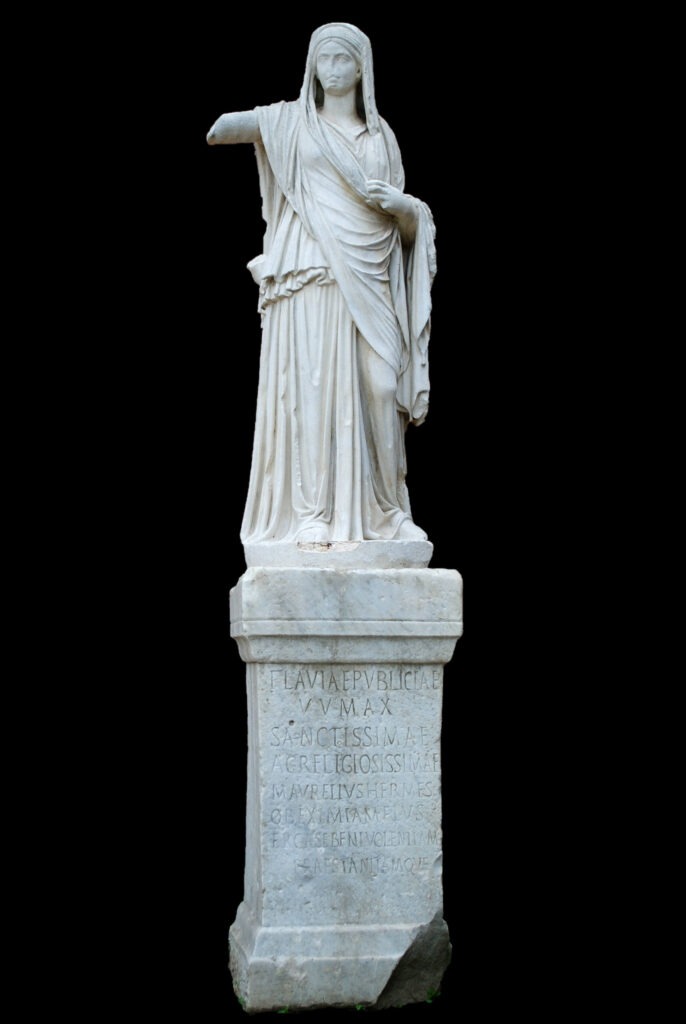
One of the last identifiable figures connected with the institution was Coelia Concordia, the final known Virgo Vestalis Maxima, or chief Vestal. An inscription records her dedicating a statue in 385 CE, offering a brief glimpse of the priesthood shortly before it vanished.
The exact moment when Vesta’s flame went out is unknown. The absence of a dramatic final account may be appropriate for an institution that had survived Rome’s kings, Republic and centuries of imperial rule. It did not end with the fall of the city but faded as Rome abandoned the religious system that had once made the lives of six women essential to its survival.
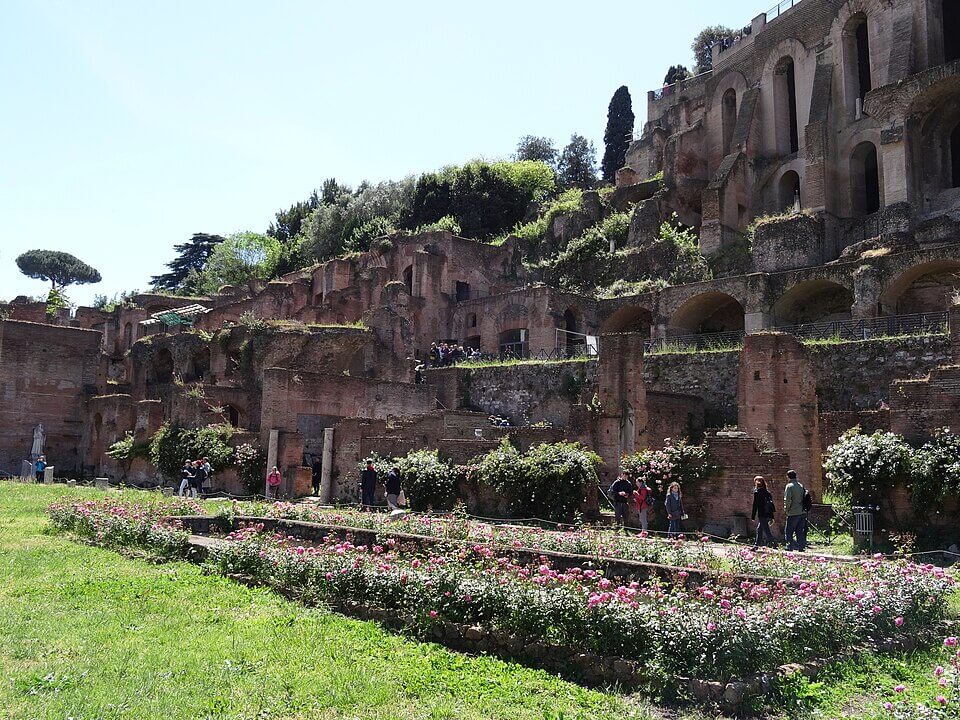
Today, the reconstructed columns and circular foundations of Vesta’s temple stand near the ruins of the Vestals’ residence in the Roman Forum. They preserve the setting of an institution that granted women exceptional authority while making their bodies symbols of public security. The flame was intended to embody Rome’s permanence, but the lives constructed around it reveal how easily extraordinary power could become absolute control.
Cover Image: An artistic reconstruction of six Vestal Virgins tending the sacred flame of Vesta in ancient Rome. AI-generated illustration.