
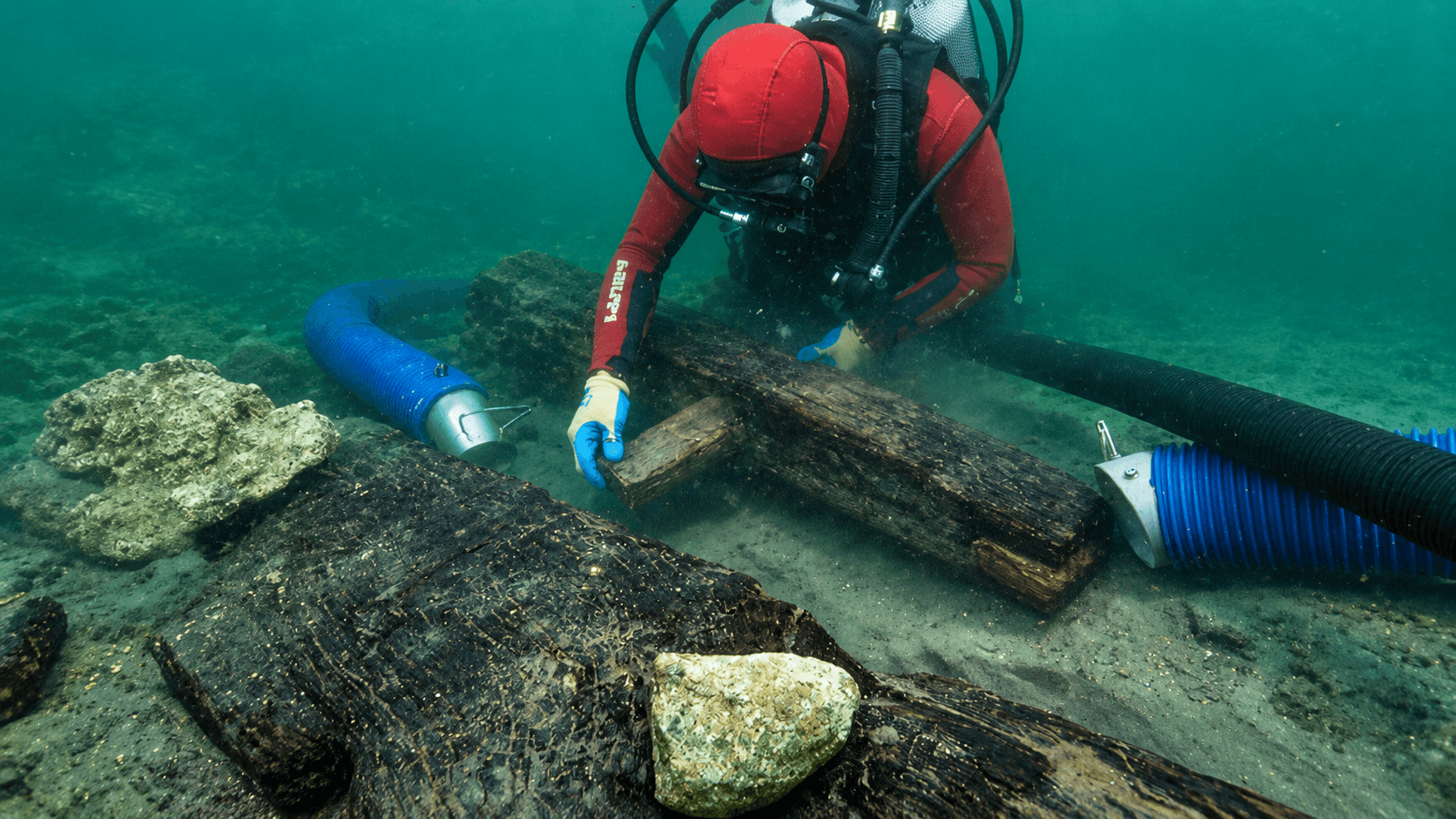
For centuries, one of Herodotus’ most detailed passages about ancient Egypt presented historians with a problem. The Greek writer described an unusual Nile cargo boat built from short pieces of acacia wood arranged “like bricks,” yet no surviving vessel seemed to match his account. That changed when an ancient Egyptian shipwreck was examined beneath the waters of Thonis-Heracleion.
That changed with Ship 17, a remarkably preserved vessel uncovered at the submerged port city of Thonis-Heracleion in Egypt. Its hull was built in such a distinctive way that archaeologists could compare it with Herodotus’ account almost detail by detail.
The discovery did not prove that everything written by the ancient historian was accurate. It did, however, provide powerful archaeological support for a technical description that had remained difficult to understand for nearly 2,500 years.
A ship beneath Egypt’s lost Mediterranean gateway
Ship 17 was identified during the underwater investigations that followed the rediscovery of Thonis-Heracleion in Aboukir Bay in 2000. The work was led by underwater archaeologist Franck Goddio and the European Institute for Underwater Archaeology in cooperation with Egypt’s antiquities authorities.
The vessel was one of more than 70 ancient ships located in the ports and canals of the submerged city. Thonis-Heracleion stood where a navigable branch of the Nile reached the Mediterranean, placing it in control of one of the principal maritime routes into Egypt before Alexandria rose to prominence.
Although Ship 17 attracted international attention in 2019, it was not a newly discovered wreck at that time. The renewed interest followed the publication of maritime archaeologist Alexander Belov’s detailed monograph, Ship 17: A Baris from Thonis-Heracleion, which brought together the excavation evidence and a reconstruction of the vessel.
Ship 17 has been dated from the early fifth to the middle of the fourth century BCE, close to the period in which Herodotus visited Egypt. About 70 percent of its hull was excavated, while the section still protected by clay was left in place. Researchers reconstructed the ship as a substantial cargo vessel measuring approximately 28 meters long and eight meters wide.
Herodotus described a boat built “like bricks”
In Book Two of the Histories, written around 450 BCE, Herodotus explained how Egyptians built a cargo boat known in Greek as a baris. Acacia wood was cut into short planks, he wrote, and the pieces were laid out in a pattern resembling brickwork.
Long wooden fastenings connected the planks, beams crossed the hull and the seams were sealed from inside with papyrus. The vessel had a single rudder passing through an opening in its bottom, while its mast was made from acacia and its sail from papyrus.
The passage was unusually specific, but some of its terminology puzzled generations of scholars. Without a surviving hull constructed in the same tradition, it was difficult to picture exactly what Herodotus meant.
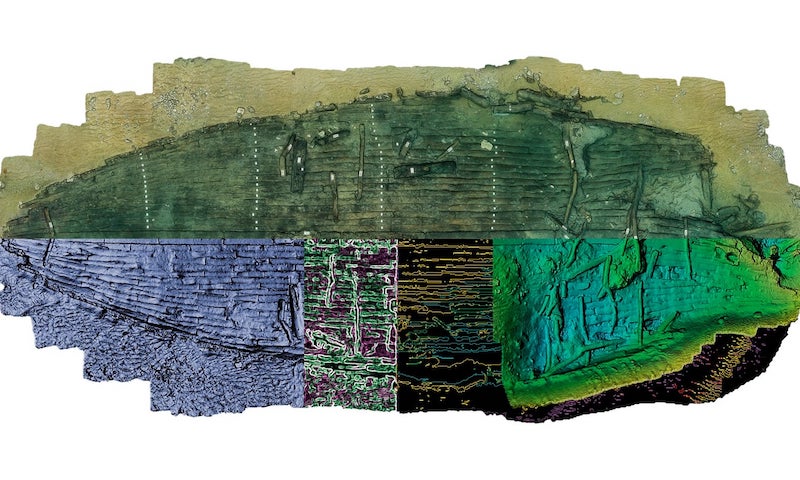
Ship 17 supplied the missing evidence. Its thick acacia planks were arranged in staggered rows and joined by exceptionally long wooden tenons. Some extended for almost two meters through several planks, forming internal lines that helped explain previously obscure parts of the ancient text.
The arrangement of the planking, transverse beams, mast and steering system all showed close parallels with the baris described by Herodotus. The method used to assemble and seal the hull was also consistent with his account.
There were differences. The planks in Ship 17 were longer than those specified by Herodotus, and its hull included framing elements apparently absent from his description. Belov suggested that these variations could be explained by the vessel’s greater size or by differences among ships belonging to the same building tradition.
For this reason, researchers do not claim that Ship 17 was necessarily identical to the boat described by Herodotus. It is more cautiously identified as a baris or a closely related type of Egyptian river freighter.
Ship 17 may never have been accidentally wrecked
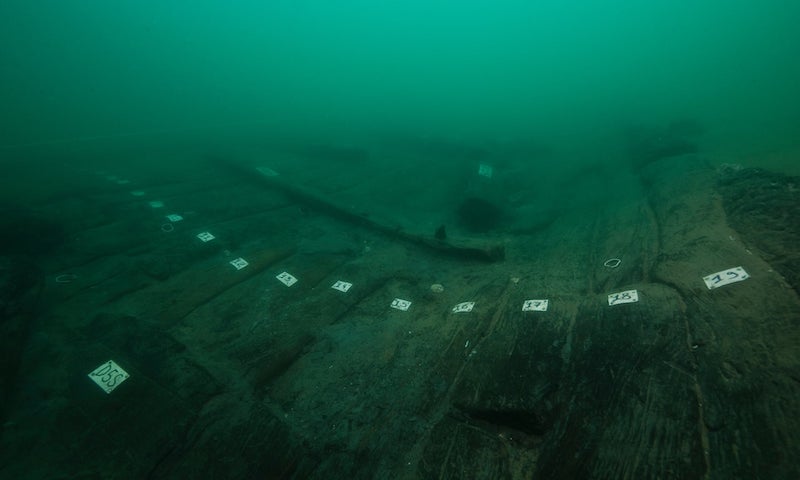
Further study of the site added an unexpected twist to the vessel’s history. Ship 17 is commonly described as a shipwreck, yet the evidence suggests that it did not reach the bottom in a sudden accident.
No cargo, equipment or personal belongings associated with its crew were found inside the hull. Instead, archaeologists documented 14 long wooden piles driven as much as three meters into the harbor floor around it.
The arrangement indicates that the aging vessel was deliberately secured at the end of a jetty, possibly to extend the landing place into deeper water. The hull appears to have remained watertight, allowing this floating addition to rise and fall with the changing level of the Nile.
Ship 17 had therefore been given a second life after it stopped carrying goods. Rather than being broken apart for timber, the large hull became part of the port itself.
Research led by Damian Robinson of the Oxford Centre for Maritime Archaeology showed that this was not an isolated practice at Thonis-Heracleion. Some old ships were dismantled, but others were abandoned, incorporated into harbor infrastructure or perhaps deliberately sunk during religious ceremonies. Ship 43 may even have formed part of a pontoon bridge connecting islands within the city.
Later discoveries revealed a crowded working harbor
No research published since 2019 has overturned the identification of Ship 17 as a likely baris. Later discoveries have instead expanded the maritime setting in which vessels of this kind operated.
During the 2021 excavation season, archaeologists found a small wooden rudder near another shipwreck at Thonis-Heracleion. The find did not provide new evidence about Ship 17 itself, but its construction added to the growing record of Egyptian steering technology at the port. Belov published the object in the International Journal of Nautical Archaeology in 2022.
Two rare one-armed wooden anchors discovered in the city’s ancient canals were examined in a separate study published in 2024. Pottery found in the same contexts dated the anchors to the fifth and fourth centuries BCE, broadly contemporary with Ship 17. Their preservation in the clay-rich sediments offered another glimpse of the ships, crews and cargo operations that once crowded the waterways of Thonis-Heracleion.
Together with the dozens of vessels already recorded, these finds have turned the submerged city into an exceptional archive of Egyptian maritime life. They show a working port where riverboats, seagoing ships and reused hulls formed part of the same busy landscape.
What Ship 17 really tells us about Herodotus
Herodotus remains a complicated historical source. Some of his accounts have been supported by archaeology, while others contain exaggerations, misunderstandings or stories gathered from people he encountered during his travels.
Ship 17 does not establish that he was reliable in every case. It demonstrates something far more precise: his description of an Egyptian Nile freighter preserved genuine technical knowledge that remained difficult to understand until a closely matching hull emerged from the clay of Thonis-Heracleion.
Nearly 2,500 years later, the timbers showed that on this occasion, the ancient historian had been looking closely.
Cover Image: An underwater archaeologist examines the remains of Ship 17 at the submerged Egyptian port of Thonis-Heracleion. Credit: Christoph Gerigk / Franck Goddio / Hilti Foundation