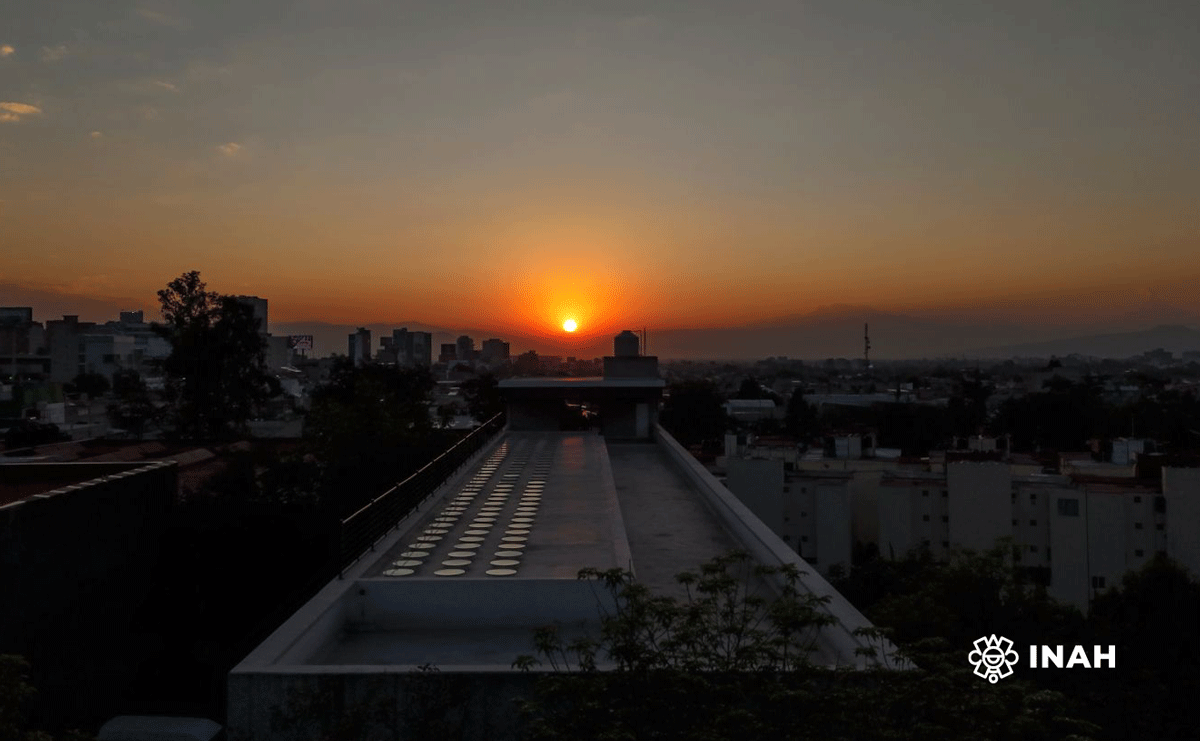
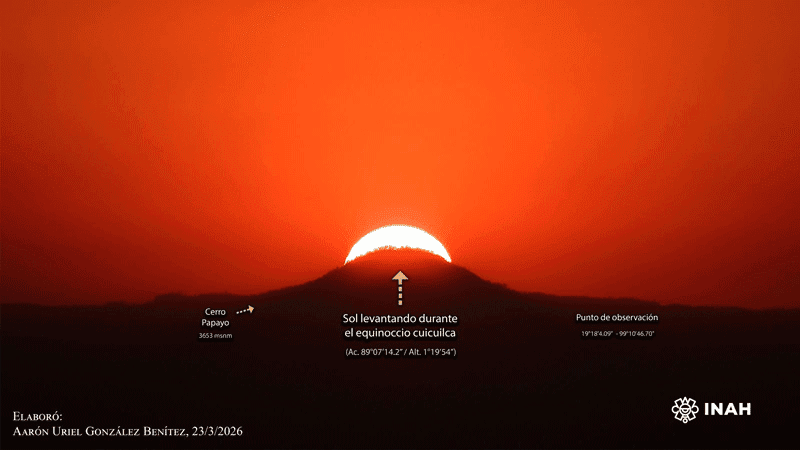
At sunrise near the spring equinox, the sun rises directly in line with a prominent hill on the eastern horizon of Cuicuilco—an alignment that may not be accidental. A new study suggests this ancient Mexican city was deliberately designed to follow the movement of the sun, pointing to an early form of astronomical urban planning.
A Solar Blueprint in the Landscape
Researchers from Mexico’s National Institute of Anthropology and History (INAH) argue that Cuicuilco’s urban layout reflects a close relationship between architecture, landscape, and celestial observation. The key feature in this alignment is the Papayo hill, located to the east, where the sun appears to rise during equinox mornings.
According to archaeoastronomer Aarón Uriel González Benítez, this alignment may have been tied not only to observation, but to timekeeping itself. The position of the sun along the horizon appears to correspond with important moments in the pre-Hispanic calendar known as the Cempohuallapohualli.
In particular, the dates around March 23–24 and September 20 align with the beginnings of the tozoztontli and teotleco periods—suggesting that Cuicuilco’s inhabitants followed a culturally defined version of the equinox.
Rethinking the Equinox
While modern definitions place the equinox on March 20 or 21, the study introduces a more nuanced idea: not all equinoxes are strictly astronomical.
González Benítez describes what he calls a “cultural equinox”—a concept based on how ancient societies interpreted the sun’s movement in relation to their own calendrical systems. Rather than marking a single global date, this approach reflects localized observations tied to landscape and tradition.
Modern Buildings, Ancient Directions
One of the most intriguing findings is that this solar orientation appears to extend beyond the ancient city itself.
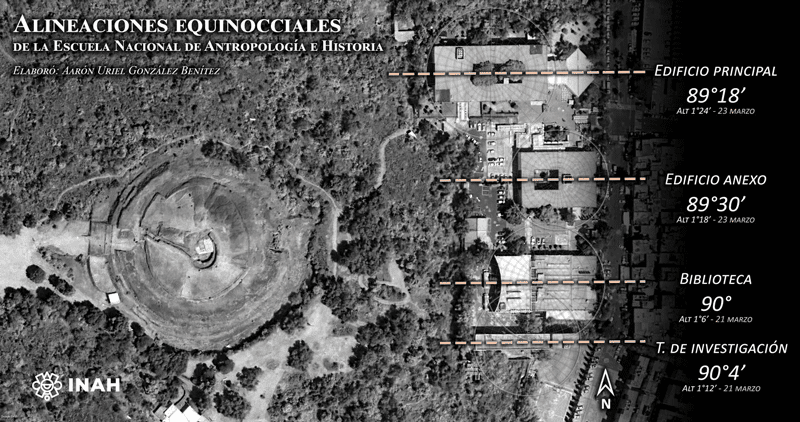
Several buildings at the National School of Anthropology and History (ENAH), including its main complex, library, and research tower, are aligned within a narrow azimuth range of 89° to 90°, effectively pointing toward geographic east—the direction of equinox sunrise.
This phenomenon was observed directly on March 23, 2026, when researchers documented the alignment at dawn.
Nearby urban features, such as the grid layout of the Isidro Fabela neighborhood, also follow similar directional patterns. While these elements are modern, their orientation mirrors that of the ancient structures—raising questions about continuity, coincidence, or long-standing spatial logic in the area.
Echoes from Cuicuilco’s Earliest Architecture
To the west of ENAH lie the archaeological remains of Cuicuilco A and Cuicuilco B, two of the earliest monumental complexes in the Valley of Mexico.
Within Cuicuilco B, structures known as Buildings VI and VIII display a geometry and orientation that appear intentionally directed toward both the Papayo hill and the rising sun during equinox periods.
This supports the idea of an integrated “architecture–landscape–sun” model, in which urban design was used to express cosmological order. In pre-Hispanic Mesoamerica, cities were not simply settlements—they were conceived as symbolic centers of the universe, structured around celestial cycles.
Coincidence or Cultural Continuity?
Despite the strong correlations, researchers emphasize that it remains unclear whether modern urban planning in the area consciously preserved these ancient alignments.
Still, the repeated orientation—from pre-Hispanic structures to contemporary institutions—suggests more than a random pattern.
As José Manuel Castillo Hernández of ENAH notes, such alignments offer a powerful bridge between past and present, keeping ancient astronomical knowledge alive while enriching modern cultural and educational identity.