
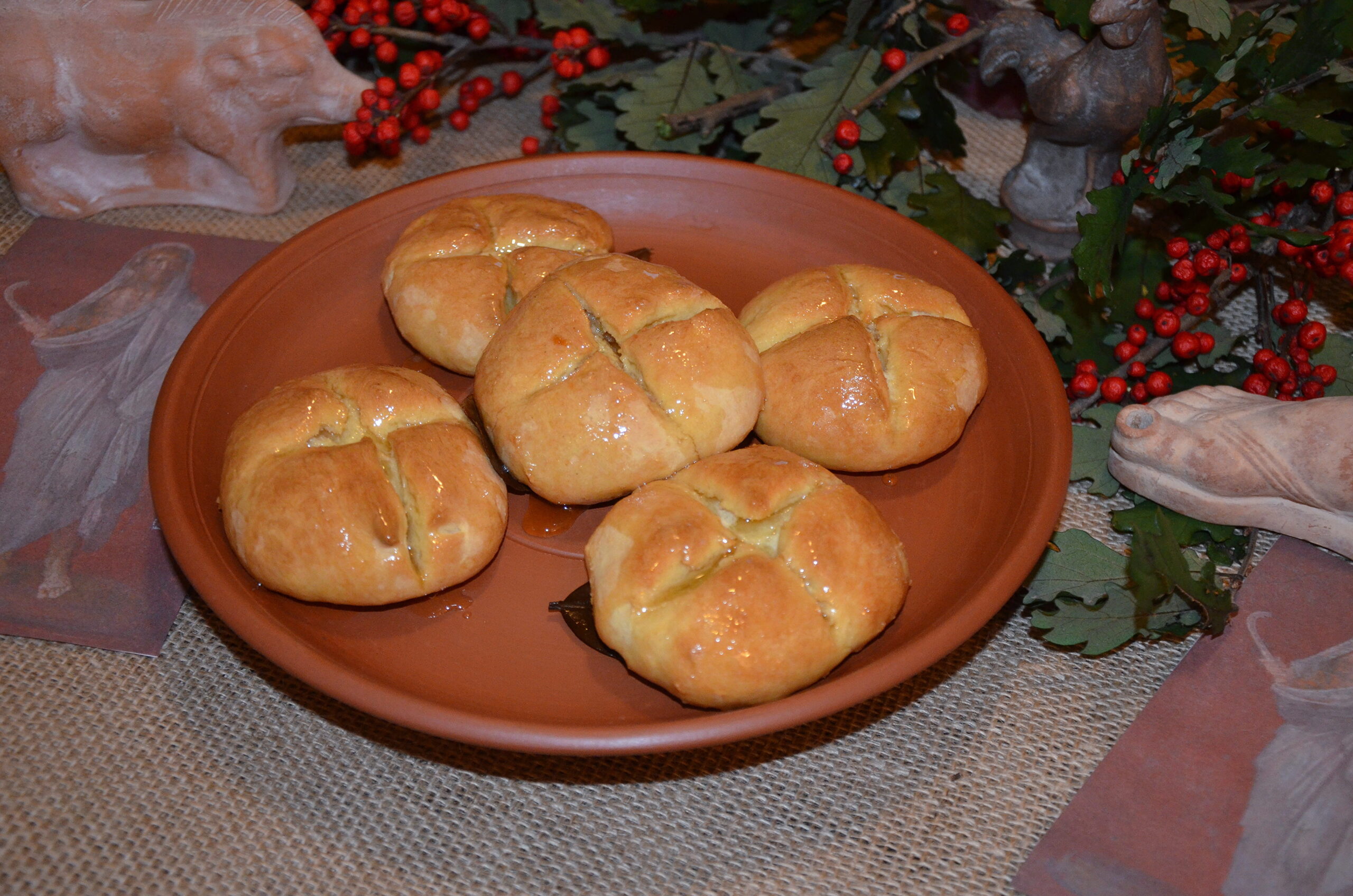
More than 2,000 years before New York cheesecake became famous, ancient Greeks were already preparing cheese-rich cakes sweetened with honey. A related Roman recipe recorded by Cato the Elder called for the cake to be covered with honey and scattered with poppy seeds before serving.
These early creations would not have looked or tasted exactly like today’s cheesecake. Nevertheless, surviving texts reveal a long Mediterranean tradition of transforming fresh cheese into rich cakes served at banquets, religious ceremonies and other special occasions.
The Ancient Greek Ancestor of Cheesecake
Ancient Greeks prepared several varieties of cake, although the term most closely connected with this culinary tradition is plakous. Derived from a word meaning “flat,” it probably described a broad category of flat or layered cakes rather than one standardized dish.
Some versions combined wheat flour, fresh cheese and honey, while others included nuts or dried fruit. Honey was particularly important because refined sugar was unavailable in the ancient Greek kitchen.
Much of what is known about these cakes survives through Athenaeus of Naucratis, who wrote Deipnosophistae, or The Learned Banqueters, around the late second or early third century AD. His extensive work preserved passages from numerous earlier Greek authors whose writings have otherwise been lost.
Among them was the fourth-century BC comic poet Antiphanes, who described a plakous prepared with flour, goat’s cheese and honey. Athenaeus also quoted passages mentioning cheesecakes soaked in honey and sold in Athens alongside fruit, honeycomb and other delicacies.
These accounts show that cheese-based cakes were familiar in the Greek world centuries before Athenaeus. However, they do not reveal one definitive recipe that can confidently be described as the world’s first cheesecake. Plakous appears to have existed in several forms, much like the numerous regional varieties of cheesecake eaten today.
Was Cheesecake Served at the First Olympics?
Popular accounts often claim that cheesecake originated on the Greek island of Samos around 2000 BC and was served to athletes at the first recorded Olympic Games in 776 BC as an early energy food.
Although cheesemaking has extremely ancient roots, these specific stories are difficult to connect to a surviving ancient source or securely identified archaeological discovery. Cheese molds demonstrate dairy production, but they cannot by themselves prove that cheesecake was being prepared.
The written evidence presents a more reliable—and equally interesting—picture. Greek authors clearly knew cakes made with cheese and honey, but the frequently repeated connection with the first Olympic Games remains uncertain.
A Roman Recipe Comes Closer to Modern Cheesecake
The clearest surviving recipes appear in De Agri Cultura, an agricultural manual written by Cato the Elder during the second century BC. Cato provided instructions for several cheese-based preparations, including libum, savillum and the layered cake known as placenta.
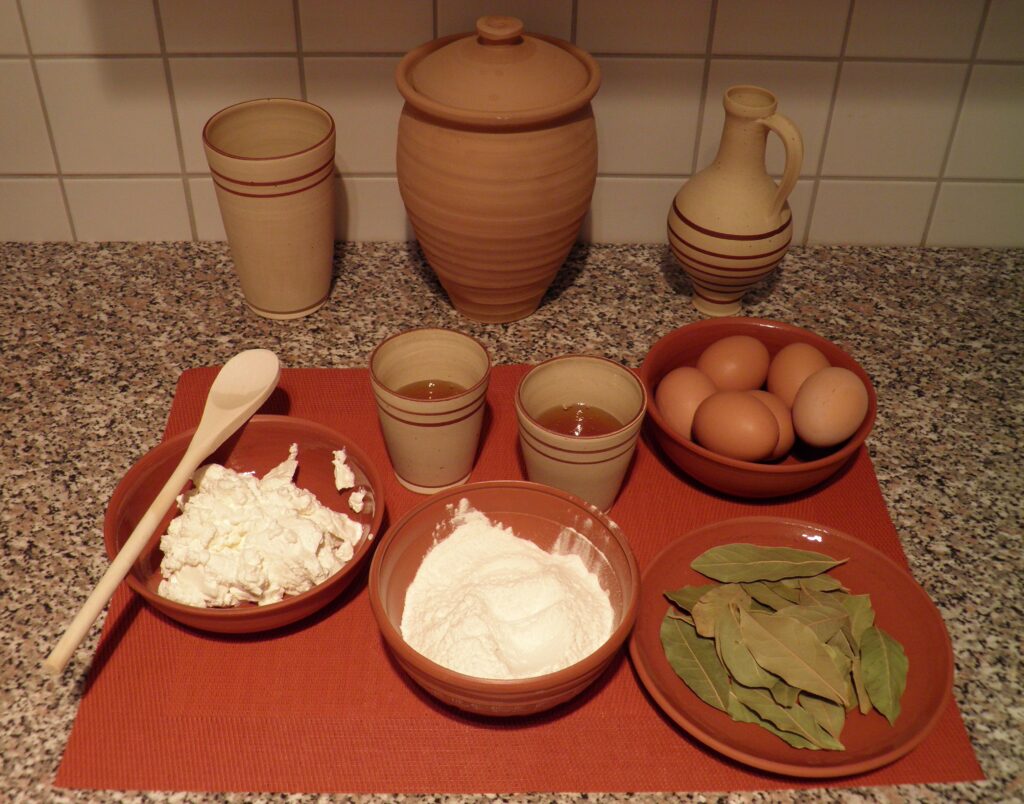
Libum was made by mixing cheese with flour and an egg before baking the dough on leaves. It was closely associated with religious offerings, showing that such cakes belonged not only to the dining table but also to ritual life.
Savillum bears an even closer resemblance to a baked cheese dessert. Cato instructed the cook to combine a large quantity of cheese with flour, honey and egg, bake the mixture in an earthenware dish and then cover it with additional honey. Poppy seeds were scattered over the surface before the cake was briefly returned to the heat.
Placenta was a more elaborate preparation. Layers of dough were arranged with a filling of cheese and honey, baked on bay leaves and finished with more honey. Rather than resembling a smooth New York cheesecake, the result may have looked more like a layered cheese pastry.
From Plakous to New York Cheesecake
The names, ingredients and techniques recorded in Roman sources reflect extensive interaction between Greek and Roman food traditions. Even the Latin word placenta was derived from the Greek plakous.
This does not mean that a single recipe travelled unchanged from an ancient Greek kitchen to a modern New York bakery. Ingredients, baking techniques and ideas about dessert evolved repeatedly as cheese-based cakes spread through Europe.
Modern cheesecake usually relies on cream cheese or another soft dairy product, together with sugar and often a biscuit or pastry base. Its ancient relatives were probably denser, less sweet and more strongly flavoured by fresh cheese and honey.
Rather than declaring one ancient baker the inventor of cheesecake, the surviving evidence reveals something more meaningful. Greek and Roman cooks were part of an established tradition of making cheese-rich cakes more than two millennia before New York gave the dessert its most famous modern identity.
Cover Image: A modern reconstruction of libum, a cheese-rich Roman cake recorded by Cato the Elder and baked on bay leaves. Credit: Carole Raddato / Wikimedia Commons, CC BY-SA 2.0