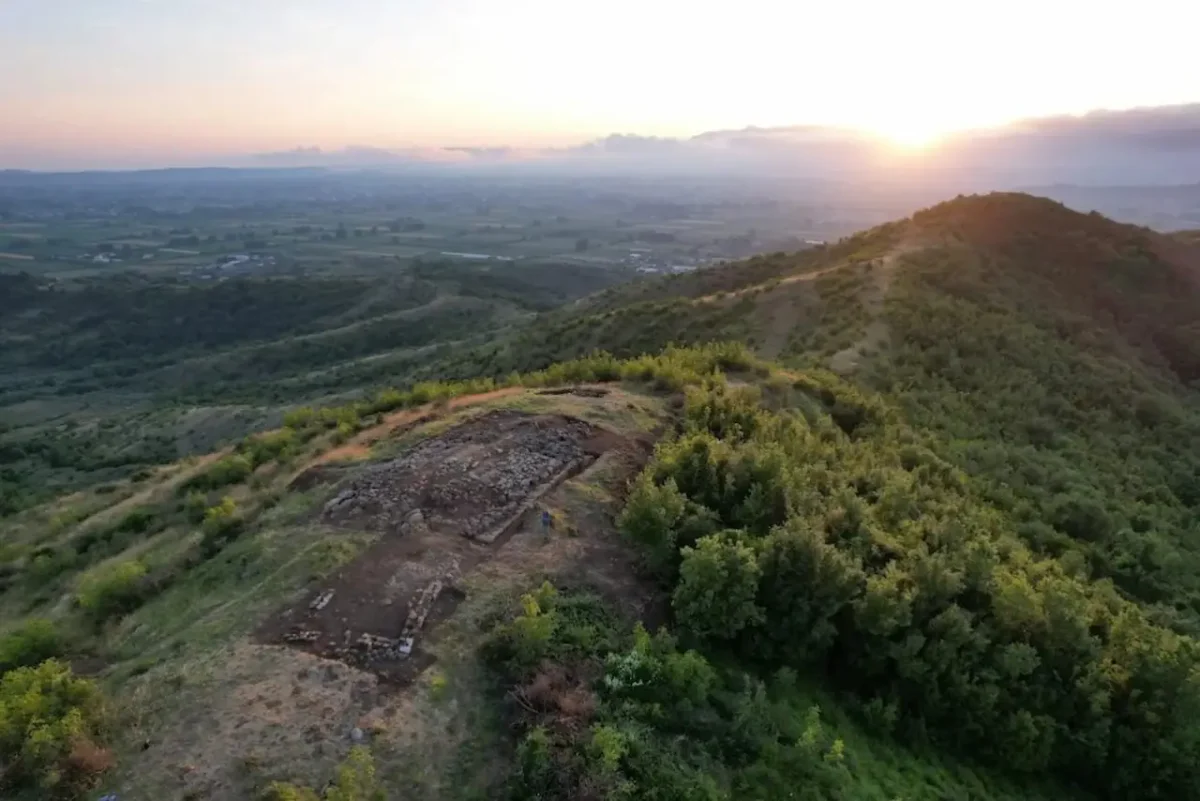
Archaeologists working in northern Albania have uncovered the stone foundations of an ancient temple on the hilltop acropolis of Bushat, a site increasingly linked to the lost Illyrian city of Bassania.
The discovery was made by a joint team from the University of Warsaw and the University of Tirana during the latest excavation season. Bushat lies about 10 kilometers south of Shkodra, one of the main historic centers of northern Albania and a key region for understanding the ancient western Balkans.
At the highest point of the settlement, the team exposed the complete foundations of a rectangular monumental building measuring 13.6 meters long and 9.6 meters wide. Its proportions, layout and position on the summit closely match the architectural logic of classical Greek temples.
Researchers believe the structure may be the first Illyrian cult building identified in this part of Albania. Its location on the acropolis, its careful orientation and its commanding visibility over the surrounding landscape all point to a religious function.
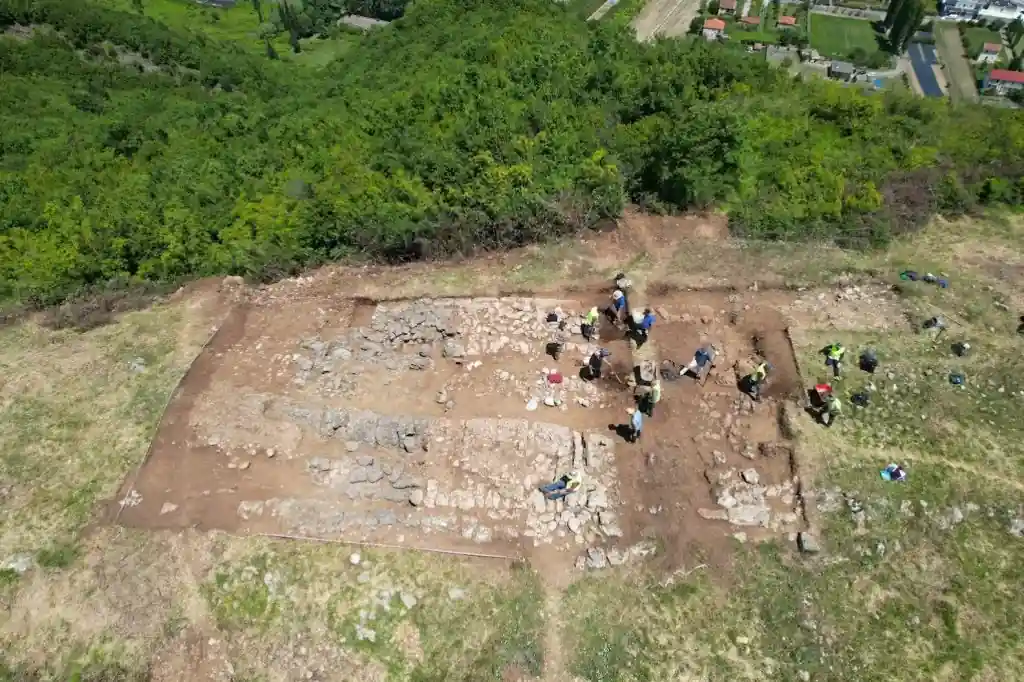
A sanctuary at the top of the city
The building stood where it would have been difficult to miss. Set on the crest of the hill, it likely crowned the ancient city and shaped the skyline of the settlement.
Prof. Piotr Dyczek, director of the Centre for Research on the Antiquity of Southeastern Europe at the University of Warsaw, said the position of the structure and its alignment with the cardinal directions support its interpretation as a temple.
The temple is thought to date between the 4th and 2nd centuries BC. That period was marked by strong contact between Illyrian communities, Greek cities and the wider Hellenistic world along the Adriatic.
Bushat’s temple does not simply suggest imitation of It points to a more interesting process: local Illyrian communities adapting familiar Mediterranean forms to their own urban, religious and political setting.
A rare trace of Illyrian sacred architecture
The Illyrians are better known from fortifications, hilltop settlements and ancient accounts of warfare than from their religious buildings. For northern Albania in particular, clear archaeological evidence for cult architecture has remained limited.
That is what makes the Bushat discovery stand out. The temple foundations add a new dimension to the city, showing that sacred architecture could occupy the most prominent point in an Illyrian urban landscape.
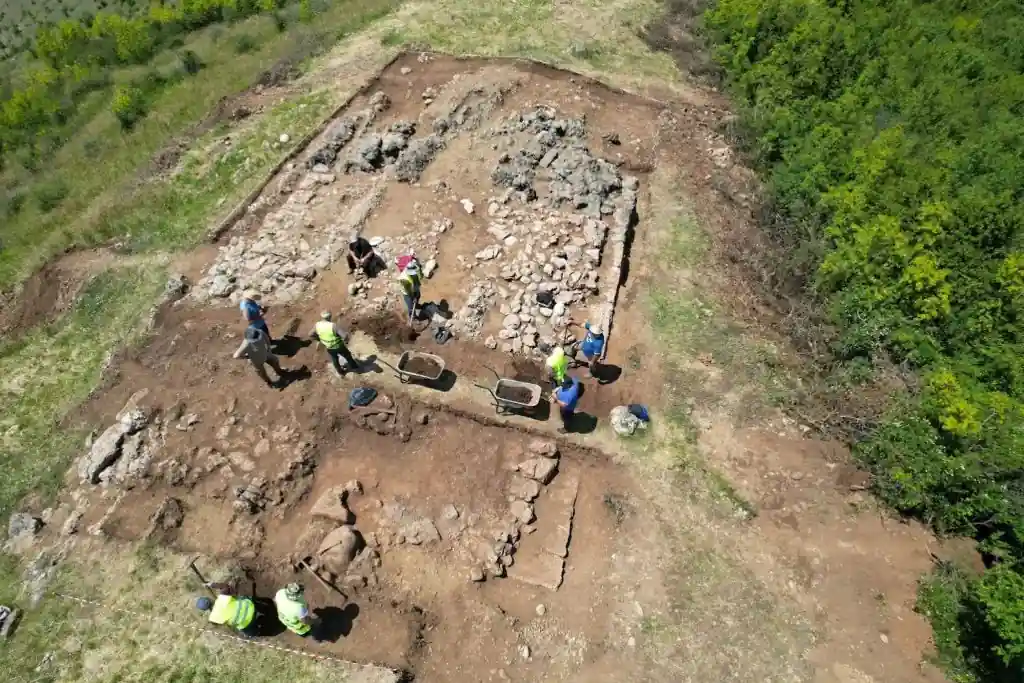
During the same excavation campaign, archaeologists also documented part of the defensive wall surrounding the hill. The wall appears to have done more than protect the acropolis. It may also have marked the boundary of a sacred precinct around the temple.
In Greek and Hellenistic tradition, such a defined sacred area was known as a temenos. At Bushat, this idea seems to have been absorbed into an Illyrian setting, where defense, ritual and civic identity met on the same hilltop.
New evidence for ancient Bassania
Bushat has been under systematic investigation since 2018, when Polish and Albanian archaeologists began studying the site in detail. Topographic research, combined with ancient written sources, has led the team to suggest that the settlement may be Bassania.
Bassania is mentioned in classical texts, but its precise location remained uncertain for centuries. The discovery of a monumental temple on the acropolis now strengthens the case that Bushat was not a minor hill settlement, but a significant Illyrian city.
The city was abandoned during the Hellenistic period, yet the hill did not lose its strategic value. In the 3rd century AD, the Romans built a smaller structure beside the ruined temple. Archaeologists interpret it as a possible lookout post that remained in use for almost a century.
From that elevated position, the surrounding territory could be watched from Shkodra toward ancient Lissos and the Adriatic coast. A place once defined by ritual and urban identity was later reused for military observation.
The temple at Bushat gives the lost city of Bassania a sharper archaeological profile. More importantly, it shows an Illyrian city not only through its walls, but through the sacred monument that once stood above them.