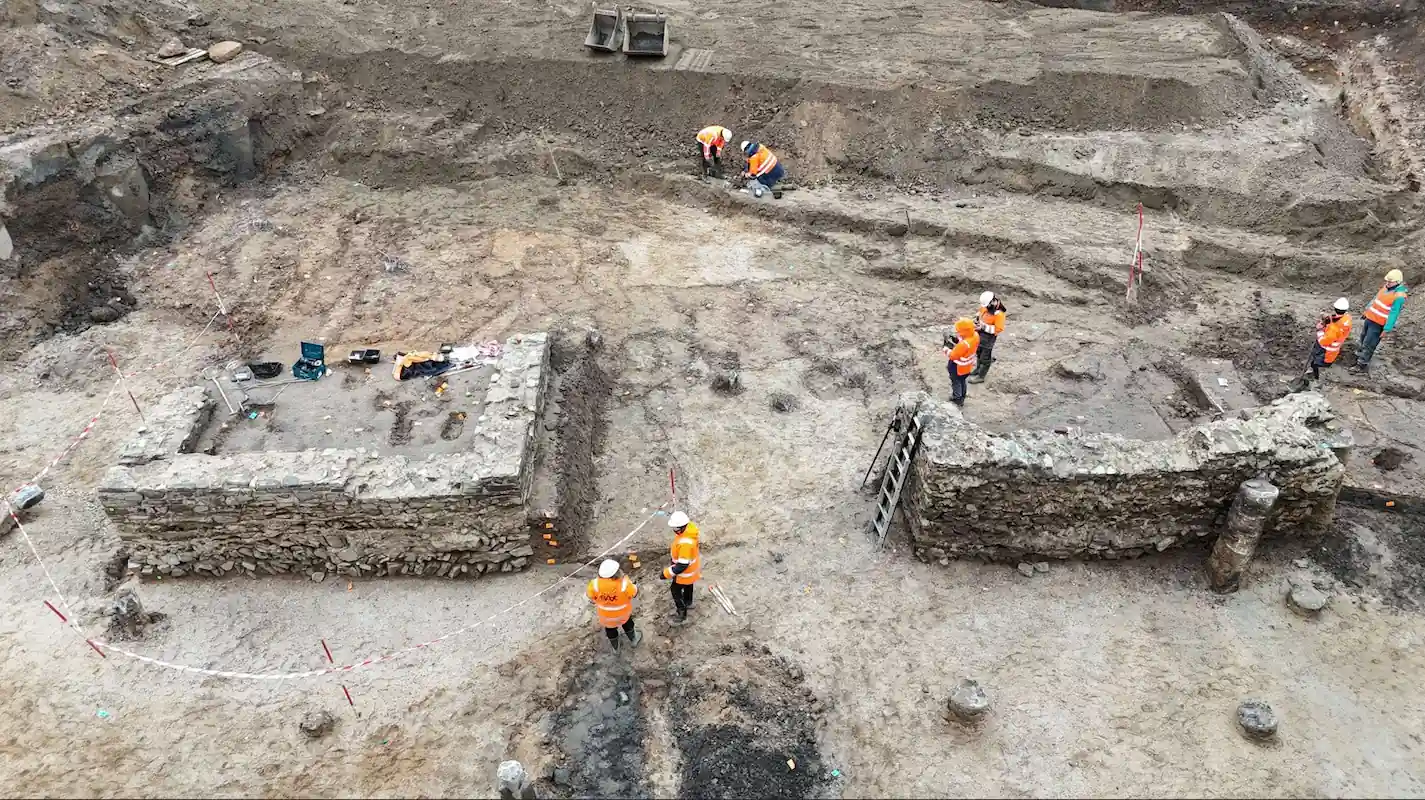
Archaeologists in Nijmegen have uncovered the largest Roman bathhouse ever found in the Netherlands, a nearly 5,000-square-meter complex that once served the Roman city of Ulpia Noviomagus.
The discovery was made in the Waalfront district, where a former industrial area is being prepared for new housing. According to the Municipality of Nijmegen, archaeologists from RAAP and BAAC have exposed a large part of the bathhouse, together with nearby streets, housing blocks, luxury townhouses and a tower.
The excavation began in September last year and is expected to continue until July. It is being carried out on a development site of BPD | Bouwfonds Gebiedsontwikkeling, under the management of The Missing Link.
The largest Roman bathhouse yet found in the Netherlands
The complex covered at least 4,900 square meters. That makes it more than twice as large as the public Roman baths previously investigated at Forum Hadriani, near modern Voorburg, and Coriovallum, now Heerlen.
For Dutch Roman archaeology, the scale is striking. The bathhouse gives Nijmegen a public building of a size rarely associated with Roman settlements in the Low Countries.
Roman baths were part of daily urban life. People washed there, exercised, met friends, discussed business and moved through rooms heated to different temperatures. A complex of this size points to a city with a large population, strong civic planning and the resources to build in stone, marble and tile.
Ulpia Noviomagus and the Roman city on the Waal
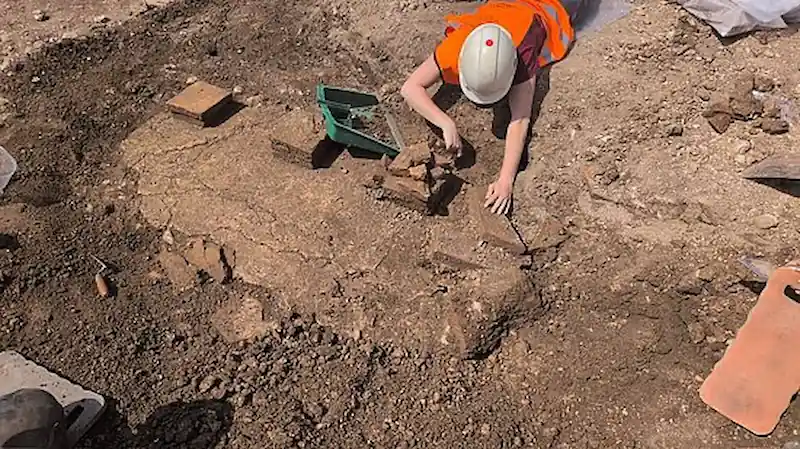
The bathhouse belonged to Ulpia Noviomagus, the Roman city that developed along the Waal River in present-day Nijmegen.
The settlement is generally believed to have received city rights around AD 100 under Emperor Marcus Ulpius Traianus, better known as Trajan. Its name preserved the emperor’s family name, while Noviomagus is often understood as “new market.”
Nijmegen stood in a strategic position on the Lower Rhine frontier. It was linked to river traffic, military supply, regional trade and administration. The new excavation strengthens the image of Ulpia Noviomagus as a real Roman city, with public buildings, wealthy residents and a developed urban layout.
Heated floors, marble pools and painted interiors
Part of the bathhouse had already been found in 1992 during the expansion of the Honig factory. At that time, only a small section could be studied. The current excavation has brought a far larger part of the complex into view.
Archaeologists have identified rooms connected with hot, warm and cold-water bathing. These spaces appear to belong to a later phase of the bathhouse.
It is still not clear whether all parts of the complex were used at the same time. The newly found rooms may have replaced older baths. They may also have formed a new wing, possibly designed to separate bathing areas for men and women.
The preservation is uneven but important. In the Middle Ages and later periods, the abandoned bathhouse was used as a source of building stone, and many walls were removed. Yet large sections of drainage channels and floors survived.
One concrete floor still preserves small brick pillars from a hypocaust, the Roman underfloor heating system that carried warm air beneath rooms and pools. Two stone foundations remain standing up to two meters high. The Municipality of Nijmegen describes them as among the best-preserved Roman masonry remains in the city.
The finishing materials show that this was a costly public building. Marble lined the inner walls of the pools. Floors were made with black and white limestone tiles. Other rooms had painted plaster walls. Limestone and sandstone moldings decorated the façades, while columns of the same materials were used inside the bath buildings.
Bacchus, jewelry and signs of urban comfort
The excavation has also produced tens of thousands of finds from the surrounding neighborhood.
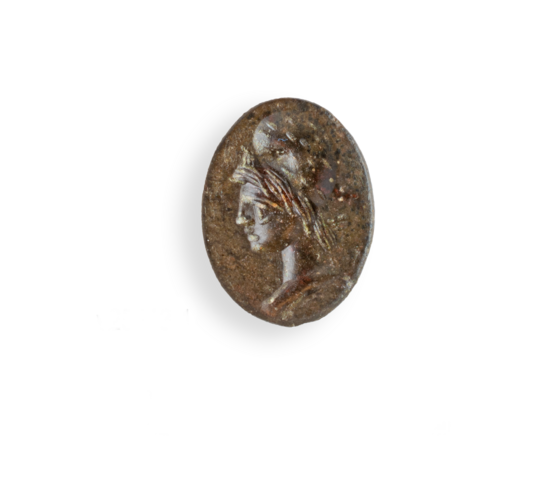
Among them are coins, jewelry, signet rings, fragments of bronze statues and a necklace with a gold clasp. Together, they point to a wealthy part of Nijmegen-West about 1,800 to 1,900 years ago.
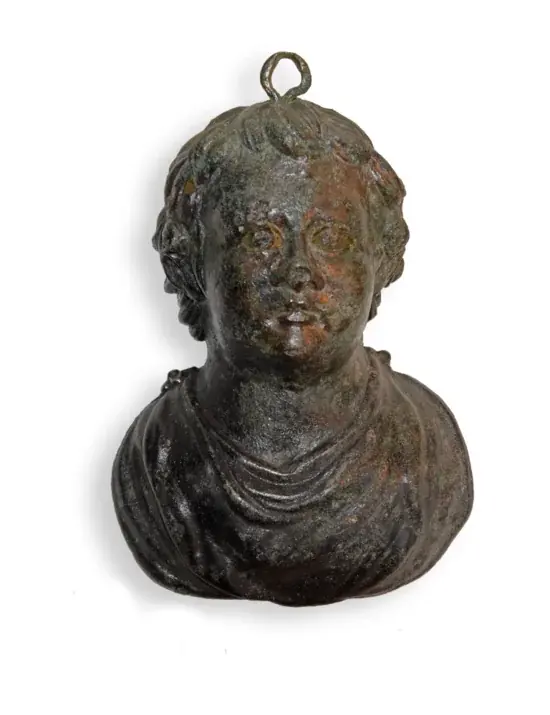
One of the most striking objects is a bronze bust of Bacchus, the Roman god of wine. It was originally part of a pouring vessel or a piece of furniture. Later, it was modified with an eyelet and reused as part of a weighing scale.
Archaeologists also found hundreds of bone hairpins, used in the elaborate hairstyles of Roman women. Two are decorated with cat figures, one seated and one standing.
These finds add a domestic layer to the monumental remains. The bathhouse shows the city’s public face. The jewelry, hairpins and reused bronze object show something closer to daily life, taste and personal status.
Postumus coins point to late activity
The excavation also shows that this part of Ulpia Noviomagus remained active well into the 3rd century AD.
The clearest evidence comes from coins of Emperor Postumus, who ruled from AD 260 to 269, along with coins of his immediate predecessors and successors. Such coins are rare in other parts of Roman Nijmegen.
Their concentration in the Waalfront area suggests that the bathhouse and nearby buildings continued to be used at a late stage in the city’s Roman history. Postumus ruled the breakaway Gallic Empire during a difficult period for the Roman West, and his coins now help date one of the later chapters of urban life in Nijmegen.
Roman remains beneath a future neighborhood
The Waalfront site will become a new residential area, but the Roman remains are not expected to vanish again. Plans are being developed to preserve the two standing foundations in place and make them visible beneath the new construction.
The future neighborhood will also keep a reference to the bathhouse. A central green square will be named Thermenplein, or “Baths Square,” after the Roman public building that stood there nearly two thousand years ago.
Some of the finds from the excavation will go on display from June 29 in a showcase in the lobby of Nijmegen City Hall.
The discovery gives archaeologists a clearer view of Roman Nijmegen at its most urban and prosperous. Ulpia Noviomagus was already known as one of the most important Roman cities in the Netherlands. Its largest bathhouse now shows that this city had the scale, wealth and public life of a major settlement on the northern frontier of the Roman Empire.
Gemeente Nijmegen (Municipality of Nijmegen)
Cover Image Credit: Gemeente Nijmegen (Municipality of Nijmegen)