
Archaeologists excavating the Gallo-Roman sanctuary of Mancey in eastern France have uncovered a remarkable painted altar block believed to depict Sucellus, one of the most important deities worshipped in Roman Gaul.
The discovery, made during the 2025 excavation season in Burgundy’s Saône-et-Loire region, may represent the only known painted depiction of the Celtic god ever identified.
The sanctuary stands on a wooded ridge overlooking the Tournugeois landscape near the historic town of Tournus. Archaeological investigations have been underway at the site since 2023, gradually revealing a large ritual complex that remained active for centuries—from the late Iron Age into the final centuries of the Roman Empire.
A Temple Filled With Evidence of Ritual Feasts
The painted altar block was discovered in the remains of a temple identified as Monument M3. Archaeologists believe the structure once hosted ceremonial gatherings and ritual banquets that may have involved local elites.
Excavations inside the building uncovered thousands of remains connected to communal feasting. Animal bones from pigs, birds, and fish were found alongside drinking vessels, jewelry, coins, and small votive objects.
Such discoveries suggest that the sanctuary was not only a place for offerings and prayers but also a setting for large ritual meals, a practice well known in many Gallo-Roman religious centers.
Amid this concentration of material, the painted altar fragment stood out as one of the most unusual finds from the site.
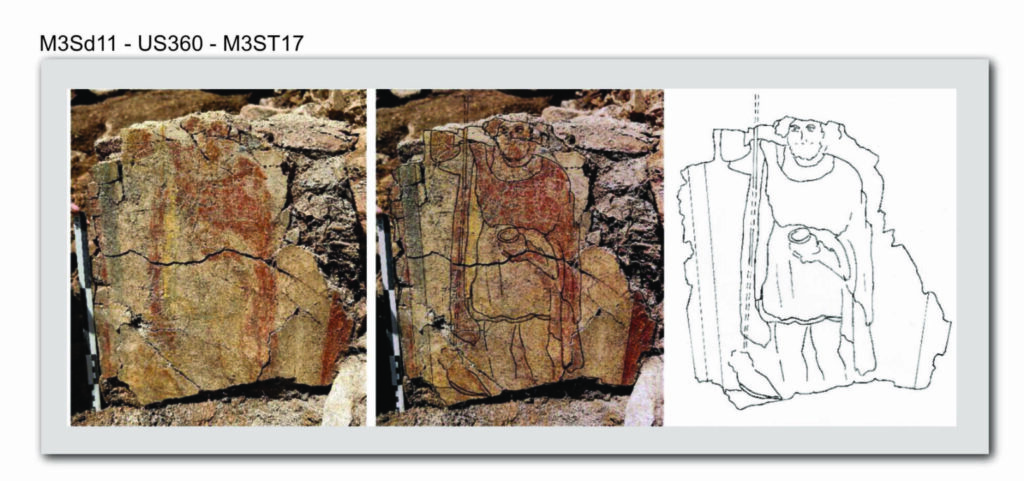
The Powerful Celtic God Sucellus
Sucellus was among the most widely worshipped gods in the Celtic regions of the Roman Empire. In sculptures and inscriptions discovered across France, Germany, and Luxembourg, the god is typically shown carrying a long-handled hammer or mallet.
This distinctive attribute is usually interpreted as a symbol of protection, fertility, and prosperity, closely linked to rural life and agricultural abundance.
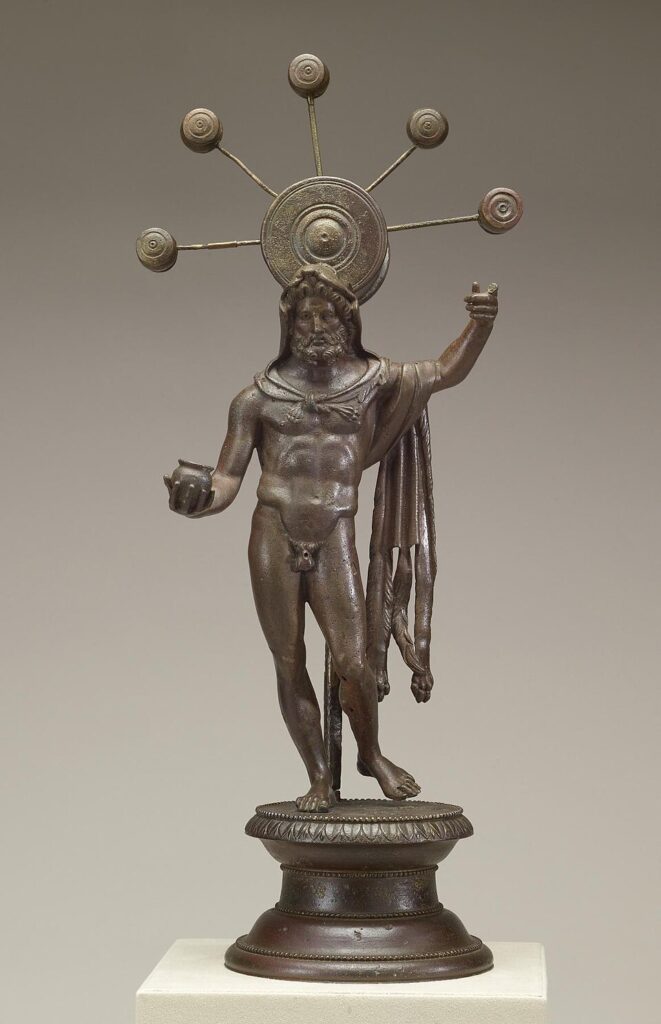
He is also frequently depicted with a wine jar or barrel, another symbol associated with wealth and the fertility of the land. In several representations, Sucellus appears alongside the goddess Nantosuelta, forming a divine pair connected with nature, prosperity, and the cycle of life.
Dozens of carved stone statues of the god have been identified throughout Roman Gaul.
Painted representations, however, are extraordinarily rare.
If the identification of the Mancey altar block is confirmed, the discovery would provide a unique glimpse into the visual culture of Celtic religious worship during the Roman period.
A Major Cult Center in Roman Gaul
Research suggests that the sanctuary at Mancey once covered around one hectare and included two temples, gathering areas, and spaces used for offerings and ritual meals.
Thousands of artifacts recovered during excavations indicate that the site attracted visitors from across the surrounding region and may have served as an important regional cult center.
Even after the temples collapsed during the late fourth century AD, people continued to return to the hill. Coins, figurines, and other offerings were left among the ruins, showing that the place retained its sacred meaning long after the buildings themselves had fallen.
For archaeologists, the painted image of Sucellus is therefore more than a rare artifact. It offers a rare window into the religious landscape of Roman Gaul, where Celtic traditions and Roman cultural influences blended in complex and enduring ways.
Grégory Compagnon (March 12, 2026). The Ancient Sanctuary of Mancey: Results of the 2025 Excavation Campaign. Le Fil d’ArAr. Accessed March 15, 2026, at https://doi.org/10.58079/15v3y
Cover Image Credit: Grégory Compagnon (2026), Le Fil d’ArAr