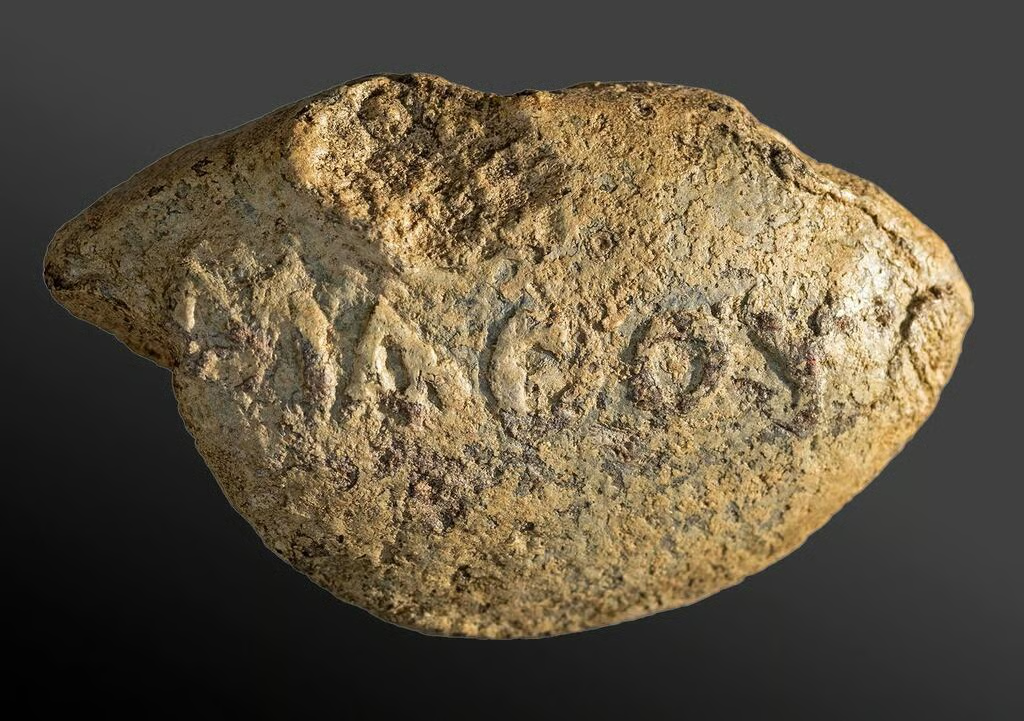
A 2,000-year-old sling bullet engraved with a mocking message has been discovered near the Sea of Galilee, offering a rare glimpse into psychological warfare in the ancient world. The small lead projectile was uncovered during archaeological excavations at the ancient city of Hippos (Sussita), where researchers identified a short Greek inscription that appears to taunt enemy soldiers approaching the fortified hilltop city.
Although sling bullets were a common weapon in antiquity, archaeologists say this particular artifact stands out because of its message. Rather than bearing the name of a commander or a symbolic motif, the inscription directly addresses the enemy with a sarcastic command.
The discovery was described in a scientific study published in the journal Palestine Exploration Quarterly by archaeologists Michael Eisenberg and Arleta Kowalewska of the University of Haifa and Gregor Staab of the University of Cologne.
A Small Projectile With a Sharp Message
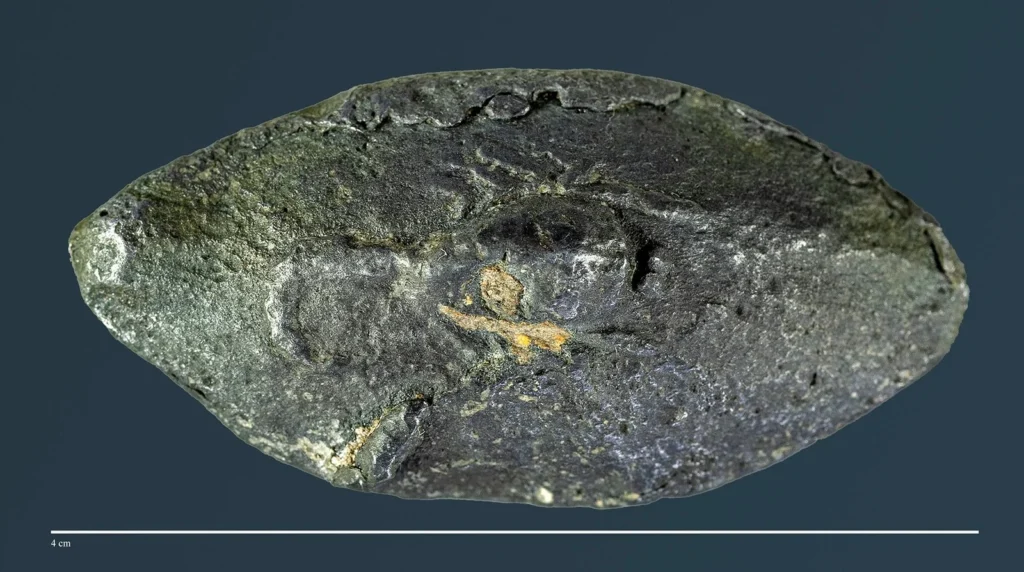
The sling bullet is modest in size but remarkable in character. Measuring about 3.2 centimeters in length and 1.95 centimeters in width, the almond-shaped projectile weighs approximately 38 grams and was cast from lead, a material commonly used in ancient sling ammunition.
One side of the bullet carries a carefully engraved five-letter Greek inscription: ΜΑΘΟΥ.
Scholars interpret this word as an imperative form derived from the Greek verb meaning “to learn.” In the context of a battlefield weapon, the phrase likely served as a taunt directed at approaching enemies — effectively telling them to “learn your lesson.”
While inscriptions on sling bullets are known from the Hellenistic and Roman worlds, they usually include the name of a military unit, the emblem of a commander, or simple symbols such as thunderbolts or scorpions. Direct messages addressed to the opponent are far rarer.
According to the researchers, the newly discovered inscription appears to be unique among known examples of ancient sling ammunition.
Found Along the Road to the City
The artifact was recovered during the 2025 excavation season in the southern necropolis of Hippos, near the bed of the Sussita Stream. The find spot lies close to the route of an ancient road that once led toward the city’s eastern gate.
This location offers an important clue about how the projectile was used.
Hippos stood on Mount Sussita, a steep hill rising roughly 350 meters above the Sea of Galilee, and its elevated position allowed defenders to control surrounding roads and approaches. Archaeologists believe the sling bullet was likely fired by defenders positioned on the slopes or fortifications of the city as attackers advanced along the road below.

The projectile was discovered about 260 meters from the city walls, a distance consistent with the effective range of ancient sling weapons.
One edge of the bullet also bears a visible impact mark, suggesting that it struck a hard surface after being launched.
Sling Weapons and Ancient Battlefield Tactics
Sling bullets were widely used across the Mediterranean world during the Hellenistic period, especially between the third and first centuries BCE. Experienced slingers were capable of launching small lead projectiles at remarkable speeds and distances.
Ancient military sources indicate that skilled slingers could hit targets at ranges exceeding 300 meters, although most combat engagements likely occurred at distances between 100 and 300 meters.
Despite their small size, lead sling bullets could be extremely lethal. Their dense material allowed them to travel at high velocity, and their compact shape made them difficult to detect in flight.
Yet the Hippos projectile suggests that ancient warfare was not only about physical force. Language and symbolism could also play a role in battle.
Psychological Warfare in Antiquity
The taunting inscription on the sling bullet reflects a form of psychological warfare that echoes practices known from later periods. Soldiers throughout history have often used humor, sarcasm, or insults to intimidate their opponents.
Other sling bullets from antiquity carry short phrases such as “Take this!”, “Catch!”, or “Taste it!” — blunt expressions meant to mock the enemy at the moment of attack.
The message discovered at Hippos follows the same tradition but adds a slightly different tone. By instructing the opponent to “learn,” the defenders may have been suggesting that the attackers were about to receive a painful lesson on the battlefield.
Such details provide rare insight into the mentality of ancient soldiersrevealing not only their weapons but also their sense of bravado and humor.
A Strategic City Above the Sea of Galilee
The ancient city of Hippos was part of the Decapolis, a group of Greco-Roman cities located in the eastern Mediterranean region. Founded in the second century BCE, likely after the Battle of Paneion, the settlement developed into an important urban center overlooking the Sea of Galilee.
Its elevated position made Hippos a powerful defensive stronghold controlling regional routes and trade networks. The city’s strategic importance also meant it was frequently involved in military conflicts throughout antiquity.
Archaeological excavations at Hippos have been underway for more than two decades, revealing streets, temples, churches, and fortifications that illustrate the city’s long and complex history.
During these excavations, archaeologists have recovered 69 lead sling bullets from the site and its surroundings. Many of them display decorative motifs or simple markings.
The newly discovered example, however, is the first known sling bullet from Hippos to carry a written message.
A Voice From an Ancient Battlefield
For researchers, the small projectile offers more than just evidence of ancient weaponry. It provides a brief but vivid connection to the soldiers who once defended the hilltop city.
Large monuments and fortifications often dominate archaeological narratives of war. Yet artifacts like this sling bullet reveal something more personal — the attitudes, emotions, and even humor of the individuals who fought those battles.
More than two millennia after it was fired, the sarcastic message engraved on the projectile still carries its voice across time.
And its target, perhaps unexpectedly, has become modern archaeology.
Eisenberg, M., Kowalewska, A., & Staab, G. (2026). Learn! – A New Type of Inscription on a Sling Bullet from Hippos of the Decapolis. Palestine Exploration Quarterly, 1–5. https://doi.org/10.1080/00310328.2026.2641294
Cover Image Credit: Dr. Michael Eisenberg