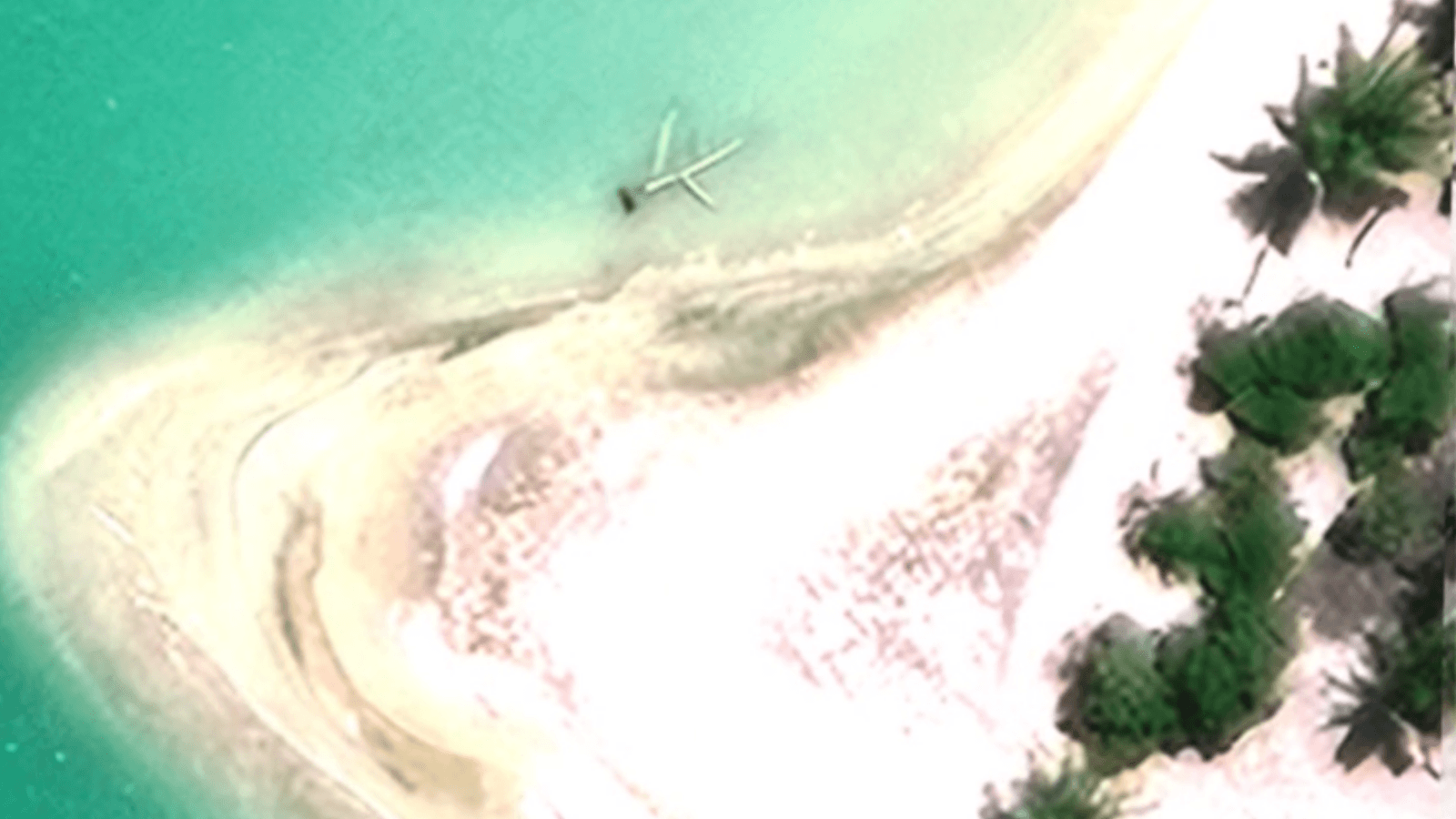
A new search for Amelia Earhart’s lost plane has begun nearly 90 years after the pioneering aviator vanished over the Pacific. This time, archaeologists are heading toward a specific object lying beneath the shallow waters of a remote Pacific lagoon.
The Taraia Object Expedition began on October 2, when members of a team organized by the Archaeological Legacy Institute, Purdue Research Foundation and Purdue University departed for Kiribati. Their destination is Nikumaroro, an uninhabited island where satellite imagery has revealed an object that some researchers believe could be connected to Earhart’s missing Lockheed Electra 10-E.
The object may ultimately prove to have nothing to do with the famous aviator. What makes the expedition significant is that researchers can now investigate a physical target rather than relying solely on historical documents, radio reports and competing theories.
A strange object beneath the lagoon
The so-called Taraia Object was first noticed in 2020 by researcher Michael Ashmore while examining satellite images of Nikumaroro. It lies in the lagoon near the Taraia Peninsula, partly obscured by sediment and shallow water.
Researchers working with the Archaeological Legacy Institute later examined older aerial imagery and argued that a similar feature may have been present there for decades. They also noted that the object’s apparent dimensions could be compatible with parts of a Lockheed Electra and that its position is close to Tatiman Passage, one of the openings connecting the lagoon with the ocean.
That does not make it an aircraft. Other researchers familiar with decades of Earhart investigations have suggested that the feature could simply be a submerged tree, root mass or natural debris. Previous searches around Nikumaroro have also failed to produce evidence strong enough to identify Earhart’s aircraft.
The new expedition is intended to move the debate away from satellite images and into the water itself.

Archaeologists will investigate it directly
The team is expected to travel from Tarawa to Nikumaroro by sea, a journey of roughly six days. If conditions and schedules hold, researchers should reach the island in mid-October and begin surveying the lagoon.
Their first objective will be documentation rather than excavation. Magnetometers, sonar and other survey equipment will be used to map the area before underwater archaeologists approach the object. If sediment prevents a clear identification, the team may use a hydraulic dredge to expose enough of the feature to determine what it is.
The expedition brings together maritime and terrestrial archaeologists, technical specialists and representatives from Kiribati. Rather than searching a vast stretch of ocean, they are testing one clearly defined target, which should make the outcome unusually straightforward: the object either has features consistent with an aircraft or it does not.
That answer alone could be valuable. The Earhart disappearance has generated decades of claims, reconstructions and disputed clues, while remarkably little physical evidence has survived close scrutiny.
Why Nikumaroro remains part of the Earhart mystery
Earhart and navigator Fred Noonan disappeared on July 2, 1937, while attempting to reach Howland Island during Earhart’s flight around the world. No confirmed wreckage of their aircraft has ever been recovered.
One of the most persistent alternative theories holds that the pair missed Howland Island and instead reached Nikumaroro, then known as Gardner Island. Researchers supporting that scenario have argued that Earhart and Noonan may have landed on the island’s reef and survived there for some time.
Archaeological investigations on Nikumaroro have uncovered evidence of human activity dating to the period, including artifacts that have occasionally been linked to a possible castaway presence. None has provided a definitive connection to Earhart, however, and the theory remains contested.
Purdue University also has a historical connection to the search. Funds raised through the university’s Amelia Earhart Fund helped finance the Lockheed Electra she used as her “flying laboratory” and later flew on her final journey.
The expedition now brings that history back to one small area of lagoon floor. The Taraia Object could turn out to be aircraft wreckage, natural debris or something far less remarkable, but this time researchers should be able to replace speculation with a direct archaeological examination.
Cover Image: Satellite image showing the Taraia Object in the lagoon at Nikumaroro, the target of a new archaeological expedition searching for Amelia Earhart’s missing Lockheed Electra. Credit: Rick Pettigrew / Archaeological Legacy Institute.