
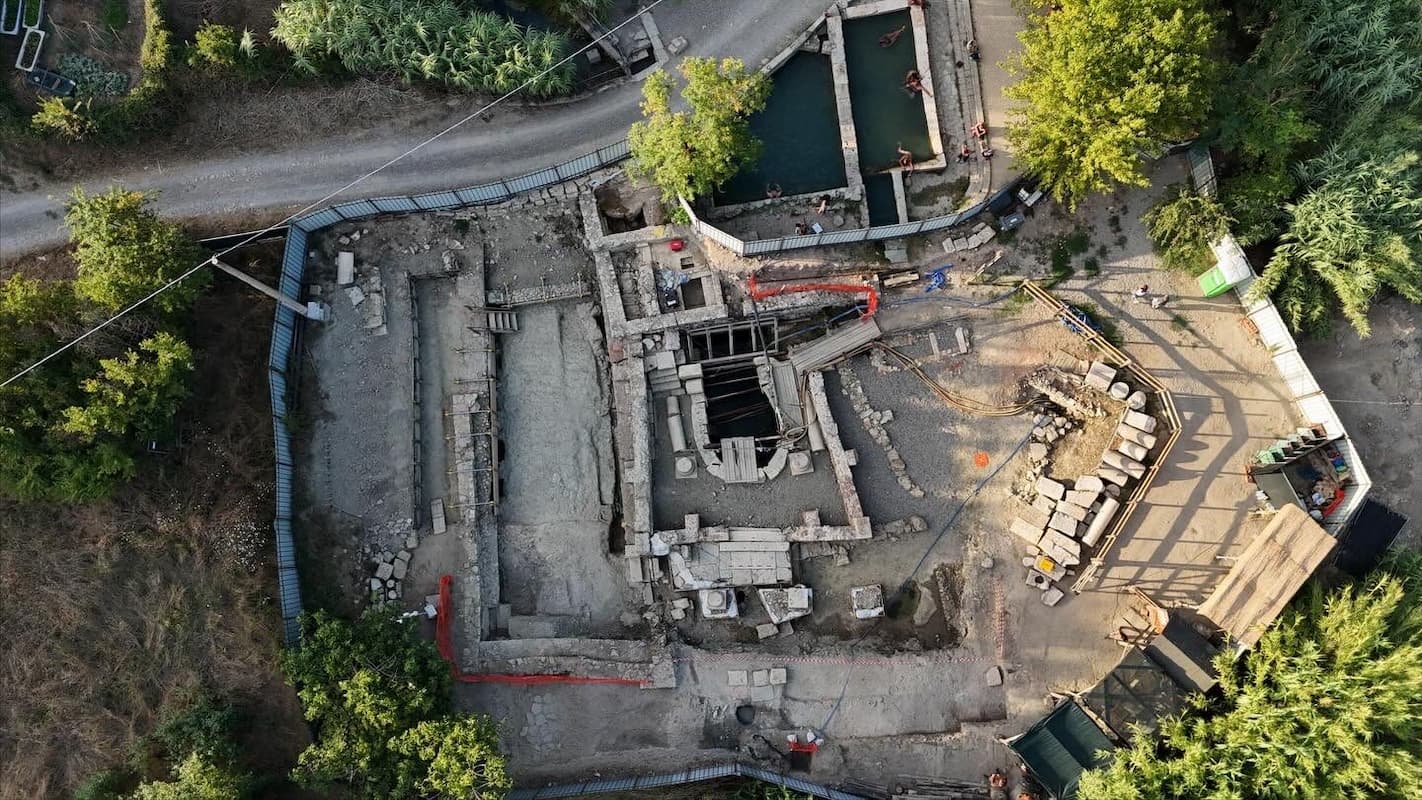
New discoveries from the 2025 excavation season at the Bagno Grande Sanctuary in San Casciano dei Bagni are forcing scholars to rethink the boundaries between religion, medicine, and scientific knowledge in the ancient Mediterranean. Long understood primarily as a thermal healing sanctuary, the site now appears to have functioned as one of the most sophisticated medical centers of the Etruscan world—possibly an organized medical school active from the Classical period onward.
The results, presented publicly in December, push the origins of the sanctuary back to the late fifth century BC, at least two centuries earlier than previously assumed. This alone reshapes the historical map of Etruscan sacred sites. Yet it is not chronology, but anatomy, that has made San Casciano dei Bagni one of the most consequential archaeological stories of the year.
A sanctuary older than expected
Until recently, the monumental phase of the Bagno Grande complex was dated to the third century BC. Excavations in 2025 overturned this framework. Securely dated materials from the late fifth century BC—including a fragment of a bronze ritual candelabrum—demonstrate that an important sanctuary already existed around the thermal spring at a remarkably early date.
Bronze has long been recognized as a defining material at San Casciano, but the new evidence shows that its ritual use spans the entire life of the sanctuary, from its earliest Etruscan phase through Late Antiquity. Such continuity suggests not an episodic cult site, but a stable institution capable of sustaining specialized practices over centuries.
The controlled end of a sacred space
The final phase of the sanctuary has also come into sharper focus. Bronze votives shaped as a lightning bolt and a branch belong to the period when pagan worship was forcibly suppressed in the late fifth century AD, following the Theodosian edicts.
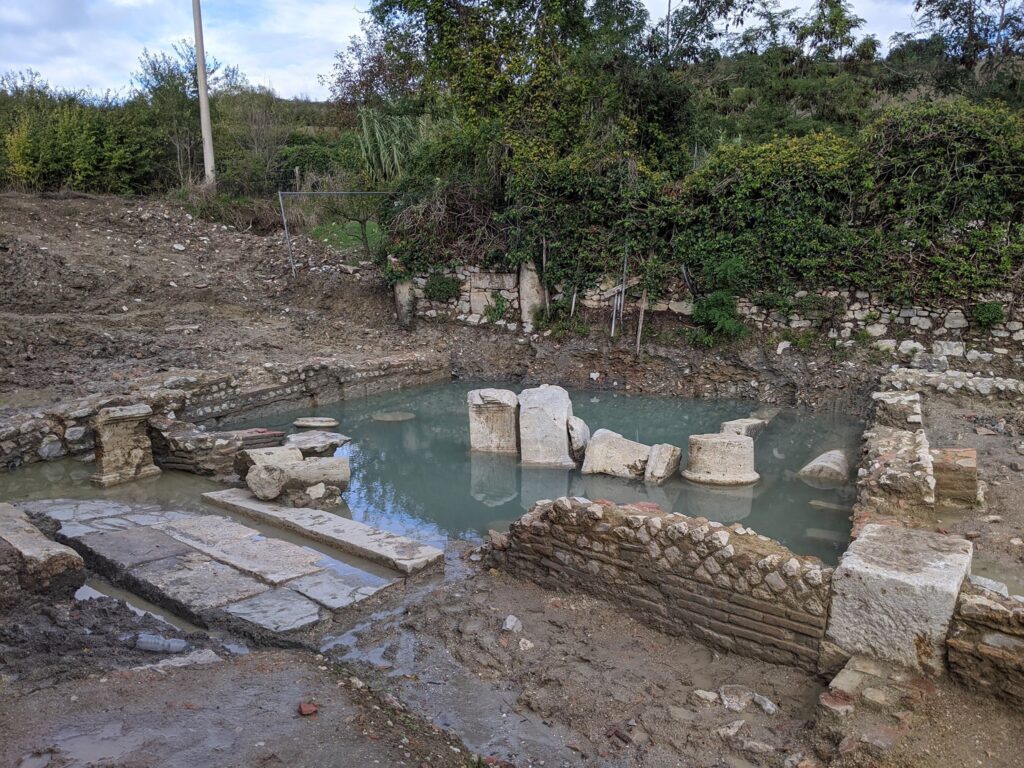
Rather than sudden destruction, the archaeological evidence points to a deliberate and highly structured ritual closure. Altars were broken and reorganized into a platform constructed between the main thermal spring and a secondary spring to the south. This spatial reconfiguration implies that multiple sacred focal points remained meaningful even at the sanctuary’s end.
A massive Etruscan enclosure wall, active from at least the third century BC and probably earlier, further confirms the long-term importance of the site. Comparable in scale to the later Roman imperial temple, the wall shows repeated episodes of ceremonial closure. Architectural terracottas were intentionally dismantled and dispersed—not as acts of vandalism, but as part of a controlled decommissioning of sacred architecture.
The favissa and the body as offering
The most consequential discoveries of 2025 came from the southwestern sector of the sanctuary, where archaeologists identified the beginning of a favissa—a ritual deposit where votive offerings were buried after being removed from active cult use.
Within this sacred archive lay an extraordinary concentration of anatomical votives: feet, legs, hands, heads, swaddled infants, along with fragments of statues and architectural elements such as antefixes. Anatomical offerings are known across central Italy, but the scale, diversity, and technical precision documented at San Casciano are exceptional.
Here, the human body appears not as a generalized symbol of suffering or gratitude, but as a carefully observed anatomical system.
A polyvisceral model without precedent
The most striking object emerged from layers disturbed during fourth-century AD construction. When Roman engineers reinforced the imperial temple with a massive retaining wall after structural collapses, they cut through older Etruscan deposits and redeposited them outside the sanctuary in a ritualized manner.
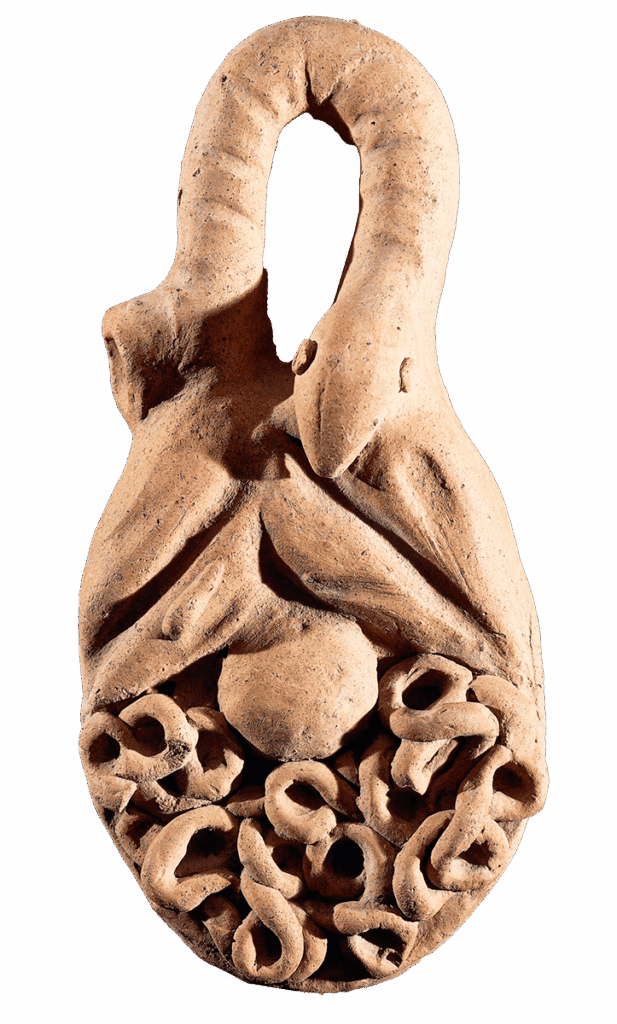
These layers contained traces of bonfires, scattered pine nuts and astragali, painted fragments, and objects with clear magical associations. Among them was a polyvisceral terracotta model depicting the internal organs of the human body with unprecedented anatomical accuracy.
For comparison, scholars point to earlier representative anatomical votives from central Italy—such as polyvisceral plaques known from Latium—which present simplified or schematic organ groupings. The San Casciano model, by contrast, displays a level of realism that implies systematic anatomical observation rather than symbolic convention.
No true parallel is known from the ancient world.
Rethinking Etruscan medicine
This single object has fundamentally altered interpretations of the Bagno Grande Sanctuary. The site can no longer be seen merely as a place where the sick bathed and prayed. Instead, it now appears to have functioned as a complex healing institution—something closer to an ancient hospital and teaching center than a traditional cult sanctuary.
Researchers argue that a structured medical school operated here from at least the third century BC, where anatomical knowledge was actively produced, transmitted, and ritualized. One of the strongest indicators is geographical: anatomical accuracy in votive offerings decreases the farther one moves away from San Casciano, suggesting that this sanctuary served as a regional hub of medical expertise.
The craftsmanship itself tells the same story. Artisans working at the site were capable of translating detailed anatomical understanding into terracotta and bronze with remarkable fidelity. This points to a shared knowledge base between healers and craftspeople, blurring the line between scientific practice and religious expression.
A sanctuary still unfolding
Excavation of the favissa has only begun, and future campaigns are expected to yield critical insights into Etruscan medicine, ritual behavior, and craft production. Each new layer promises to refine our understanding of how knowledge, belief, and community intersected at this exceptional site.
Beyond the trenches, San Casciano dei Bagni is also preparing for a new chapter. The University for Foreigners of Siena, through its CADMO Center, has acquired a historic property in the town to establish an international research hub. Plans for a museum and archaeological park are underway, with construction expected to begin in 2026.
As Mayor Agnese Carletti noted during the presentation, the aim is not only academic progress, but restitution—returning the bronzes, the votives, and the story of this ancient medical center to the community where they were created more than two thousand years ago.
San Casciano dei Bagni, once known for its waters, is now redefining what we know about ancient medicine itself.
Unione dei Comuni Valdichiana Senese
Cover Image Credit: Ministero della Cultura