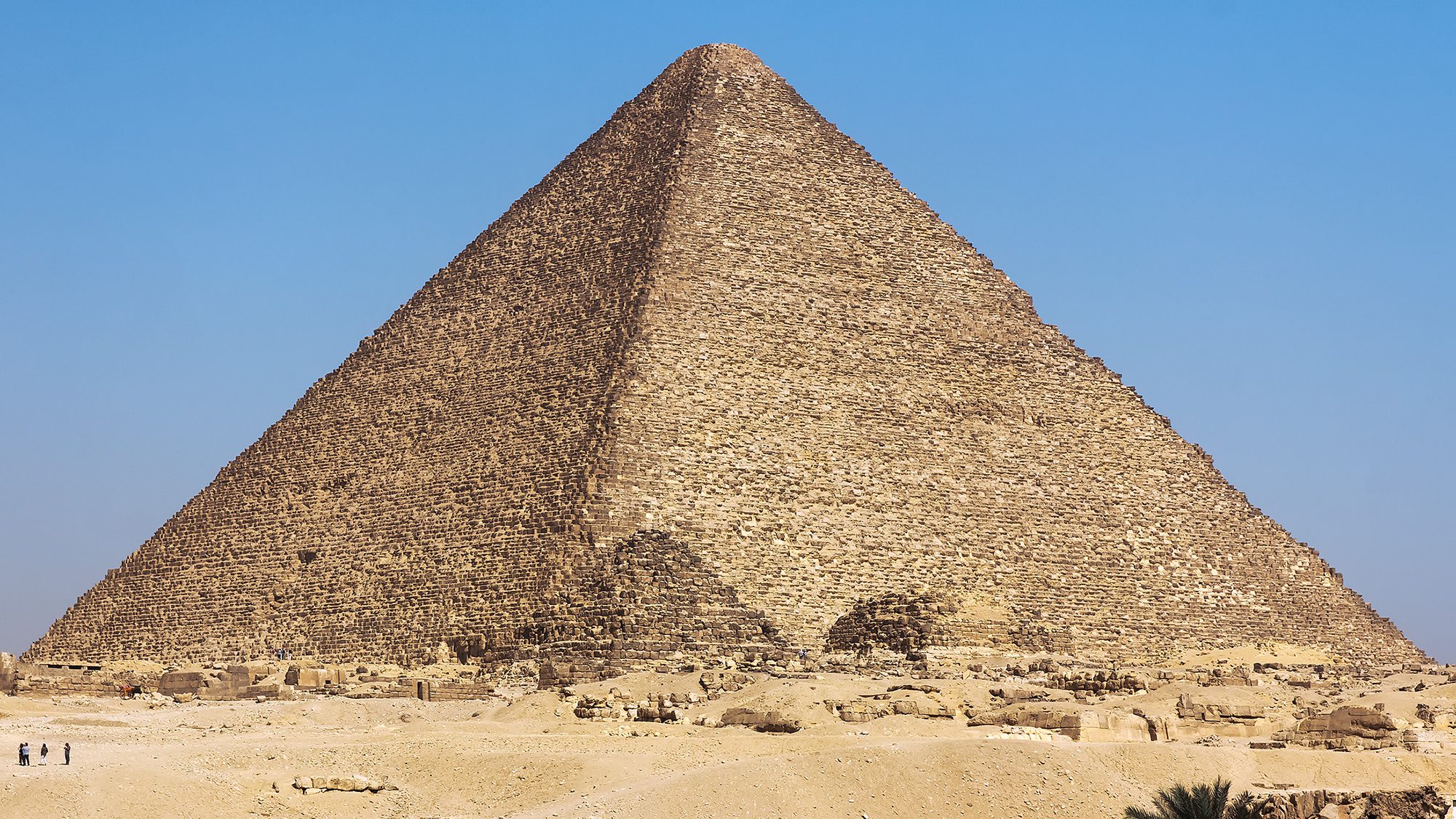
A newly released study is once again pushing the Great Pyramid of Giza into the center of a long-running archaeological dispute—not about how it was built, but when.
Published in January 2026, a preliminary paper by Italian engineer Alberto Donini proposes an unconventional dating model that, if correct, would place the monument far earlier than the traditional Fourth Dynasty timeline. Using a technique he calls the Relative Erosion Method (REM), Donini argues that parts of the pyramid’s limestone base may have been exposed for tens of thousands of years, potentially pushing its origins deep into prehistory.
If substantiated, the claim would challenge one of the most stable pillars of Egyptology. For now, however, it sits firmly outside academic consensus.
Rethinking the Age of the Great Pyramid of Giza
The accepted chronology places the construction of the Great Pyramid around 2560 BC, during the reign of Khufu, based on inscriptions, quarry marks, radiocarbon dates from associated organic material, and broader archaeological context.
Donini’s study takes a radically different route. Rather than dating the monument through historical or textual evidence, REM attempts to estimate age by comparing erosion levels on adjacent limestone surfaces—surfaces that share the same material and environment but have been exposed for different lengths of time.
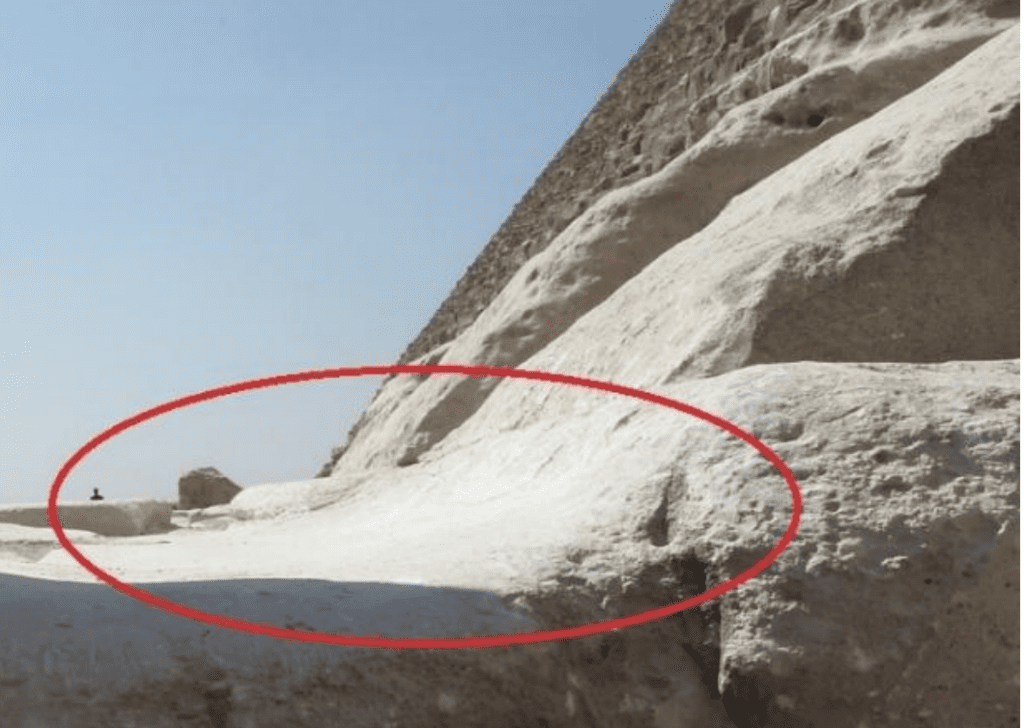
The premise rests on a well-documented historical event. Much of the pyramid was originally encased in fine limestone blocks which were removed after medieval earthquakes—most notably the devastating 1303 AD Cairo earthquake—and later reused during the Mamluk period. As a result, some limestone surfaces at the pyramid’s base have been exposed for only about 675 years, while neighboring surfaces have remained exposed since the monument’s original construction.
The erosion gap between these surfaces, Donini argues, can be translated into time.
Measuring Stone, Not History
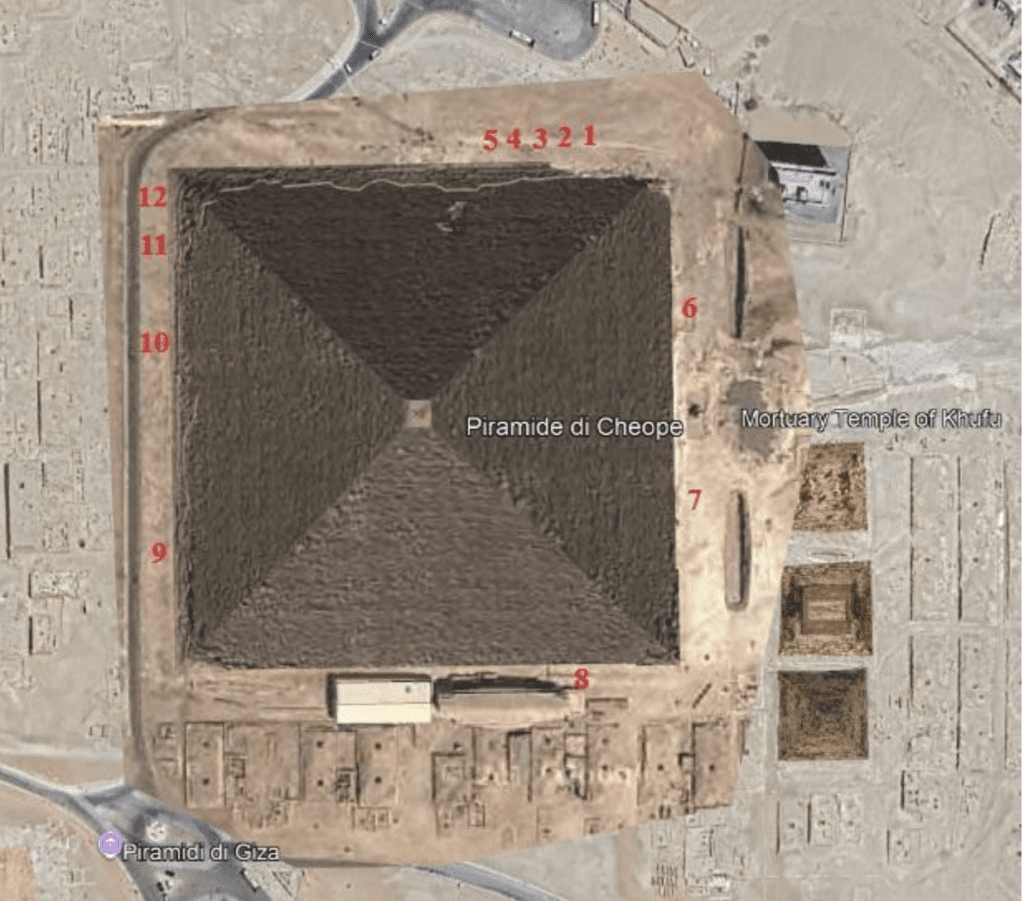
The study examines twelve measurement points around the pyramid’s base. At each point, Donini analyzed either pitting erosion—small cavities caused by chemical and mechanical weathering—or more uniform surface wear. By estimating how much limestone had been lost from each surface, he calculated erosion ratios between long-exposed and recently exposed stone.
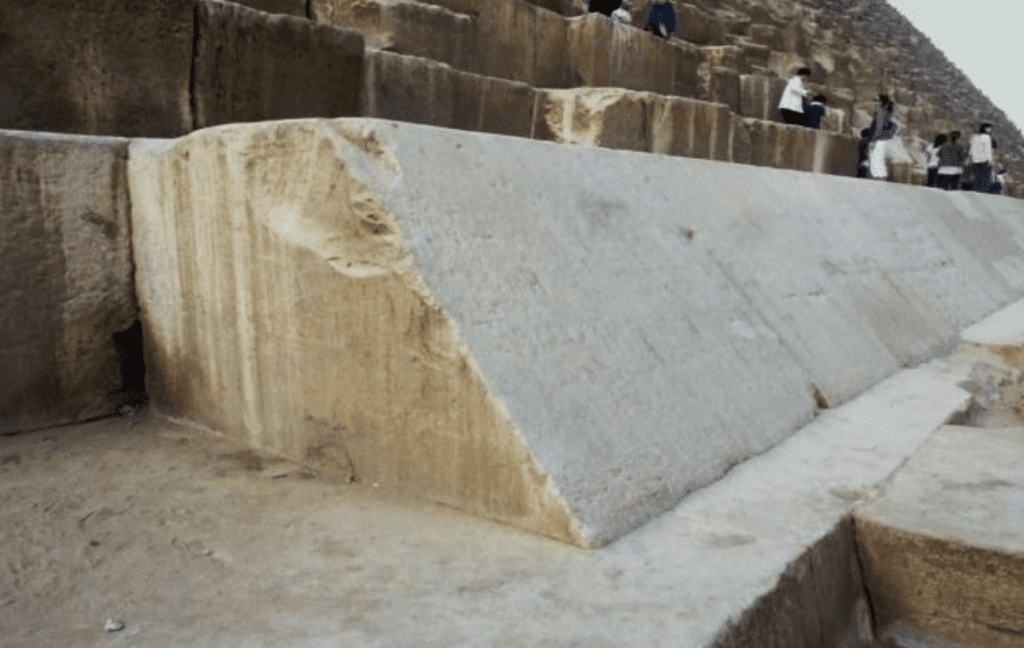
In one illustrative case, a pavement slab shows deep pitting on the surface exposed since antiquity, while the adjacent surface—uncovered only after medieval stone removal—shows comparatively minor erosion. Using a linear erosion model, Donini estimates that this single point implies an exposure time of more than 5,700 years before present.
Other measurements go much further. Several suggest exposure equivalents of 20,000 to over 40,000 years, and when all twelve points are averaged, the resulting figure is approximately 24,900 years before present—around 22,900 BC.
Probability, Not a Fixed Date
Donini is careful to stress that REM does not claim to deliver an exact construction date. Instead, it estimates an order of magnitude. To address uncertainty, the study applies a basic statistical model, producing a Gaussian probability curve.
According to this model, there is a 68.2% probability that the pyramid’s construction falls between 9,000 BC and 36,000 BC, with the highest probability clustering in the early 20,000s BC.
These figures are explicitly presented as preliminary. The author calls for independent measurements and collaborative testing, acknowledging that erosion is influenced by multiple variables that are difficult to reconstruct precisely.
Climate, Humans, and Sand
The paper openly discusses factors that could distort erosion-based dating.
Ancient Egypt’s climate was likely wetter than today’s, potentially accelerating erosion in the distant past. In contrast, modern pollution and acid rain may have increased erosion rates in recent centuries. Human activity also complicates matters: the pyramid’s base now experiences heavy tourist foot traffic, unlike most of its ancient history.
There is also the possibility that parts of the structure were periodically buried by sand, temporarily shielding them from erosion—an effect well documented at the nearby Sphinx.
Donini argues that while individual measurements may overestimate or underestimate exposure time, averaging multiple points reduces error. Critics, however, note that erosion rates rarely remain linear over millennia, let alone tens of thousands of years.
Collision With Established Egyptology
REM-based dates stand in stark contrast to the conventional archaeological framework that firmly places the Great Pyramid in the Old Kingdom’s Fourth Dynasty.
To reconcile this gap, Donini suggests a controversial possibility: the pyramid may predate Khufu and have been renovated or repurposed during his reign. Versions of this idea have circulated for decades in fringe literature but have been consistently rejected by mainstream scholarship due to lack of supporting evidence.
At present, Donini’s study has not undergone peer review in a major archaeological journal. Most specialists remain skeptical, emphasizing that erosion is highly variable and poorly suited for long-range absolute dating without extensive calibration.
A Debate That Refuses to Die
Whether REM will emerge as a useful supplementary tool or prove to be a methodological dead end remains unclear. What the study undeniably demonstrates is that even the most intensively studied monument on Earth can still provoke fundamental questions.
For now, the Great Pyramid remains securely anchored in the Fourth Dynasty. Yet proposals like Donini’s ensure that discussions about its origins—scientific, controversial, and sometimes uncomfortable—are far from over.
As the author himself concedes, extraordinary claims will require extraordinary verification.
Donini, A. (2026). Preliminary report on the absolute dating of the Khufu Pyramid using the Relative Erosion Method (REM). University of Bologna. DOI:10.5281/zenodo.18315238
Cover Image Credit: Public Domain – Wikipedia Commons