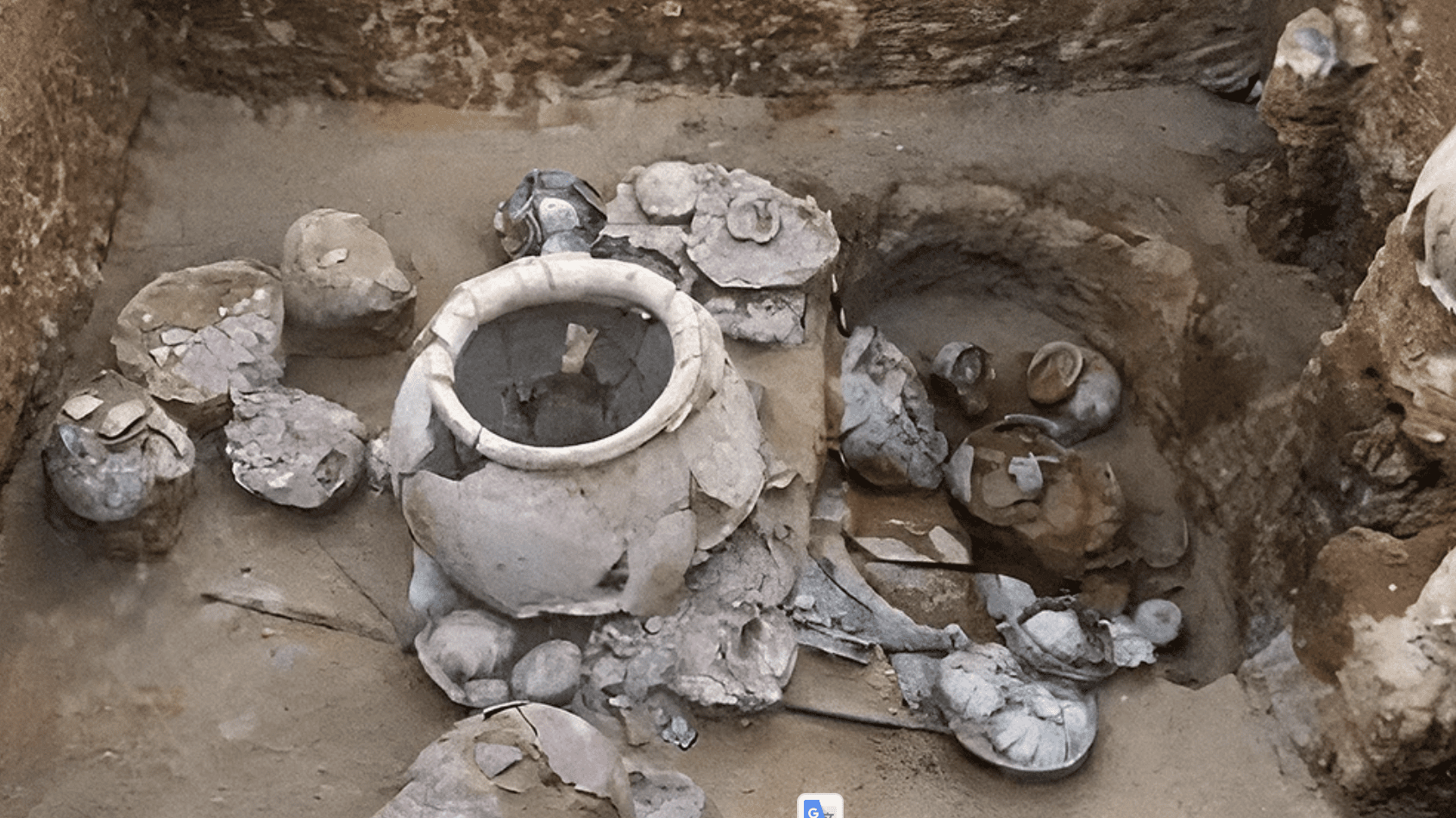
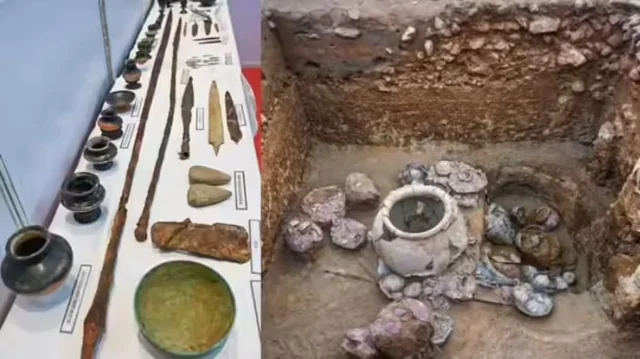
In the dry soil of southern India, archaeologists have uncovered a weapon that is forcing scholars to reconsider the technological limits of the Iron Age. Excavated from a burial site in Tamil Nadu, a nearly 2.5-meter-long iron spear is now believed to be the longest Iron Age iron spear ever discovered in India—and possibly one of the most ambitious iron objects of its time.
The artifact was found in a carefully arranged funerary context, lying alongside a second, slightly shorter spear placed in a cross-like formation. Nearby, a burial urn contained gold objects, a detail that immediately signaled the elite status of the individual laid to rest. Together, the objects suggest a burial designed not only to honor the dead, but to project authority, power, and identity beyond life.
A Weapon That Speaks of Power, Not Just Combat
While iron spears were common in Iron Age burials across the subcontinent, this example stands apart for its sheer scale. At more than eight feet long, the spear would have been cumbersome in routine combat. Researchers therefore believe it likely carried a symbolic or ceremonial roleperhaps associated with a chieftain or high-ranking leader.
Excavation director K. Vasanthakumar notes that one end of the spear is subtly rounded, a deliberate design choice that improves grip and balance. This detail, though minor at first glance, points to a deep understanding of ergonomics and metalworking—evidence that the object was not a crude display piece, but a carefully engineered artifact.
For Iron Age specialist Professor Vibha Tripathi of Banaras Hindu University, the discovery fits within a broader burial tradition. Weapons frequently accompany elite graves, she explains, reinforcing the idea that the deceased belonged to a warrior aristocracy. What makes this find exceptional is not the presence of weapons, but the quality and preservation of the iron itself.
Why Tamil Nadu Preserves What Other Regions Lose
Iron rarely survives intact over millennia, particularly in humid or riverine environments. In regions such as the Gangetic plains, corrosion often reduces iron artifacts to faint stains in the soil. Tamil Nadu, however, offers a different story.
The region’s soil chemistry and climatic conditions have proven unusually favorable for preservation. As a result, archaeologists here can study iron objects in a state that allows direct observation of forging techniques, surface finishing, and structural integrity—details often lost elsewhere.
This preservation opens a rare window into early metallurgical practice. Producing iron requires temperatures between 1,200 and 1,500 degrees Celsius, a demanding technological threshold by ancient standards. According to archaeologist R. K. Mohanty, formerly of Deccan College, the spear was almost certainly custom-made, likely commissioned to communicate prestige as much as function.
“Its size alone suggests it was designed to demonstrate elevated status,” Mohanty notes, emphasizing that such objects were as much political symbols as practical tools.
Rethinking the Timeline of Iron in South India
Perhaps the most consequential implication of the find lies in its chronology. A growing body of research now suggests that iron production in Tamil Nadu may date back to 3000–2500 BCE, far earlier than traditional models once allowed.
Academic advisor K. Rajan of the Tamil Nadu Department of Archaeology describes the spear as a “technological achievement of its time,” arguing that it strengthens the case for southern India as an early innovator rather than a late adopter of iron technology
This perspective aligns with evidence from other regional sites, including Adichanallur, Kodumanal, and Keeladi, where excavations have revealed advanced knowledge of smelting, forging, and alloying. Some radiocarbon dates from nearby contexts reach as far back as 3345 BCE, suggesting a long and continuous tradition of experimentation with iron and steel.
Beyond Weapons: A Broader Metalworking Culture
Ancient Tamil metalworkers were not limited to producing arms. Archaeological records show iron used extensively in agriculture, domestic life, and trade. Tools designed for farming, construction, and craft production played a key role in economic growth and social organization.
Notably, southern India also developed early forms of high-carbon steel, comparable to the later-famous wootz steel that would gain international recognition centuries afterward. Techniques such as controlled heating, repeated hammering, and quenching were already in use, laying the groundwork for metallurgical traditions that influenced much of South Asia.
What Comes Next
The discovery has prompted calls for expanded scientific investigation. The Tamil Nadu Department of Archaeology has announced plans to collaborate with IIT Gandhinagar on a multi-year program of metallurgical analysis across Iron Age sites in the region.
Researchers aim to refine dating frameworks, reconstruct technological sequences, and better understand how early iron production shaped social hierarchies. As this work progresses, the Tamil Nadu spear stands as more than an extraordinary artifact—it is a tangible reminder that technological innovation in the ancient world often emerged far earlier, and in more diverse places, than once believed.
Cover Image Credit: Banaras Hindu University