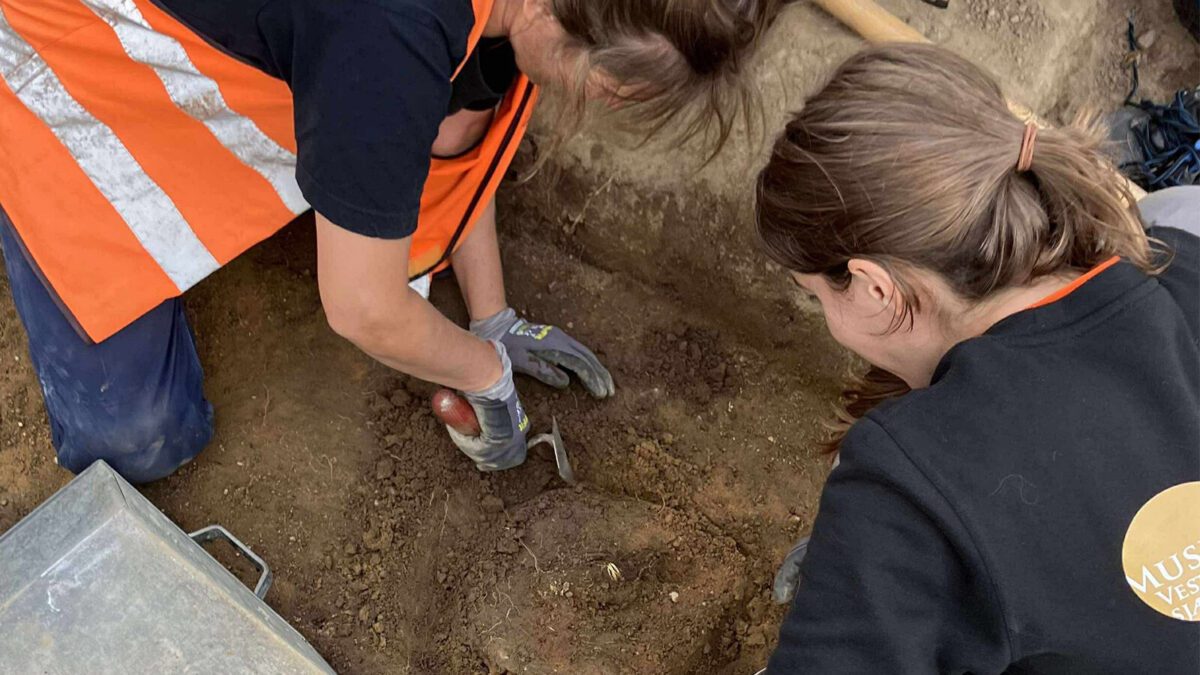
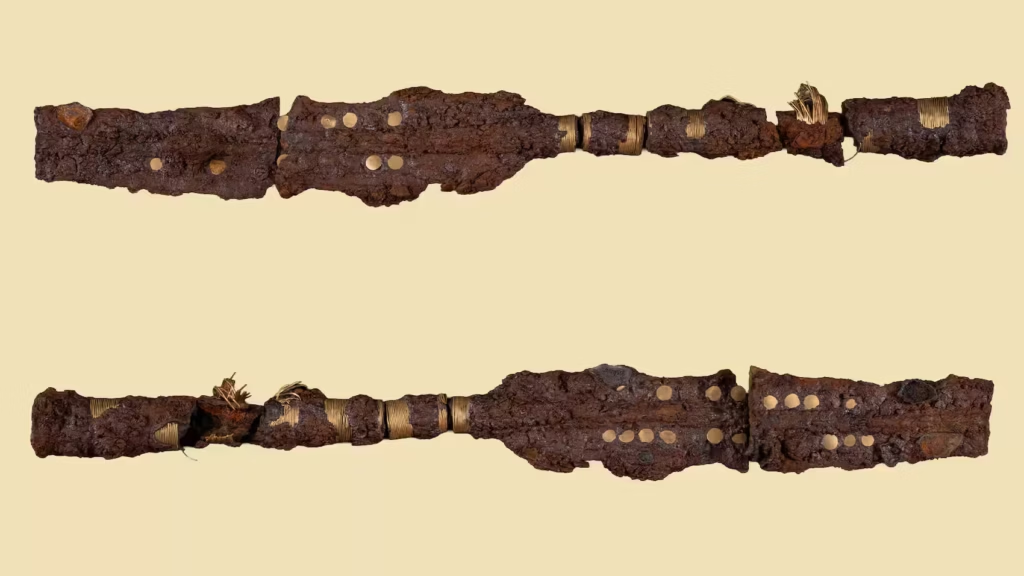
When a small archaeological team reopened the windswept fields of Boeslunde in southwest Zealand last summer, they expected yet another chapter in a region already famed for glittering Bronze Age offerings. Instead, they uncovered an object that should not have existed there at all—an iron spearhead embellished with shimmering gold. Within hours, a second appeared. And with that, Danish prehistory gained a discovery that challenges nearly every assumption about the arrival of iron in northern Europe.
The unexpected emergence of these two weapons, dating to roughly 900–830 BCE, marks the earliest known iron artefacts in Denmark. Until now, scholars believed that iron technology reached Scandinavia centuries later. Yet the Boeslunde spears—luxury items combining imported metal and local gold craftsmanship—place iron in the hands of an elite community far earlier than previously recognized.
A discovery that defied every rule of Bronze Age archaeology
The moment of unearthing was as startling as the objects themselves. Lone Claudi-Hansen of Museum Vestsjælland later admitted that she instinctively set the first spearhead back into the ground out of shock. Iron weapons simply do not appear in Nordic Bronze Age contexts. They belong to a different technological world.
But the spearhead’s weight, form, and flashes of gold inlay left little doubt: this was the real thing.
X-ray imaging has now revealed astonishingly detailed gold ornamentation, arranged in geometric bands across the iron surface. The best-preserved example measures 47 centimeters in its surviving portion, and analysis suggests a full length of around 60 centimeters—exceptionally large for the period. Nothing comparable exists anywhere in Scandinavia.
A sacred spring beneath centuries of gold
The implications became even more profound when archaeologists opened a lower stratigraphic layer and encountered a waterlogged spring directly beneath earlier gold finds. For more than a decade, the Boeslunde fields have produced treasures of extraordinary density—ten heavy gold oath rings, nearly 2,200 tiny spirals, and, further upslope, six rare gold bowls. Until now, their purpose was unclear.
The spring provides the missing context. Across Europe, Bronze Age communities treated flowing water as a liminal space—an opening to the divine. Springs received objects of value, prestige, or symbolism, intentionally surrendered during ceremonies, funerary rites, or seasonal gatherings. At Boeslunde, this tradition appears to have endured for centuries.
An AMS radiocarbon date taken from birch pitch adhering to the spear’s sheath confirmed its age with striking precision, aligning the weapons with the final centuries of the Nordic Bronze Age. The finding demonstrates that iron arrived not through local experimentation but through long-distance interactions, likely traveling from Central Europe or even farther south, where early ironworking traditions were emerging.
Iron as an exotic material in a world of gold
In Greece and parts of Central Europe, early iron blades are known from the early first millennium BCE. But none are decorated with gold inlays. The Boeslunde spears represent a hybrid technological moment: foreign iron introduced into a community whose wealth and identity were long tied to gold.
This is not a story of incremental metallurgical progress. It is a story of choice—of a society that incorporated a rare imported material into its ritual life while maintaining its established visual language of gold prestige.
Claudi-Hansen and her colleagues believe the surrounding landscape may reflect the influence of a powerful lineage or cultic center whose connections stretched far beyond Zealand. The repeated deposition of luxury objects—always near the newly identified spring—suggests organized ceremonies rather than sporadic offerings. Nearby cooking pits reveal gatherings that were likely communal, celebratory, and highly choreographed.
Reconstructing a Bronze Age worldview
For archaeologists, the spears illuminate a pivotal cultural threshold. For the people who placed them in the spring, they likely carried meanings tied to authority, ancestral identity, and the permeability of the human-divine relationship.
Iron, still unfamiliar in the north, may have been valued not for its practical qualities but for its strangeness—its foreignness. To dedicate such objects to a sacred spring would have been a profound act, transforming political or personal power into perpetual spiritual presence.
The discovery also highlights the emotional dimension of field archaeology. Claudi-Hansen’s moment of disbelief mirrors the cognitive shock that ancient communities may have themselves felt when encountering this new metal. Her instinctive gesture—setting the spear back into the earth—symbolically echoes the very act performed by Bronze Age worshippers nearly three millennia earlier.
A new chapter for Denmark’s archaeological story
The two spears, conserved and studied alongside the region’s earlier gold finds, will soon be displayed together at Museum Vestsjælland. For the first time, visitors will see how iron and gold—materials with distinct technological histories—intersected in a single ritual landscape.
The Boeslunde spears fundamentally alter our understanding of when and how iron entered the north. They also remind us that technological revolutions seldom unfold as smooth progressions. Instead, they can appear suddenly, through networks of travel, diplomacy, exchange, and belief, refracted through the hands of the people who chose to give these weapons to the waters of a sacred spring.