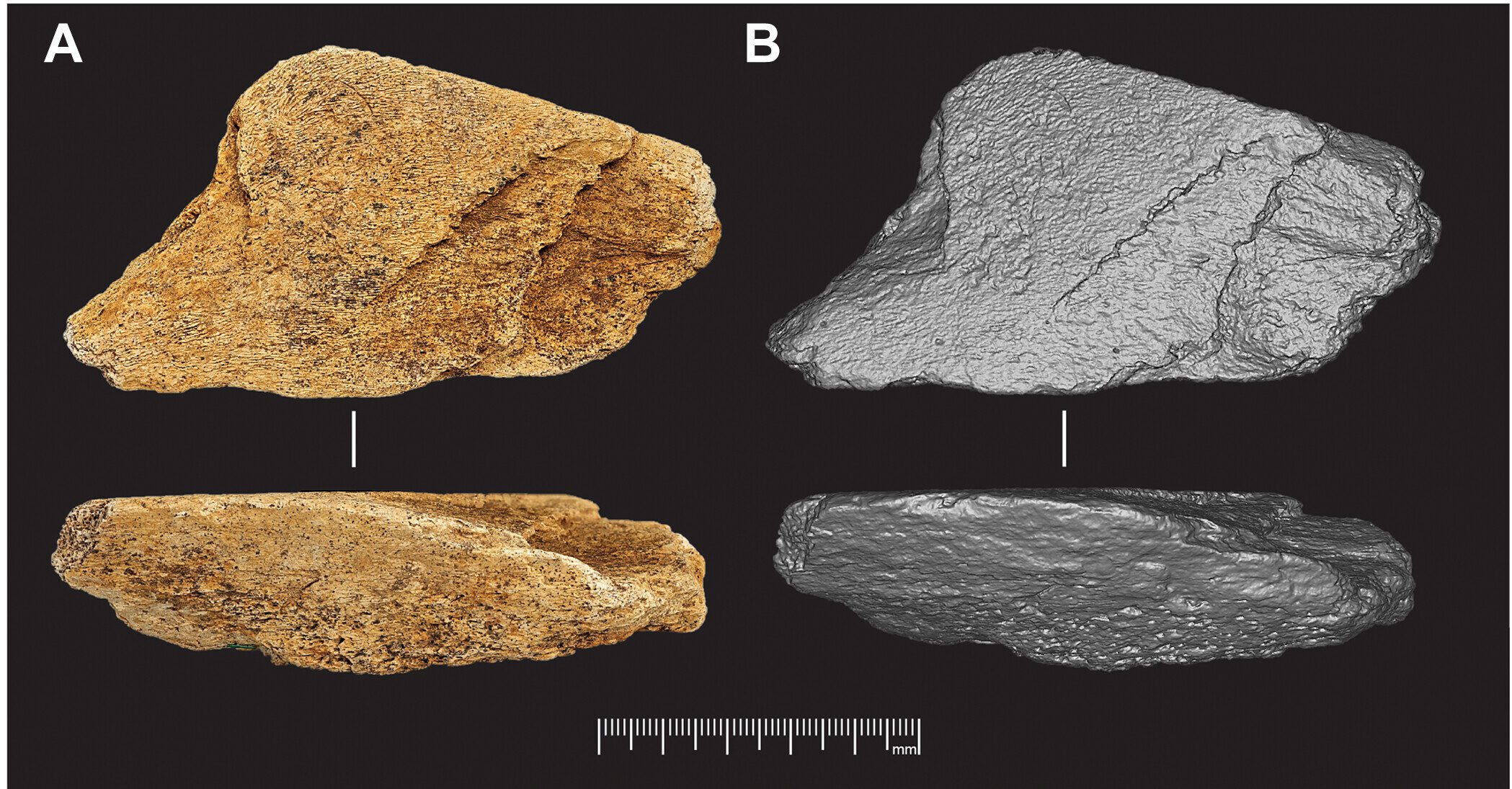
Archaeologists working in southern England have identified what is now considered the oldest elephant bone tool ever documented in Europe—a discovery that reshapes how researchers understand the technological abilities of early human populations nearly 500,000 years ago.
The artefact, a carefully shaped bone hammer, offers rare insight into how early humans in prehistoric Britain selected materials, planned tool use, and maintained stone implements with remarkable precision. Far from being opportunistic or crude, the evidence points to deliberate craftsmanship and forward-thinking behaviour.
A tool hidden in plain sight for decades
The bone fragment was originally excavated in the early 1990s at the Boxgrove site near Chichester—one of Europe’s most important Lower Palaeolithic localities. For years, it sat among thousands of faunal remains and stone tools. Only recently, through detailed reanalysis, did its true function become clear.
Researchers from University College London and the Natural History Museum subjected the bone to high-resolution 3D imaging and electron microscopy. Their findings, published in Science Advances, revealed microscopic impact marks, edge damage, and embedded flint fragments—unmistakable signs of repeated tool use.
Why elephant bone mattered
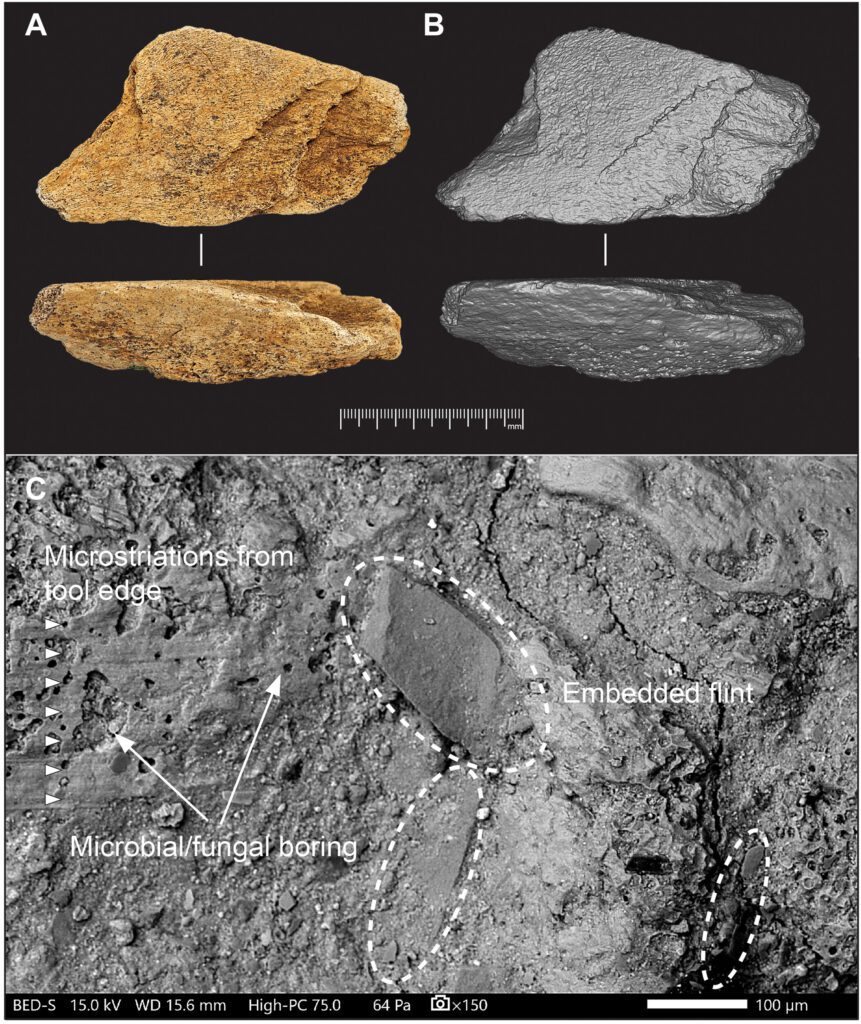
The artefact is a soft hammer, known to archaeologists as a retoucher, used to re-sharpen stone tools during knapping. Measuring roughly the size of a human palm, the tool was made from dense cortical bone—strong enough to absorb repeated blows without shattering.
Analysis indicates the bone came from an elephant or mammoth, animals that were rare in prehistoric southern England. This scarcity makes the choice of material especially revealing. Rather than using more common animal bonesearly humans appear to have deliberately selected elephant bone for its durability and long-term value.
“Elephant bone would have been an exceptional resource,” explained Simon Parfitt, lead author of the study. “Its careful shaping and repeated use suggest it was not disposable, but something worth keeping, transporting, and maintaining.”
Evidence of planning and technical foresight

The wear patterns show the tool was used while the bone was still relatively fresh, implying it was collected soon after the animal’s death—whether through hunting or scavenging remains uncertain. What is clear, however, is that the tool was not a one-off experiment. It was used repeatedly over time, reflecting long-term planning and familiarity with material properties.
According to Silvia Bello, the find challenges outdated assumptions about early humans in Europe. “This kind of behaviour shows an understanding of material selection and tool maintenance that goes well beyond basic survival,” she noted. “It reflects technological foresight.”
The tool is attributed to early Neanderthals or their ancestors, Homo heidelbergensis, a species known to have occupied Britain during warmer phases of the Middle Pleistocene.
Rewriting Europe’s early technological history
Elephant bone tools are known from much earlier contexts in Africa, particularly at Olduvai Gorge, where examples date back more than 1.5 million years. In Europe, however, such finds are extraordinarily rare—especially from periods predating the arrival of Homo sapiens around 43,000 years ago.
That makes the Boxgrove retoucher exceptional. At roughly half a million years old, it now stands as the earliest confirmed elephant bone tool in Europe, pushing back the timeline for advanced organic tool use on the continent by hundreds of thousands of years.
Supported by English Heritage and the Calleva Foundation, the research underscores how much remains to be learned from existing collections. As this discovery demonstrates, some of the most important evidence for human innovation may already be sitting in museum drawers—waiting to be seen in a new light.
University College London (UCL)
Parfitt, S. A., & Bello, S. M. (2026). The earliest elephant-bone tool from Europe: An unexpected raw material for precision knapping of Acheulean handaxes. Science Advances, 12(4). https://www.science.org/doi/10.1126/sciadv.ady1390
Cover Image Credit: Parfitt & Bello, 2026 -Science Advances