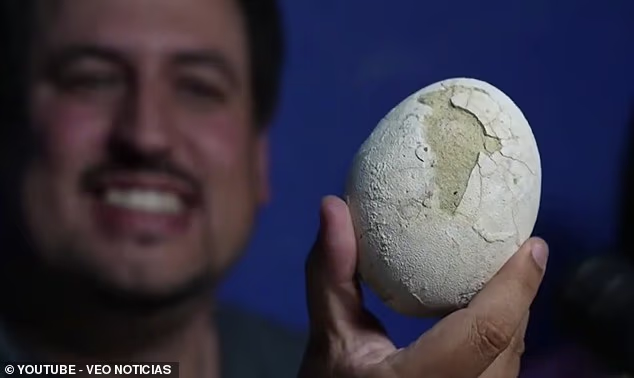
What looks like a freshly laid egg has turned out to be a 70-million-year-old relic of the Cretaceous world. Unearthed in the arid expanse of Rio Negro, northern Patagonia, this remarkably intact dinosaur egg may hold embryonic material — a potential window into the reproductive secrets of predatory dinosaurs.
Argentine paleontologists have announced the discovery of a perfectly preserved dinosaur egg that dates back roughly 70 million years, astonishing scientists and enthusiasts alike. The find was made during the Cretaceous Expedition I in Rio Negro Province, a region long known for its rich fossil beds but rarely yielding such pristine examples of dinosaur reproduction.
Preliminary analysis suggests the egg likely belonged to a small carnivorous theropod of the Bonapartenykus genus — a bird-like predator that roamed the Cretaceous landscapes of Patagonia. Measuring comparable in size and texture to a modern ostrich egg, the fossil’s shell is exceptionally well-preserved, with visible microstructural details rarely seen in specimens of this age.
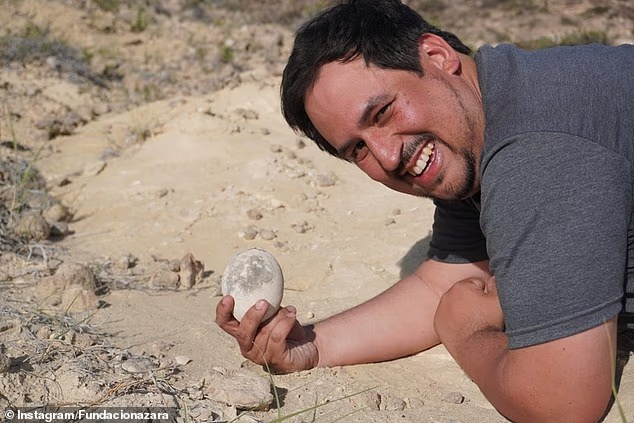
Dr. Gonzalo Muñoz from the Bernardo Rivadavia Argentine Museum of Natural Sciences described the discovery as “a complete and utter surprise.”
“It’s not unusual to find dinosaur bones in Patagonia,” he said. “But carnivorous dinosaur eggs are incredibly rare — their shells are thinner, more fragile, and far less likely to survive millions of years of geological pressure.”
Unlike the thick-shelled eggs of herbivores, carnivorous dinosaur eggs were more avian in character — a reflection of the evolutionary link between theropods and modern birds. This fragility makes the discovery all the more significant.
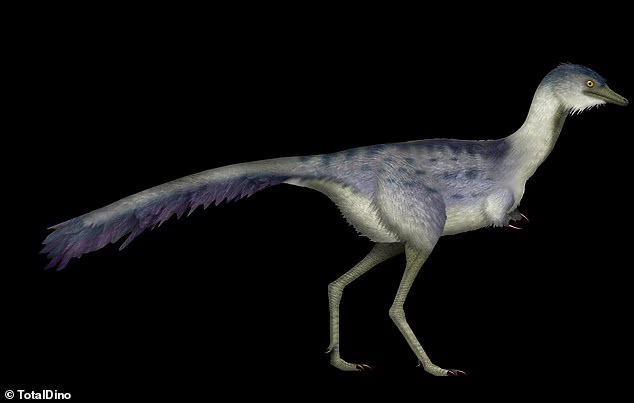
The research team plans to conduct high-resolution CT scans in the coming weeks to determine whether the fossil still contains traces of embryonic tissue. Should an embryo be present, it would represent one of the most remarkable paleontological discoveries in South America — offering unprecedented insight into the early life stages of these Cretaceous predators.
Alongside the egg, the excavation also revealed fragments of additional eggs, mammal teeth, and snake vertebrae — evidence suggesting that the site once served as a nesting ground teeming with prehistoric life.
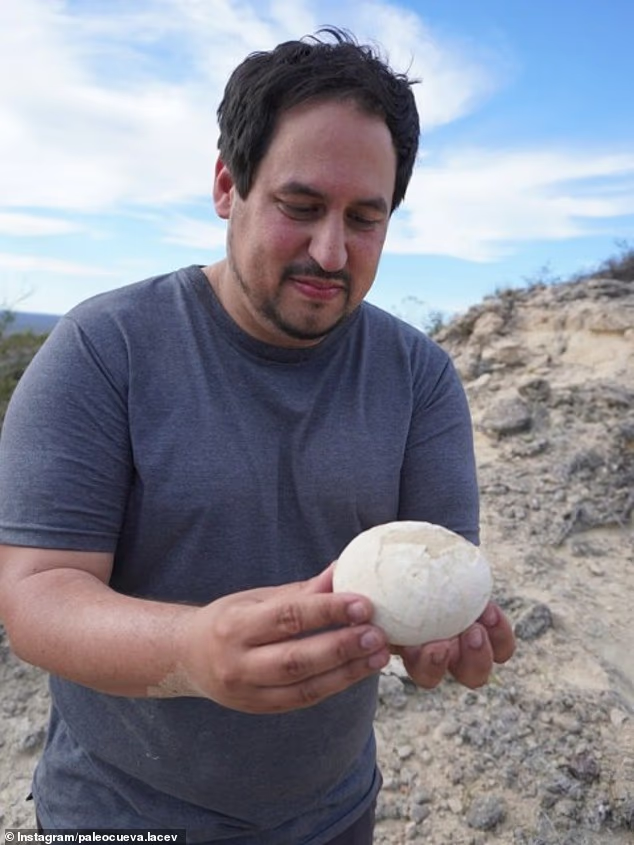
A video shared on Instagram by expedition member Federico Agnolín captures the moment of discovery, showing the egg resting almost exposed on the dusty Patagonian surface. “It could be the first discovery of its kind in South America,” the caption reads. “And it wasn’t alone — we found a cluster.”
The fossil has since been transferred to the Argentine Museum of Natural Sciences in Buenos Aires, where detailed laboratory studies are expected to begin shortly. Whether or not an embryo is preserved inside, this extraordinary find deepens the story of how dinosaurs — especially their bird-like descendants — reproduced, nested, and evolved in the final age of the dinosaurs.