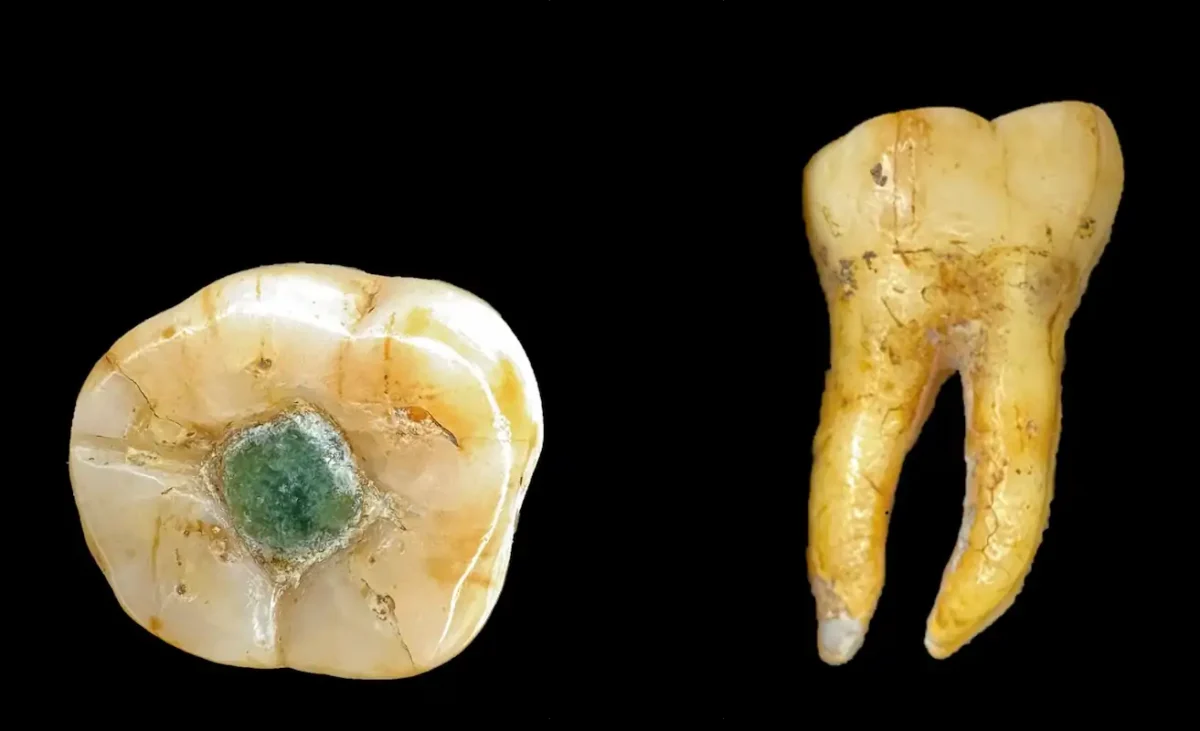
A rare Maya molar with a gemstone filling has been identified as the first known example of its kind—and scientific evidence shows the procedure was carried out while the individual was still alive.
The discovery, based on a detailed analysis of a single tooth preserved in the Museo Popol Vuh, is reshaping what researchers understand about ancient Maya dental practices. The study was conducted by researchers from Guatemala and Mexico, combining regional expertise in Maya bioarchaeology and dental anthropology. While decorative dental modifications are well documented in the region, this case stands apart in both technique and location.
Gemstone Inlay in a Maya Molar Tooth
At the center of the lower left first molar lies a small green stone, likely jadeite or a similar material, carefully inserted into the chewing surface. Unlike the more familiar Maya dental inlays placed in front teeth for display, this modification was made in a molar—completely out of sight.
That detail alone raises a compelling question: why alter a tooth that no one would normally see?
The stone is flush with the tooth’s surface, meaning it would not have interfered with biting. Its shape—wider at the top and tapering downward—suggests it was intentionally crafted to fit a carved cavity, then secured with a cement-like substance.
Proof the Procedure Happened in Life
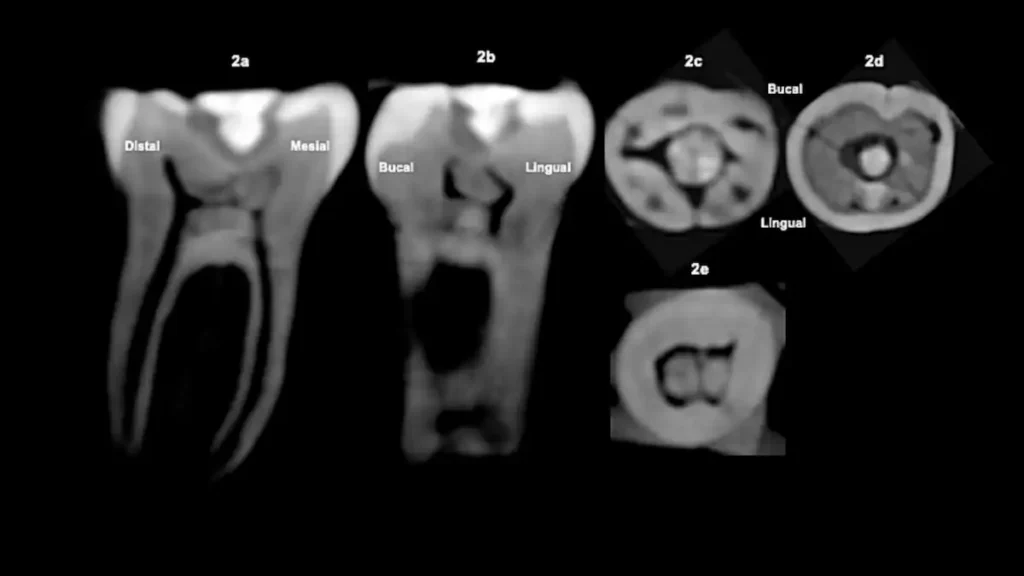
To determine whether the inlay was placed before or after death, researchers conducted cone-beam computed tomography (CBCT) scans. What they found provides decisive evidence.
Inside the tooth, just beneath the cavity, the pulp chamber shows extensive calcifications—mineral deposits that form when living tissue reacts to stress or trauma. These are not signs of natural aging; rather, they indicate a biological response to the drilling process itself.
In practical terms, the tooth was alive when the cavity was created and the stone inserted.
The imaging also reveals a controlled intervention. The cavity extends into the dentin but stops short of the pulp, suggesting a deliberate effort to avoid severe damage. Fine radial grooves inside the cavity point to the use of specialized tools.
Skilled Dentistry, but an Unusual Choice
The ancient Maya were highly skilled in dental modification. Previous research shows that they could drill into teeth with remarkable precision, rarely reaching the pulp despite the absence of modern instruments.
Yet those practices were almost exclusively limited to visible teeth—incisors and canines—where inlays served as markers of identity, status, or beauty.
This molar, however, does not fit that pattern.
Published in the Journal of Archaeological Science: Reports, the study emphasizes that no other example of a gemstone inlay in a molar has been documented in the Maya world.
Therapy or Something Else?
With aesthetics effectively ruled out, researchers propose two main interpretations.
One possibility is therapeutic intent. The irregular shape of the cavity suggests the tooth may have been treated for decay, with damaged tissue removed and the space filled afterward. Supporting this idea, previous studies have shown that Maya dental cements could contain plant resins and essential oils with antibacterial and anti-inflammatory properties, potentially useful for sealing cavities.
However, the scans do not clearly show typical signs of active decay. This could mean the drilling removed all traces of the original lesion—or that the cement obscured them.
The second possibility is harder to define. This may have been a personal or experimental intervention, carried out without a broader cultural or medical purpose. If so, it reflects an individual choice that has left behind no clear explanation.
A Single Tooth, a Larger Question
The specimen itself offers limited context. The tooth is an isolated find, lacking associated skeletal remains, which makes it impossible to determine the individual’s identity, sex, or precise cultural background. It comes from a collection assembled in the 1970s to protect Guatemalan archaeological materials from looting and destruction—an effort that preserved the specimen, but also left its exact origin unknown.
Even so, its implications are significant.
This single molar expands the known range of Maya dental practices, suggesting their expertise may have extended beyond visible ornamentation into more complex—and possibly experimental—procedures.
For now, the tooth stands alone—a small object carrying a disproportionately large question about knowledge, intention, and innovation in the ancient Maya world.
Estuardo Mata-Castillo, Andrea Cucina, et al., A Prehispanic Maya molar with occlusal jadeite inlay. Journal of Archaeological Science: Reports, Volume 72, June 2026, 105731. doi.org/10.1016/j.jasrep.2026.105731