Modern human DNA appears to preserve traces of two ancient human populations that scientists have never identified directly from ancient genomes. One of those lineages may reach back to a population that split from other human ancestors roughly 1.8 million years ago.
The finding comes from a new study published in Science, in which UC Berkeley researchers used a computational method called TRACE to reconstruct deep genetic relationships hidden within modern genomes. The analysis suggests that human evolution involved even more interbreeding between different populations than the already complicated history revealed by Neanderthal and Denisovan DNA.
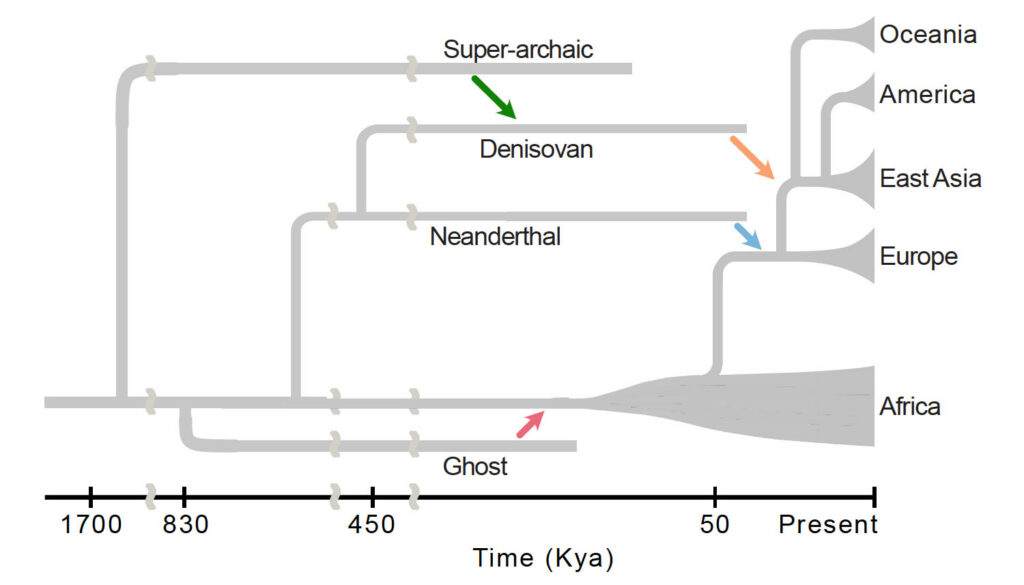
Researchers identified the first unknown lineage in both African and non-African populations. Their results indicate that this group separated from the ancestors of modern humans around 800,000 years ago and later mixed with Homo sapiens in Africa more than 50,000 years ago.
That ancient population may account for around 0.5 to 1 percent of the genomes of people living today.
The identity of this population remains uncertain. The estimated dates overlap with a period when several archaic human populations lived in Africa, including 773,000-year-old hominins recently identified in Morocco, but the genetic evidence cannot yet connect the signal with a particular fossil species. Scientists therefore describe it as a “ghost” population: its existence appears in DNA, even though researchers have not recovered an ancient genome from the group itself.
The second lineage appears to reach much deeper into human prehistory, with roots extending to a population that diverged from other human ancestors around 1.8 million years ago.
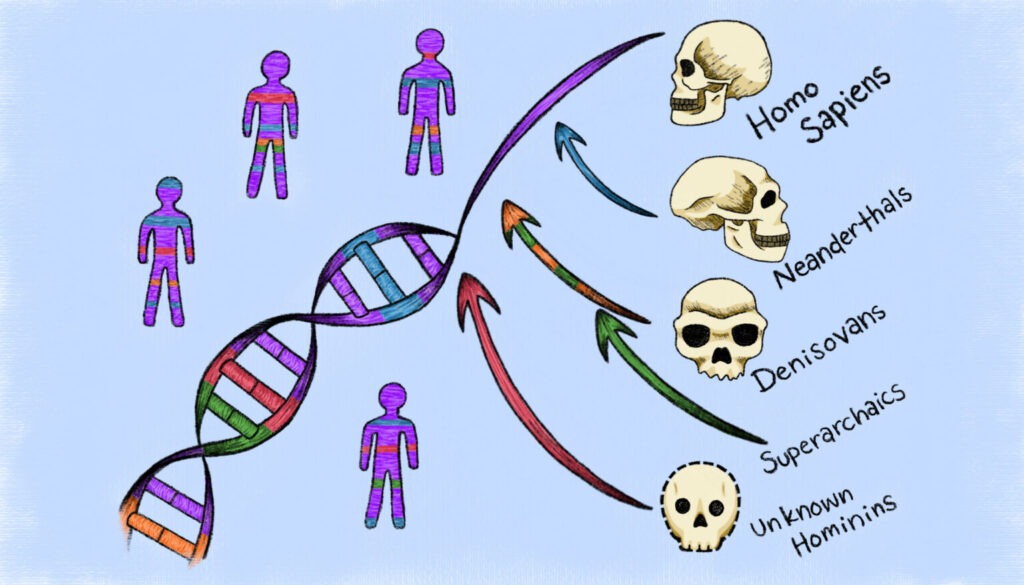
According to the study, a population that diverged from other human ancestors around 1.8 million years ago later contributed DNA to Denisovans, probably more than 200,000 years ago. Denisovans subsequently passed a small part of that ancestry to modern humans when the two populations interbred.
Researchers found the clearest traces of this much older ancestry in people from Oceania, where Denisovan ancestry is already relatively high. The study estimates that Denisovans inherited roughly 3 to 5 percent of their genome from this unidentified “super-archaic” population.
The 1.8-million-year estimate falls within the broad period associated with the early spread of Homo erectus and related human populations across Eurasia. However, the study does not identify the super-archaic lineage as Homo erectus, and the genetic data alone cannot establish which ancient human group produced the signal.
Reconstructing ancestry without ancient bones
The researchers reached these conclusions using TRACE, or TRacking Archaic Contributions via ARG Estimation.
Instead of relying only on DNA extracted from ancient bones and teeth, the method examines genealogical relationships within modern genomes. It reconstructs ancestral recombination graphs, which trace how different sections of DNA relate to common ancestors through time.
Using genetic data from the 1000 Genomes Project, the team searched for unusually ancient genome segments and compared their genealogical patterns with known Neanderthal and Denisovan ancestry.
As a test, TRACE successfully identified known Neanderthal and Denisovan ancestry. Researchers then found additional ancient segments that did not fit either group, leading them to investigate the possibility of previously unidentified sources of human ancestry.
Genetic studies have already shown that modern humans interbred with Neanderthals and Denisovans. Denisovan genomes have also revealed evidence that they themselves encountered an older human population. The new study suggests that some of these unidentified groups left genetic traces that still survive in people today.
Genetic evidence increasingly shows that these populations did not remain isolated after they diverged, but encountered one another again and exchanged genes.
Some of the ancient DNA identified in the study occurs in regions associated with immunity and metabolism. Researchers say this raises the possibility that certain inherited variants may have helped later populations adapt to new environments, although much more work will be needed to understand what those segments actually did.
The findings also show why researchers do not have to rely exclusively on ancient DNA to identify lost human populations, especially when fossils are scarce and genetic material has not survived.
The populations behind these genetic signals remain unidentified, but their surviving DNA suggests that several branches of the human family may still be missing from the fossil and ancient-genome record.