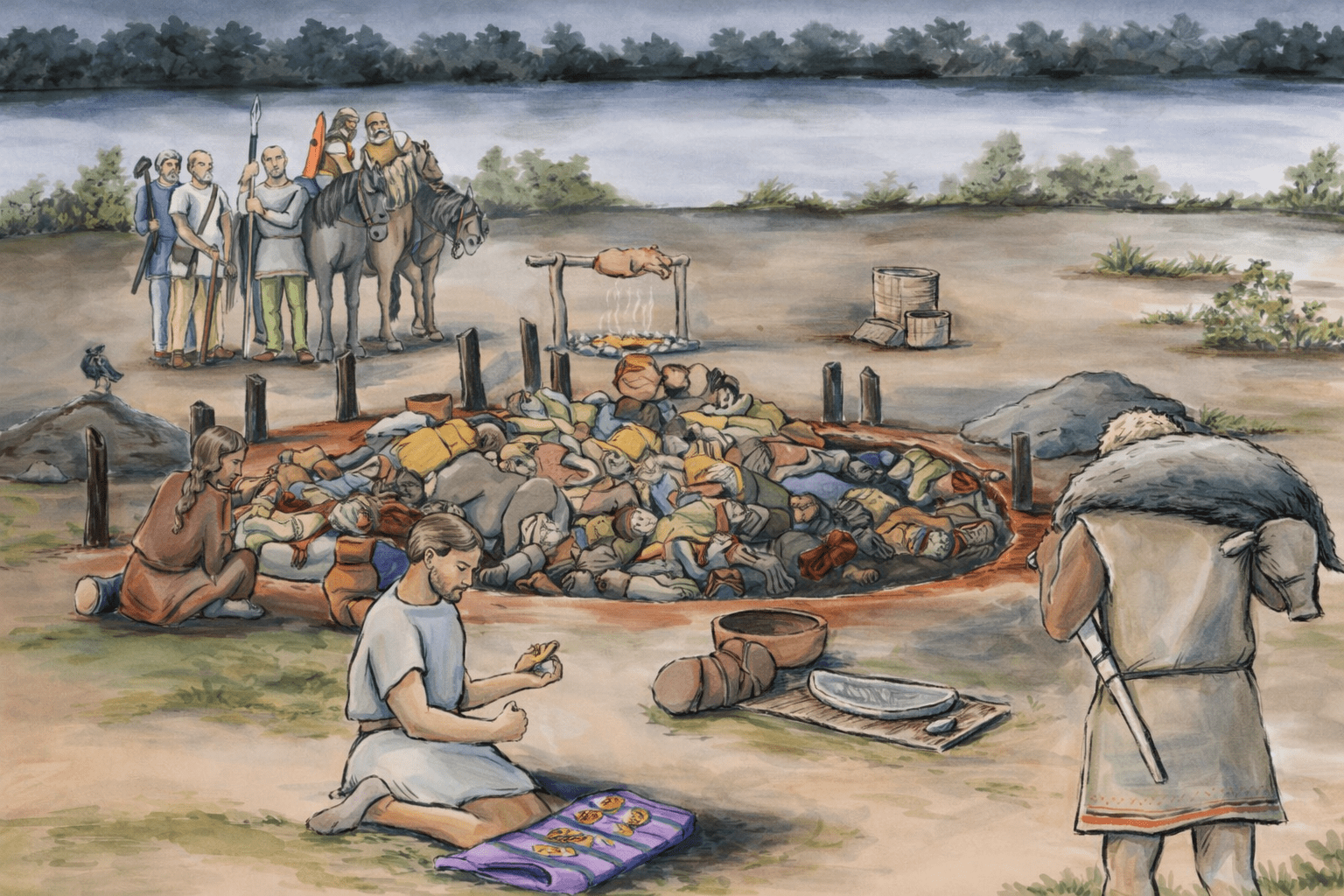
An interdisciplinary study published in Nature Human Behaviour has brought renewed attention to one of Europe’s largest prehistoric mass graves. At the site of Gomolava in northern Serbia, archaeologists uncovered the remains of more than 77 individuals buried around 2,800 years ago. Almost all were women and children.
The demographic pattern is striking. In most prehistoric conflict burials, adult males dominate the record. Here, that pattern is reversed. The evidence points not to indiscriminate warfare, but to selective, structured violence during the Early Iron Age.
Close-Range Violence
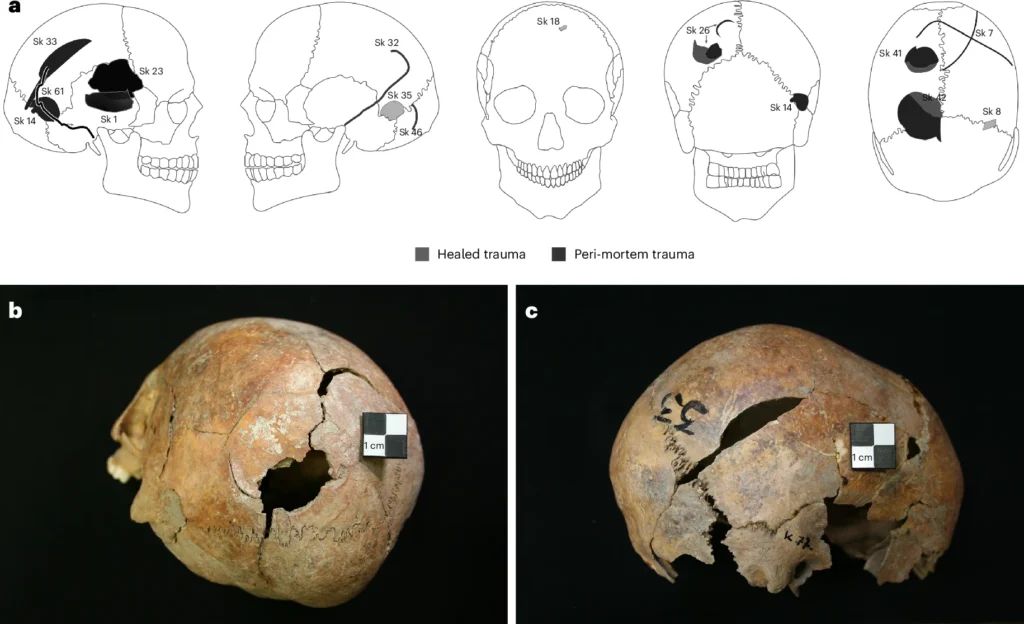
Osteological analysis and CT imaging show that many of the victims died from blunt force trauma and stab wounds. The injuries suggest close-contact attacks rather than casualties of distant combat.
Yet the burial itself complicates the picture.
The bodies were not discarded in haste. Personal ornaments and pottery accompanied the dead. The remains of up to one hundred animals were placed within the pit. At its base lay an intact calf. Above it, archaeologists documented burnt cereal grains and broken grinding stones. The arrangement appears deliberate — staged rather than chaotic.
Such details indicate that the event was not only violent, but also formally commemorated.
Genetics, Isotopes, and Mobility
Ancient DNA analysis revealed that few of the individuals were closely related. Strontium and carbon isotope data further showed that many had grown up in different regions and consumed distinct diets. Some of the livestock remains also appear to have originated elsewhere.
Together, these findings suggest population movement and interaction across a wider landscape. The grave does not represent a single extended family wiped out in isolation. It reflects a broader social rupture.
Dr. Miren Iraeta Orbegozo of the University of Copenhagen, one of the lead authors, explained:
“By combining osteology, CT scans, radiocarbon dating, and genetic and isotopic analyses, we were able to reconstruct not only how these individuals died, but how communities lived and were transformed in the Early Iron Age.”
Leiden University archaeologist Dr. Jason Laffoon, who contributed to the study, emphasized the methodological implications:
“This research demonstrates how interdisciplinary approaches can provide new insight into the complex dynamics of mass violence and public commemoration. The implications extend beyond archaeology, offering perspectives on structural violence more broadly.”
Why Women and Children?
The dominance of women and children in the burial is central to the study’s interpretation. Associate Professor Hannes Schroeder, senior author of the research, noted:
“Systematically targeting women and children is a strategy aimed at breaking lineages and weakening community resilience.”
In Early Iron Age societies, kinship networks were closely tied to land tenure, inheritance, and political continuity. Eliminating younger generations and women of reproductive age would have disrupted social reproduction itself. The violence appears not merely punitive, but strategic.
A Turbulent Transition
The massacre likely occurred during a period of upheaval following the collapse of Bronze Age networks in southeastern Europe. Communities were resettling landscapes, founding enclosed settlements, and reoccupying fortified sites. Competition over territory and resources intensified.
Within this context, the Gomolava grave may reflect systemic, multi-group conflict rather than a single isolated raid. The carefully structured burial suggests that the event carried symbolic weight — an assertion of power as much as an act of destruction.
Nearly three millennia later, the findings challenge simplified narratives of prehistoric warfare. Violence in the Early Iron Age was not limited to battlefield encounters between male combatants. It could be selective, targeted, and socially transformative.
The Gomolava grave does not merely record death. It documents a moment when power was enforced by attacking the foundations of community life.
Cover Image: Artist’s reconstruction of the mass burial at Gomolava. Illustration by S.N.