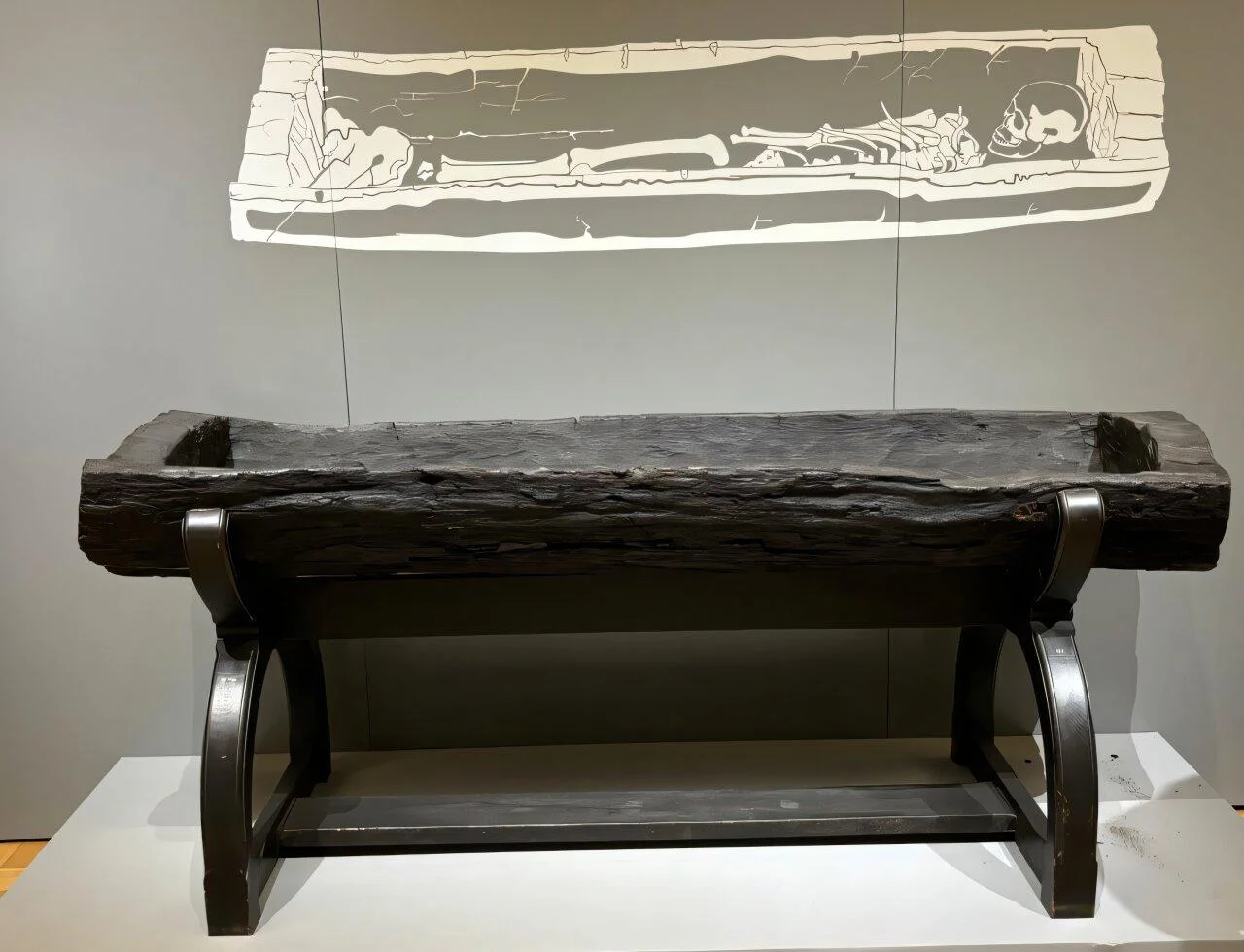
A windswept stretch of Poland’s Baltic coast has quietly reshaped one of the most persistent chronological puzzles in European archaeology. The so-called “Princess of Bagicz” — the only well-preserved wooden log coffin from the Roman Iron Age ever found in Poland — has finally been dated with precision, resolving a discrepancy that troubled researchers for nearly four decades.
The new study, published in Archaeometry and led by Dr. Marta Chmiel-Chrzanowska, demonstrates how dendrochronology — the science of tree-ring dating — can outperform radiocarbon analysis when environmental variables distort the latter. The result is more than a corrected date; it is a methodological lesson with implications far beyond a single burial.
A Coffin Revealed by the Sea
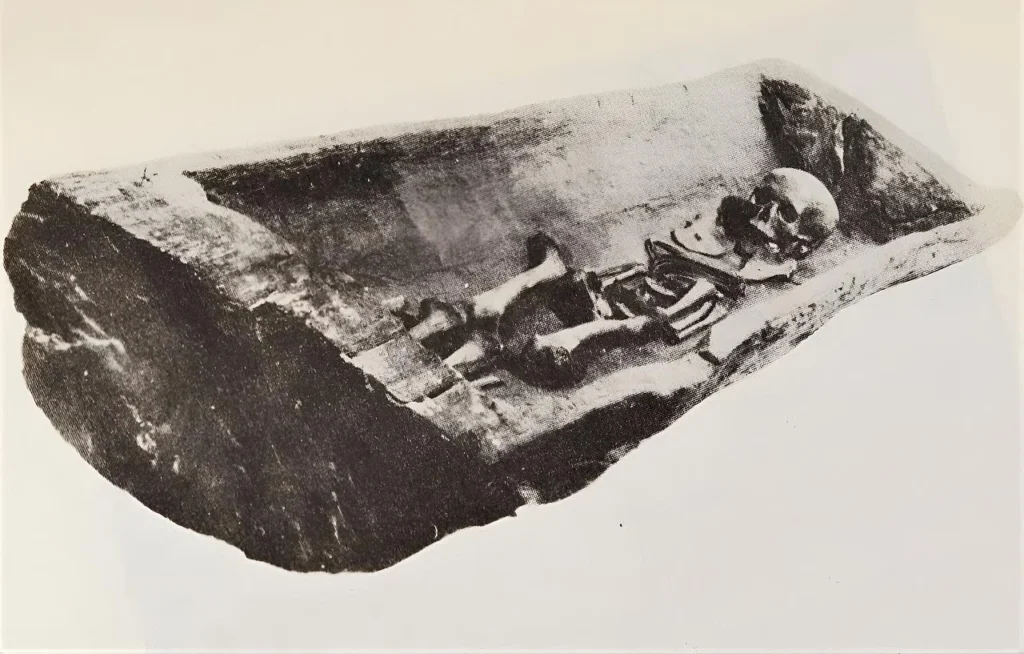
The burial was first uncovered in 1898 near Bagicz, in the Pomeranian region of northern Poland. Coastal erosion, which in some years consumes up to a meter of shoreline, caused a section of cliff to collapse, exposing archaeological material long hidden beneath the soil.
Inside a hollowed oak log coffin lay the remains of a young woman accompanied by bronze ornaments: a fibula, a decorative pin, two bracelets, and a necklace of glass and amber beads. Early reports also mentioned a wooden stool and cattle hide, though these organic items did not survive long enough to enter museum collections.
The burial was linked to the Wielbark culture, a cultural horizon active between the 1st and 4th centuries CE. Communities associated with this culture often buried their dead in log coffins or graves lined with organic materials. Yet in the acidic soils of Pomerania, wood rarely survives. That makes the Bagicz coffin not merely unusual, but singular — the only well-preserved example of its kind in Poland.
Because the grave goods appeared refined and the burial initially seemed isolated, early researchers assumed elevated social status and coined the enduring nickname “Princess of Bagicz.” Later excavations revealed a nearby cemetery, suggesting she was part of a broader funerary landscape rather than a solitary elite burial.
The 100-Year Problem
For decades, the burial’s age seemed secure. In the 1980s, typological analysis of the bronze ornaments placed the grave in the mid-2nd century CE — roughly between 110/120 and 160 CE. The stylistic parallels fit well within established Roman-period chronologies in Central Europe.
Then came an unexpected complication.
In 2018, radiocarbon testing of one of the woman’s teeth produced a dramatically earlier date: between 113 BCE and 65 CE. The discrepancy approached a century. Either the typology was wrong, or the radiocarbon result was misleading. Both scenarios carried serious implications.
Tree Rings Provide the Answer
To resolve the contradiction, researchers turned to dendrochronology in 2024. By examining the growth rings preserved in the oak coffin and matching them against established regional tree-ring sequences, they determined the tree was felled around 120 CE, with a margin of error of seven to eight years.
The date aligns closely with the earlier typological assessment and decisively contradicts the radiocarbon result. The burial belongs in the early 2nd century CE.
The question then shifted: why did radiocarbon dating produce a date that was too old?
The Reservoir Effect Explained
Stable isotope analysis revealed that the woman consumed significant quantities of animal protein and likely freshwater fish. This detail proved crucial.
Fish living in rivers and lakes can absorb dissolved ancient carbon from geological sources such as limestone or glacial deposits. When humans consume those fish, their bones and teeth may incorporate that older carbon. The phenomenon — known as the reservoir effect — can artificially age human remains in radiocarbon testing.
The environmental context reinforced this explanation. The region’s moderately hard water contains elevated dissolved carbonates, which aquatic organisms incorporate into their tissues. That ancient carbon then enters the human food chain, distorting radiocarbon measurements.
Strontium isotope analysis added further complexity. The woman’s isotopic signature resembles values recorded in parts of Scandinavia, including Öland. However, glacial geology in Pomerania can produce similar signatures locally. At present, there is no definitive evidence that she migrated from Scandinavia.
Why This Case Matters
The redating of the Bagicz burial extends beyond regional chronology. It underscores a fundamental principle in archaeological science: no single method is infallible.
Radiocarbon dating remains a cornerstone of archaeological chronology, yet it can be vulnerable to environmental and dietary distortions. Dendrochronology, when preserved timber is available, offers extraordinary precision — often to a single calendar year. When combined with typology, isotope analysis, and contextual archaeology, it provides a far more secure framework than any one technique alone.
In this case, tree rings anchored the burial firmly to the early 2nd century CE. The oak used for the coffin was cut around 120 CE, placing the woman squarely within the Roman Iron Age.
More than 125 years after coastal erosion exposed the grave near Bagicz, the debate has finally been settled. The woman once thought to be a princess may no longer hold that title. Yet her burial has become something arguably more important: a case study demonstrating how interdisciplinary science can refine, and sometimes correct, our understanding of the past.
And in doing so, it reminds us that even the most trusted methods require context — because the past does not always yield its dates easily.
Chmiel-Chrzanowska, M., Fetner, R., & Krąpiec, M. (2026). Unrevealing the date of a Roman Iron Age period burial in log coffin from Bagicz: A multidisciplinary approach. Archaeometry, (arcm.70113). doi:10.1111/arcm.70113
Cover Image Credit: Contemporary view of the Princess of Bagicz’s oak log coffin exhibited in Poland. Chmiel-Chrzanowska et al., Archaeometry (2026).